
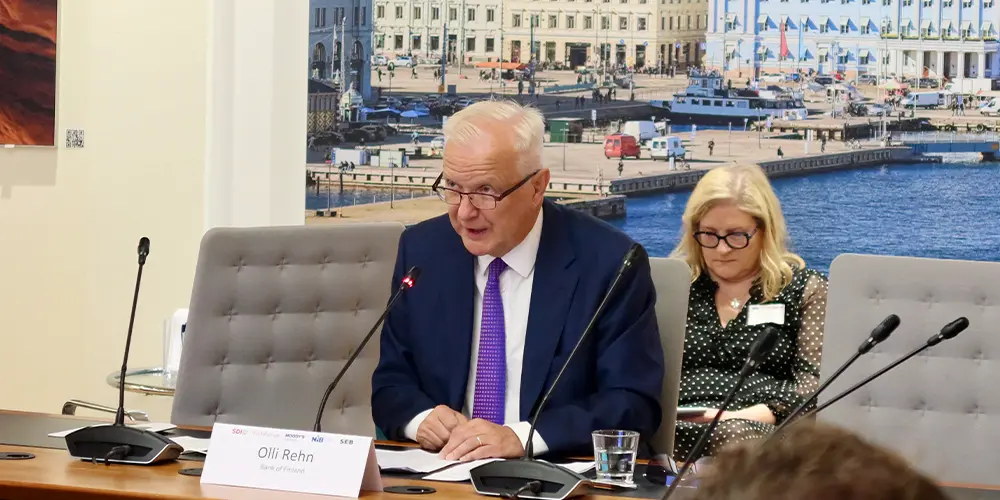
A fresh strategic approach for the European Central Bank on long-term growth and stability issues has been laid out by Olli Rehn, governor of the Bank of Finland.
In separate interventions, Rehn has advocated a more sophisticated framework for interest rate setting and a new push for developing European ‘safe assets’ to underpin the euro internationally and lower borrowing costs.
Rehn, a former European Commissioner for enlargement and economic and monetary affairs, has headed the Finnish central bank since 2018. He is (after the Luxembourg and Greek governors) the third longest-serving member of the ECB governing council.
Advancing ECB’s intellectual framework
In proposing ideas extending beyond the 27-member council’s routine discussions, Rehn is setting out to advance the ECB’s intellectual framework in key policy spheres. His suggestions, in an article for the Financial Times on 18 August, for an amended form of ‘forward guidance’ on interest rate perspectives delivers an important, though nuanced, signal ahead of the ECB’s next monetary policy decisions.
His separate presentation of the case for a common European ‘safe and liquid asset’, at the OMFIF Nordic SSA forum in August at the Nordic Investment Bank in Helsinki, was carefully framed to avoid the impression of an accommodative approach to debt.
Aware that developing common European assets through more European joint borrowing is highly unpopular in Germany and several other northern governments, including his own, Rehn underlined: ‘Sound national public finances remain essential as we develop joint financing instruments.’
But, referring to the need to intensify Europe’s financial market integration, he affirmed: ‘We cannot stand still unless we are satisfied with our current irrelevance.’
His reminder, in the FT’s ‘forward guidance’ article, that Europe may one day have to cut interest rates to the near-zero ‘lower bound’ sends a message to other council members and the markets that a forthcoming ECB rate rise should not be taken for granted.
The governing council’s next decision-making meeting is on 10 September in Berlin. The gathering may be partly overshadowed by questions on whether Christine Lagarde, the ECB president, will drop further hints of her intention to quit ahead of her scheduled leaving date at end-October 2027. Current thinking focuses on her possible departure at end-May to facilitate an EU ‘package deal’ on her and two other board members’ successors.
Monetary and financial policy differences between Europe and US
In both interventions, Rehn has been assiduous in clarifying monetary and financial policy differences between Europe and the US. Kevin Warsh, the new Federal Reserve chair, has pulled back from giving market guidance over the Fed’s view of future interest rate changes, claiming he prefers the financial markets to give a lead.
Many analysts regard Warsh’s reluctance to clarify his position as underlining anxieties that, should the Fed tighten money, President Donald Trump will renew forceful criticism of Fed policies.
Rehn, like others within and outside the council, is critical of the overly constrained interpretation of ECB ‘forward guidance’ at the end of 2021. This prevented the ECB from raising interest rates until ECB net asset purchases had finished, with the first anti-inflation interest rate rise delayed in July 2022. Lagarde subsequently admitted this had been a mistake.
Rehn drew on the experience to term the ECB’s June 2026 interest rate increase – which appeared partly driven by wishes to avoid a repeat of 2021-22 errors – as an ‘insurance hike’. Lagarde rejected that view.
On 18 August, Rehn wrote that the equilibrium (or ‘natural’) rate of interest – consistent with output at potential and stable inflation – was structurally higher in the US than in the euro area, at 3-4% against about 2%. Since the Fed had more room to cut rates before the ‘lower bound’, forward guidance retained ‘particular value’ in Europe. ‘The ECB should preserve forward guidance as an instrument while not tying its hands unnecessarily,’ writes Rehn.
Call for pooling of debt issuance and clarity about EU debt
In his 19 August remarks to the OMFIF Nordic forum, Rehn said the euro area suffered from fragmentation in bond issuance. ‘Europe’s funding needs are large or even huge, and our capital markets should better match the scale and needs of the European economy.’
He underlined the importance of recently enhanced ECB repo facilities, allowing foreign central banks to access euro liquidity against high-quality euro denominated collateral. Rehn claimed that a European ‘safe asset’ could help reduce European investor outflows to the US, where Europe was effectively helping to finance America’s ‘exorbitant privilege.
He called for more pooling of debt issuance and greater clarity about the long-term role of EU debt. He highlighted OMFIF’s 2026 survey in the Global Public Investor report where 55% of respondents said they would increase their euro holdings if the EU became a permanent large-scale issuer.
David Marsh is Chairman of OMFIF.
Olli Rehn joins OMFIF on 17 September for a timely discussion on the outlook for the European economy and monetary policy amid an evolving global landscape.

Interested in this topic? Subscribe to OMFIF’s newsletter for more.