

Predictions of the demise of the dollar have become a recurring feature of the international monetary debate. Every geopolitical crisis, every discussion of sanctions and every sign of China’s economic rise has produced a new wave of forecasts announcing the end of dollar dominance.
Yet the dominant position of the dollar has proved remarkably resilient. The reason is that most observers focus on what central banks hold today rather than on how reserve managers are thinking about tomorrow. Reserve portfolios adjust only slowly.
The international monetary system has entered a new phase best described as ‘dissatisfaction without displacement’. Confidence in some of the institutional foundations of dollar dominance is gradually eroding, yet reserve portfolios remain overwhelmingly anchored to the dollar because no credible alternative ecosystem has yet emerged.
Confidence is changing
The first and perhaps most important finding is that reserve managers are becoming more concerned about the institutional foundations of US financial leadership.
The debate is no longer centred solely on fiscal deficits or inflation; Increasing attention is being paid to issues that until recently were largely absent from discussions among reserve managers. These include the independence of the Federal Reserve, the rule of law, political polarisation, transparency of public institutions and the growing use of financial sanctions as an instrument of foreign policy.
These concerns do not imply an imminent loss of confidence in the dollar. However, they do suggest that the assumptions supporting its long-term dominance are no longer taken for granted.
Figure 1. Expected deterioration of key US economic and institutional factors
% of respondents
Source: UBS Annual Reserve Manager survey 2026
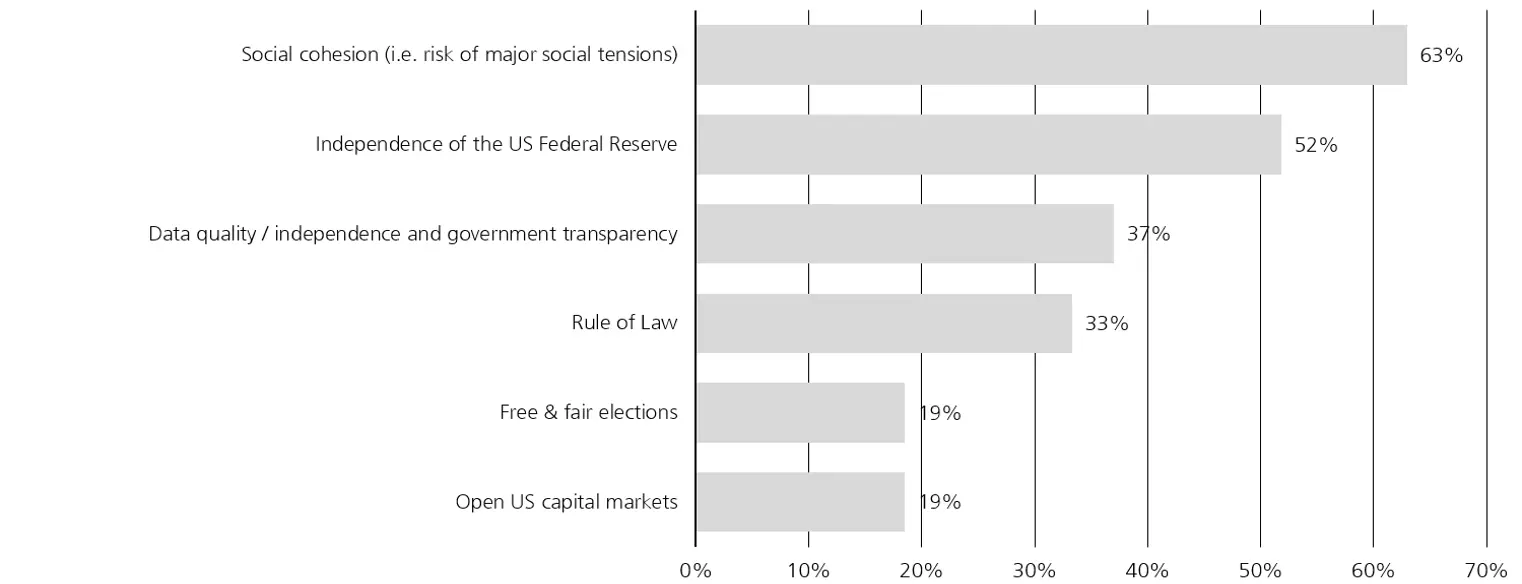
The message is striking. Reserve managers are increasingly questioning the institutional pillars that have long underpinned the attractiveness of US assets. That represents an important shift in beliefs.
If confidence is evolving, one might expect reserve portfolios to change accordingly. They have not. Despite growing concerns, an overwhelming majority of reserve managers still expect demand for both US Treasuries and the dollar to remain broadly stable over the coming years. At first glance, this appears contradictory. In reality, it reflects the structural nature of dollar dominance.
The dollar is far more than the world’s largest reserve currency. It sits at the centre of an extraordinarily deep financial ecosystem built over decades. US Treasury markets remain unmatched in their size and liquidity. Dollar assets dominate collateral markets, international trade invoicing, wholesale funding markets and global payments infrastructure. These are operational necessities for reserve managers whose primary objectives remain liquidity, capital preservation and the ability to intervene rapidly during periods of market stress.
The international monetary system has therefore entered what might be called a belief-behaviour gap: reserve managers increasingly question the long-term foundations of dollar dominance, yet their portfolios remain anchored to the dollar because no alternative ecosystem yet exists. The implication is clear. Dissatisfaction alone does not produce displacement.
Figure 2. Reserve managers still expect demand for dollar and US Treasuries to remain stable
% of respondents

Source: UBS Annual Reserve Manager survey 2026
Is the euro finally gaining ground?
If the dollar is unlikely to be replaced soon, which currency is best positioned to benefit from gradual diversification?
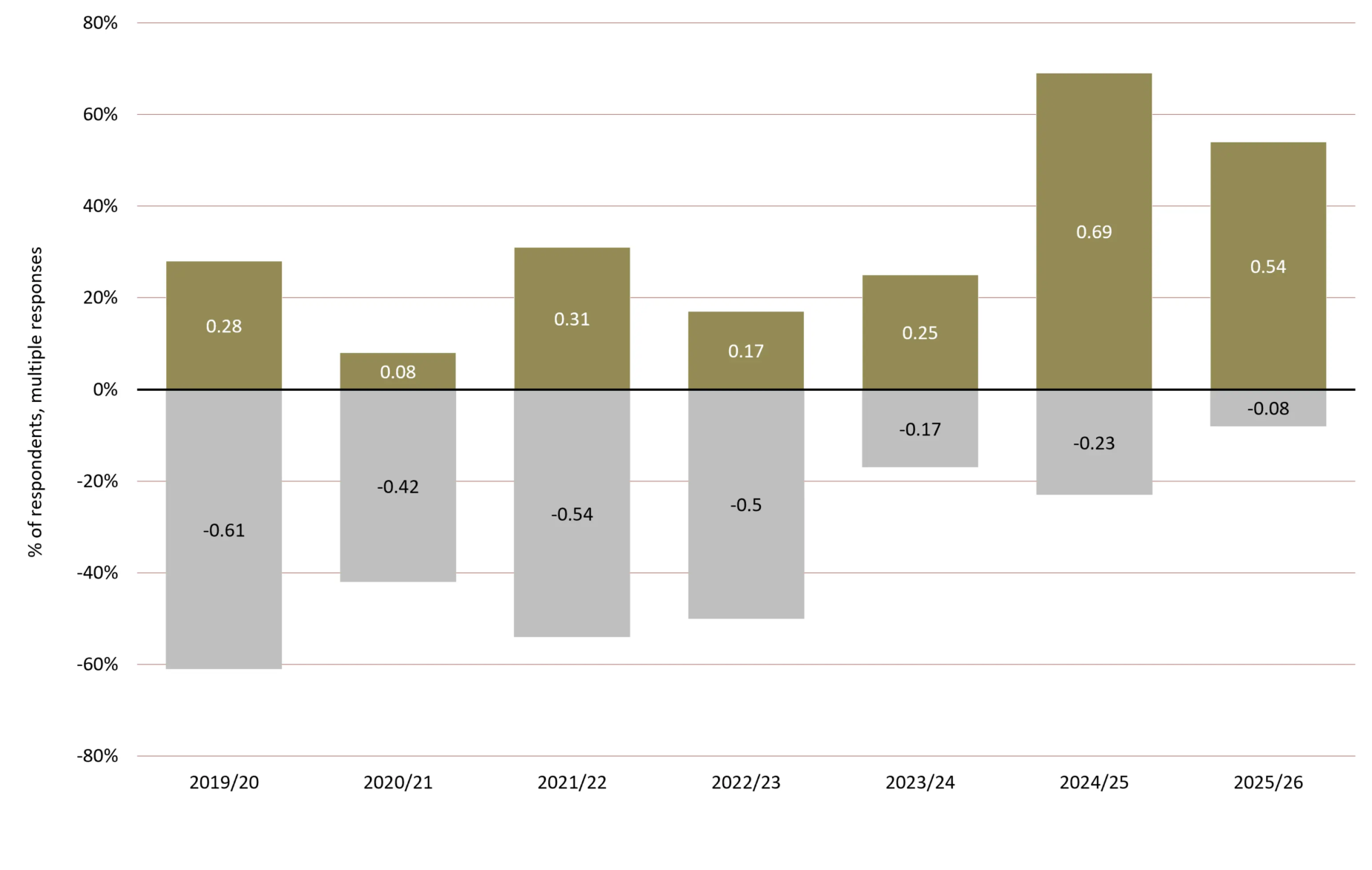
The answer remains the euro. Reserve managers have become noticeably more constructive on the single currency over the past two years. Europe has regained credibility following the sovereign debt crisis, while recent initiatives – including common debt issuance, higher defence spending and renewed efforts to build a genuine Savings and Investment Union – have improved perceptions of the euro area’s long-term prospects.
Figure 3. Growing interest in euro allocations among reserve managers
Source: UBS Annual Reserve Manager survey 2026
Nevertheless, optimism should be tempered. The euro still lacks one essential ingredient required of a global reserve currency: a sufficiently large supply of homogeneous safe assets comparable to the US Treasury market. Progress is evident, but it remains incremental rather than transformational.
China’s renminbi presents a different challenge. While China’s economic weight is unquestionable, capital controls, governance concerns and limited convertibility continue to constrain its role in reserve portfolios. Gold, meanwhile, has become increasingly attractive as a hedge against geopolitical risk but functions as a complement to reserve currencies rather than a substitute.
No credible alternative currently combines the liquidity, scale, legal certainty and financial infrastructure that underpin the dollar’s dominant position.
Stability today, vulnerability tomorrow
History suggests that international monetary systems rarely evolve in a linear fashion. Sterling did not gradually lose its dominant role simply because the US became the world’s largest economy. For decades, the two currencies coexisted before successive crises accelerated the transition. Today’s environment may prove similar.
The evidence does not suggest that the dollar is about to lose its dominant position. On the contrary, its structural advantages remain formidable. But it does suggest that policy-makers should avoid complacency.
The most important development may not be visible in today’s reserve statistics. It lies instead in the gradual evolution of reserve managers’ beliefs.
Reserve managers are not abandoning the dollar; they are quietly reassessing the assumptions that have underpinned its dominance for more than 70 years. That distinction may prove far more consequential than today’s reserve statistics.
This article draws upon the recent paper in the Financial and Economic Review of Magyar Nemzeti Bank, ‘Dollar Dominance in the Global Financial System: Dissatisfaction without Displacement’.
Massimiliano Castelli is Head of Strategy and Advice, Official Institutions at UBS Asset Management.
 Interested in this topic? Subscribe to OMFIF’s newsletter for more.