
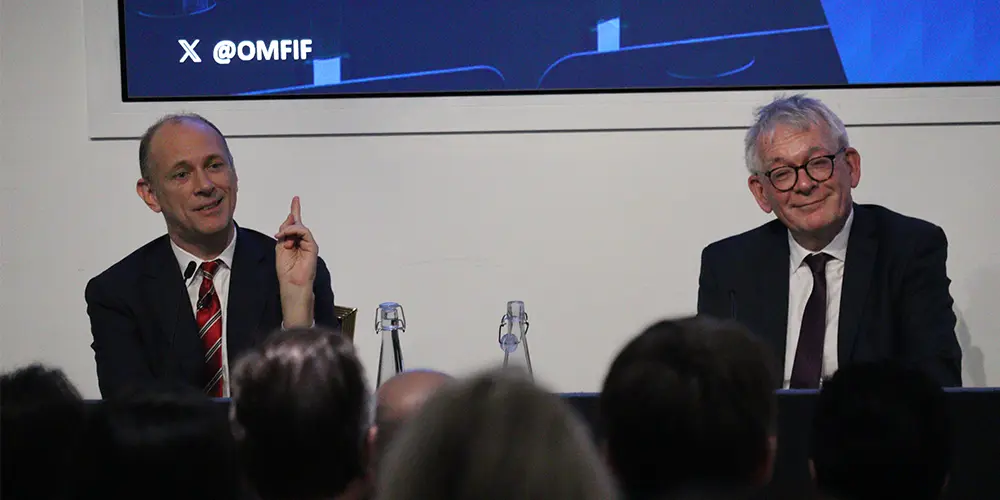
Forecasters have pushed back the expected peak of US inflation five times so far. The turn was meant to come in the fourth quarter of 2025, then quarter by quarter in 2026 and is now projected for some point in 2027. For Austan Goolsbee, president of the Federal Reserve Bank of Chicago, that is ‘not a comfortable pattern’.
Speaking at an OMFIF lecture in London last week, Goolsbee argued that the central banking habit of ‘looking through’ supply shocks may have reached its limits. The current climate, with shocks that keep arriving or refuse to fade, requires a Fed response that is ‘unlikely to be painless’.
Goolsbee has been president and chief executive officer of the Chicago Fed since January 2023. In the wake of the 2008 financial crisis, he served as chief economist and chief of staff to Paul Volcker’s President’s Economic Recovery Advisory Board, before chairing Barack Obama’s Council of Economic Advisers, a cabinet-level post. He dissented at the Federal Open Market Committee’s final meeting of 2025, warning against ‘just assuming that inflation will be transitory’, and returns to a voting seat in 2027.
Gradual, but not painless
Since the 1970s, Goolsbee explained, central banking instinct has largely favoured looking through supply shocks, responding only when they spill over into other industries or begin to unanchor inflation expectations. But this premise no longer holds. Over the past six years, the US has witnessed pandemic supply chain disruption, an energy shock from the war with Iran and escalating tariffs, each of which has lasted far longer than expected. Futures markets priced a rapid fall in oil after the war began, yet crude remains around $100 a barrel and may climb further. Tariffs, too, have come in repeated rounds rather than as the textbook one-off rise in the price level.
With this persistence, a central bank that promises both 2% inflation in the medium term and no response to supply shocks will find that ‘one of those two statements is going to end up being wrong’. Large shocks, Goolsbee concluded, should be presumed persistent until the data show otherwise.
However, the response need not match the one used against overheating demand. With only demand to work on, the Fed can close a supply gap only by weakening output and employment, and sticky wages mean moving too fast would overshoot on job losses. That trade-off argues for a gradual response, though gradual does not mean easy.
Nevertheless, demand-driven inflation remains very much on Goolsbee’s radar. Services inflation and spending tied to artificial intelligence data centre construction look to him like old-fashioned overheating, with investors spending anticipated AI gains before the new capacity exists. Pressed from the floor, he accepted that with unemployment at roughly 4% and core inflation above 3%, ‘there’s not a conflict of mandates. There’s just an inflation problem’.
The FOMC had signalled much the same just five days earlier, voting unanimously to raise rates on 16 September.
Staying in the Fed’s lane
Asked about Fed independence, Goolsbee defined it narrowly. Independence is freedom from political interference when setting the interest rate: ‘that’s the only thing.’
The same restraint shapes his view of the US deficit (which the Congressional Budget Office projects at 5.8% of gross domestic product this fiscal year). Fiscal policy, he argued, is simply part of aggregate demand, a condition for the Fed to analyse rather than lobby on: ‘there’s no bad weather, only bad clothing’. What matters for the business cycle is less the size of the deficit than how much it changes from one year to the next.
He was firmer when questioned on calls for the Fed to cut rates to ease government borrowing costs. That, he warned, would amount to monetising the debt, which is ‘the canonical reason why you want monetary independence’.
The hard way back
Before rates fall, Goolsbee wants evidence that the shocks are fading. He will be watching services inflation, shorter-horizon survey measures of inflation expectations and any spillover from the AI build-out into wages and prices. Without that evidence, he said, ‘we know what has to happen’.
September’s projections suggest that rise will not be the last: the median official expects one more quarter-point rise this year, and the median federal funds rate for 2027 was revised up to 4.1%, from 3.6% in June. Speaking at OMFIF’s FOMC Watch three days before Goolsbee, former New York Fed president Bill Dudley warned that a lone quarter-point rise rarely does the job, and that the Fed has seldom stopped after one.
Goolsbee is not indifferent to the cost of unpopular decisions. In his office, he keeps a length of 2×4 timber once posted to Volcker, scrawled with the words, ‘lower these insane interest rates’, as a reminder that the Committee’s decisions affect real people. If doing the job makes the Fed unpopular, Goolsbee says, ‘so be it’. Like Volcker before him, the only way back is the hard way.
Jessica Pretorius is Programmes Coordinator at OMFIF.

Interested in this topic? Subscribe to OMFIF’s newsletter for more.