
Coinciding with the United Nations General Assembly, New York Climate Week 2026 saw the city brought almost to a standstill, its streets filled with dignitaries and financial market leaders hurrying from one event to the next. But the conversations at these events were far from sluggish. The atmosphere was one of possibility, with a focus on the opportunities for investors in a changing world, while remaining aware of the risks posed by global uncertainty.
Last year, New York Climate Week had a distinctly subdued air as the first following climate-sceptic Donald Trump’s return to office. Much of the shine had come off ‘ESG’ as a framing for sustainability, and some institutions sought to distance themselves for political and business reasons.
This year’s Climate Week, following a summer of extraordinary heat and droughts around the world, felt different. ‘Resilience’ was the word on everyone’s lips – environmental resilience, but also social and financial. Dominating the discussions were two topics in particular: data centres and nature.
Data centres and sustainability
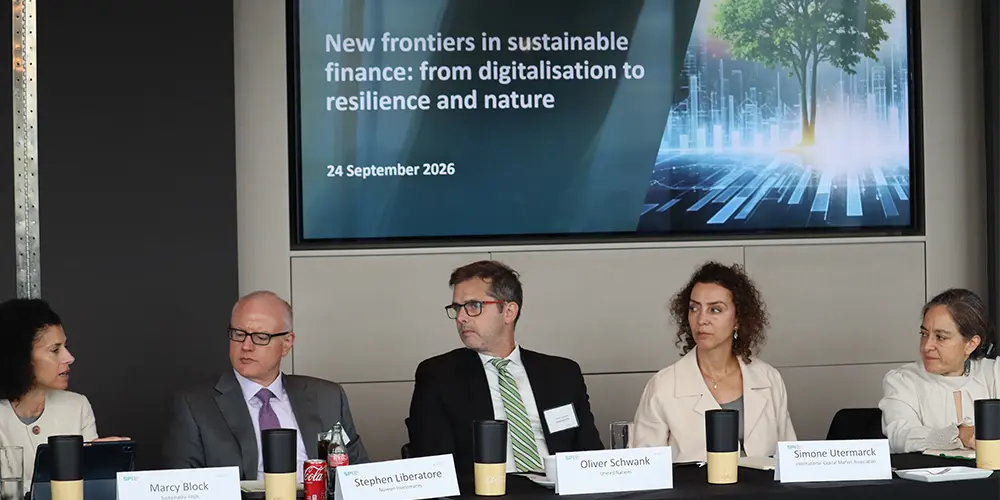
OMFIF organised two roundtables during Climate Week in partnership with Moody’s Ratings and Sustainable Fitch. Both events focused on the explosive growth of investment in data centres and the need to manage this in a way that is sensitive to the impact on energy demand, water use and local communities. In a sign of just how live this issue is, one roundtable attendee said the event was the third on data centres they had been to that week.
The roundtables brought together investors, central banks, standard-setters, ratings agencies and commercial banks to examine trends and opportunities within the sector. All investors present said they were either investing in data centres or looking to do so, but that this was not straightforward due to a lack of information on impact reporting.
One investor said that this was becoming more available, but most agreed more project-level information is needed on electricity sourcing, energy efficiency, water consumption and environmental impacts. As such, second-party opinions from institutions such as Fitch and Moody’s are providing much-needed guidance to investors as they navigate this new and evolving space.
The consensus was that greater transparency in disclosure reporting would help investors assess the sustainability of individual assets. One representative from an engineering consultancy said that data centre developers do have this information, they are just not required or incentivised to share it with investors. Given recent political pushback towards the sector, this may be something that regulators seek to address in the near future.
In the past few days, the European Union has announced a new rating system for data centres for assessing and monitoring energy use in new facilities being built across Europe. The idea is to introduce more transparency into the sector as the EU looks to triple the number of data centres in the bloc over the next five to seven years. However, the speed at which the market is developing further complicates matters. While frameworks provide a useful starting point, they cannot keep up with the pace of change.
Impact on nature
For many, there is an incongruity between the development and operation of data centres and the urgent need to conserve and protect the environment. There is no denying that data centres are huge consumers of critical natural resources. Globally, the International Energy Agency estimates that data centres consume over 560bn litres of water annually, placing further strain on what the UN termed earlier this year an ‘era of global water bankruptcy’. If this usage continues unchecked, it will have severe consequences for drinking water, natural habitats, livelihoods and supply chains that depend on nature.
When asked what it would take to ensure large-scale infrastructure developments like data centres have a nature-positive, or at least nature-neutral, impact on the environment, one roundtable participant said there would always be trade-offs. Another representative from a central bank and the Network for Greening the Financial System said that, when it comes to nature, the financial sector is currently where we were on climate 10 years ago.
Participants at the roundtables agreed that the existing voluntary frameworks and taxonomies are the best thing we have by which to assess impact on nature. But it is becoming increasingly clear that they are not as impactful as they should be. Earlier this year, the NGFS released new tools to aid central banks and supervisors in integrating nature-related risks into their work, and is working on a new set of nature scenarios due to be published later this year.
Changing perspective
The tension between extracting value from natural resources and valuing nature as natural capital was raised multiple times during the roundtables. Recent years have seen calls for nature to be viewed as an asset in itself, led by the International Public Sector Accounting Standards Board. IPSAS 51 is a new standard that urges sovereigns and governments to account for natural assets on their balance sheets.
This change in perspective formed the framing for the UN Nature Summit, hosted by the Kingdom of Tonga and chaired by Prime Minister Lord Fatafehi Fakafānua. The summit reinforced the centrality of nature to national resilience, sovereignty and prosperity. Lord Fakafānua highlighted the importance of this to small island developing states in particular: ‘When nature is undervalued, countries like ours have to rebuild again and again and again.’
Tonga, a country with vast natural capital and extreme vulnerability to the impacts of climate change, has made the ocean the basis of its national strategy for building prosperity and resilience. It was joined by Panama and Vanuatu in becoming the first signatories to the For Nature Coalition of States – a new initiative that seeks to recognise nature as sovereign capital. Dominica, Ghana and Palau are set to follow.
The central message of the Nature Summit was that nature loss is not only an environmental issue; it’s also a fiscal one. As the financial sector becomes increasingly aware of its tangled dependencies on nature, it is hoped that investments in new forms of infrastructure like data centres will help to create a world that protects nature for its value, rather than destroying it through relentless extraction.
Sarah Moloney is Editorial Director at OMFIF.

Interested in this topic? Subscribe to OMFIF’s newsletter for more.