

At the end of 2024, the international claims of Brazilian banks on the rest of the world sat at $71bn; now they total $53.2bn. Against $82.3bn in the third quarter of 2024, that is a retreat of more than a third in five quarters, the sort of number cited as evidence of an emerging market pulling back from international lending. Adjusted for a series break the Bank International Settlement records, the fall is 16.8%.
The break arrives in the first quarter of 2025, and the BIS puts it at $15.6bn. It is the mirror image of the one I described in an earlier article, when Brazil’s entry into the counterparty-country total in early 2022 added $66.5bn to claims on Brazil and accounted for close to half the apparent recovery since 2017.
What changed then was not who reports – Brazilian banks have reported since 2002 – but what the aggregate counts. The same is true here, in reverse and on the opposite leg.
Figure 1. Half the collapse in Brazilian banks’ foreign claims is definition
International claims of Brazilian banks on the rest of the world, published and break-adjusted, $bn
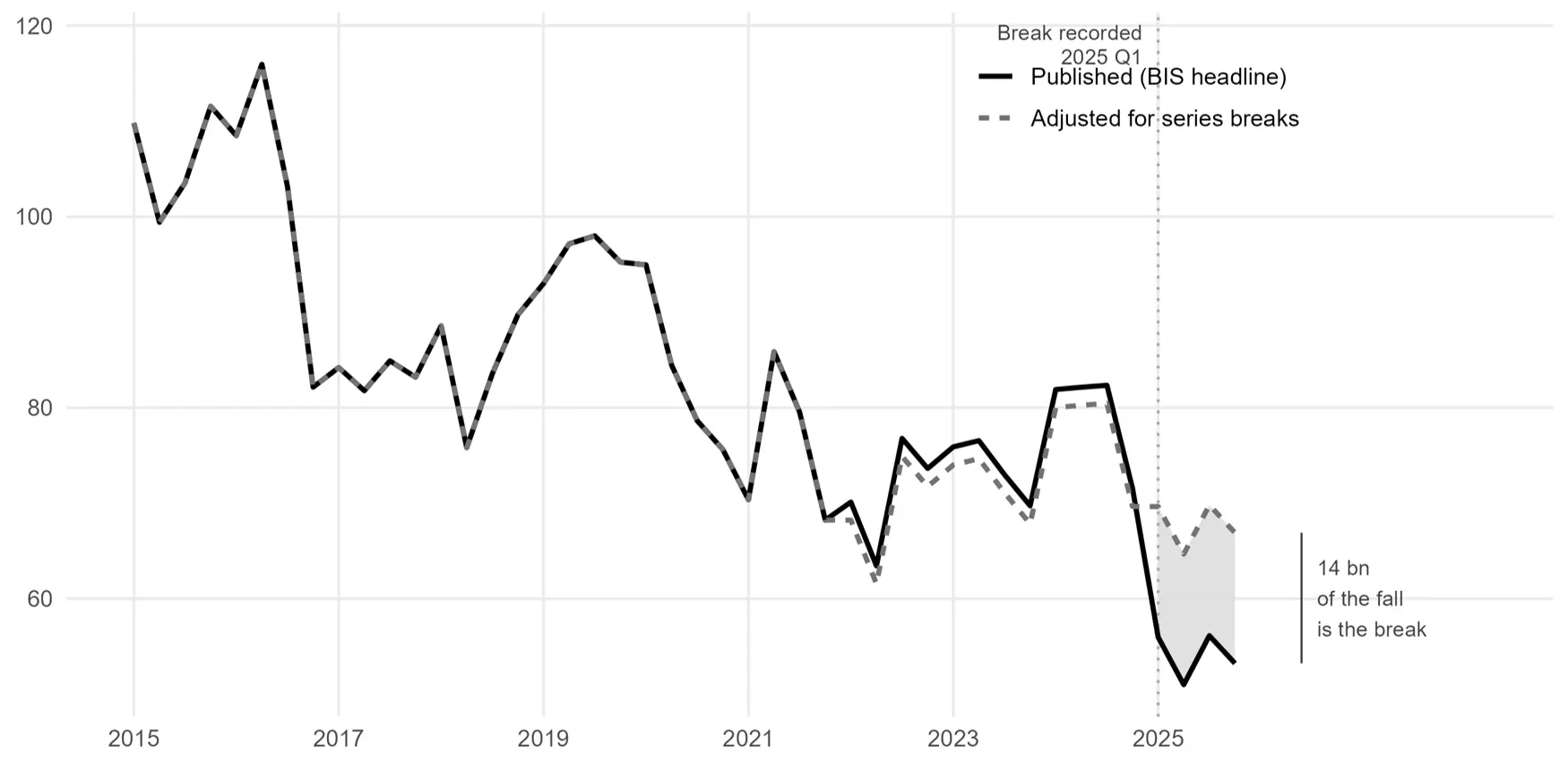
Source: BIS consolidated banking statistics, author’s calculations.
Note: Adjusted series removes the BIS break in stocks from quarterly changes, chained from 2017 Q4.
Where the $15.6bn went
The break has a location. Brazilian banks’ claims on the UK fall from $17.1bn at the end of 2024 to $1.7bn a year later. That decline of $15.4bn is, to within rounding, the whole of the recorded break. Whatever changed in the first quarter of 2025 – a reclassification, an entity leaving the consolidation perimeter, a reporting boundary redrawn – it did not involve Brazilian banks unwinding a British loan book. A position stopped being counted where it had been counted before.
Two other booking centres shrank beyond the break. Claims on Luxembourg fell from $3.3bn to $1.3bn, and on Switzerland from $1.3bn to $0.3bn. With smaller moves alongside, that leaves roughly $1.8bn of genuine decline in claims on financial centres, against a headline group decline of $17.2bn. About nine-tenths of the retreat from booking centres is a change in the statistics rather than a change in the banks.
What survives the adjustment
Underneath the break, something moved in the other direction, and it appeared in no headline.
Brazilian banks’ claims on regional Latin American markets rose from $14.6bn at the end of 2024 to $18.2bn a year later, an increase of 24.6% in a year when the aggregate for the same banks fell by a third. The growth is concentrated rather than diffuse. Claims on Chile rose from $2.4bn to $4bn, and on Argentina from $500m to $1.6bn, more than tripling. Uruguay and Paraguay, already the largest regional exposures relative to their size, added $1.1bn between them.
None of these positions carries a break. They are the ordinary quarterly accumulation of a banking system extending credit in neighbouring markets – and the part of the picture a reserve manager reading the published series would not see, because the aggregate containing it is dominated by a reclassification 20 times larger.
Why this matters beyond Brazil
The consolidated banking statistics were built to measure how exposed a creditor banking system is to a host country, and they answer that question well. They were not built to describe the international footprint of a banking system from a country that is simultaneously host and home. Brazil has been both since 2022.
That dual position produces a specific failure. A country entering or leaving the reporting population moves both legs of its own statistics at once – the claims on it and the claims of its banks – and the movements are large relative to the underlying business. In the first quarter of 2025 the recorded break was $17.1bn on the inward leg and $15.6bn on the outward, in the same quarter and the same direction. Neither corresponds to a dollar of credit extended or withdrawn.
The BIS does not adjust its published consolidated statistics for breaks. It records them separately and leaves the adjustment to the user, which is a defensible design that places an obligation on readers who may not know they have it. For countries with long, stable reporting histories that obligation is light. For the growing group of emerging economies that joined the reporting population over the past decade, whose banks are expanding regionally while their statistics are still settling, it is not.
An answer to an earlier question
In July, I argued that Brazil had become an exporter of banking capital and closed by asking a companion question to the one the statistics were built for: not how exposed global banks are to Brazil, but how exposed Brazil is to the rest of the world. The answer, adjusted for breaks, is $66.9bn at the end of 2025.
The composition of that figure is the more useful part. Brazilian banks’ foreign presence is shifting away from booking centres and towards the markets next door – the Chile, Colombia, Peru and Mexico expansion that is now visible in the claims data itself. The direction my article identified is intact. What the published series does is bury it, because the aggregate mixes a regional franchise with a reporting boundary that moved.
None of the three figures quoted across these articles is wrong. The difficulty is that a measure built for one question keeps being read as the answer to another, and the gap between the two widens precisely where the interesting cases are – countries changing position in the international financial system faster than the statistics describing them can settle.
This is the final article in a series on Brazil. Read the first and second parts here.
João Gabriel de Araujo Oliveira is a postdoctoral research fellow in economics at the University of Brasília, an Associate Fellow of the World Academy of Art and Science.
The views expressed are his own and do not necessarily reflect those of the World Bank, its board of executive directors, or the governments they represent.

Interested in this topic? Subscribe to OMFIF’s newsletter for more.