
For six decades the US has financed its external deficits by issuing liabilities the rest of the world wanted to hold on unusually favourable conditions. Valéry Giscard d’Estaing famously called this an ‘exorbitant privilege’. The debate today is mostly about whether the world will keep using the dollar. We ask how much the US must now pay for the rest of the world to keep holding its liabilities. The higher that price, the less exorbitant the privilege.
In mid-September the 10-year Treasury yield crossed 5% for the first time since October 2023 and has since climbed further, closing at 5.31% on 5 October. Many read this as a sign that the world has begun to leave the dollar. Yet the dollar’s share of foreign exchange reserves is still close to 57%, and the most recent flow data point to a more nuanced reading: a shift in the composition of the US liabilities foreigners prefer to hold. The $83.7bn net inflow in July was driven entirely by short-term instruments, with foreign holdings of Treasury bills rising by $38.8bn and banks’ dollar liabilities to foreigners by $46.6bn. Private foreign investors, meanwhile, sold a net $29.1bn of Treasury notes and bonds.
The evidence suggests that this price now depends on which liability one looks at: dollar money continues to command a premium, while Treasury debt is losing it.
Reading the yield
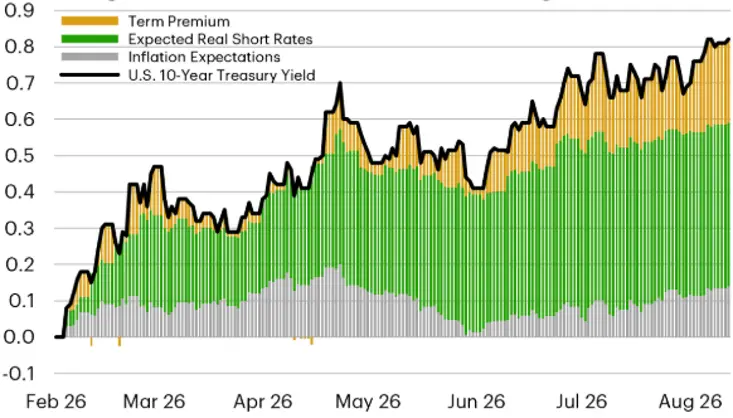
Most of the current 10-year yield reflects expected policy rates, which have risen with inflation. In mid-September the term premium – the extra return investors demand for holding a 10-year bond rather than rolling over short-term ones – stood at between 0.6 and 1 percentage point, depending on the model. The New York Fed’s Adrian, Crump, and Moench model gives the lower figure, while TD Economics’ Vikram Rai puts most estimates at 80 to100. Rai’s decomposition (Figure 1) attributes about 20 of the yield’s 80-basis-point rise since late February to the term premium, a contribution that grew in June and July before levelling off. Government bond yields have risen elsewhere too, including Japan, Germany, France and the UK. When duration is being repriced across markets , the level of US yields does not isolate anything specific to the dollar.
Figure 1: Decomposing the US 10-year yield’s rise
Change since start of the US–Iran conflict, percentage points
Source: Federal Reserve Bank of San Francisco, Federal Reserve Bank of New York, TD Economics. Last observation: 7 September 2026.
Measured against a comparable asset, the premium tells a different story. A National Bureau of Economic Research paper by Wenxin Du, Ritt Keerati and Jesse Schreger estimates separately the convenience yield for the dollar and for Treasuries, which measures the return investors are willing to forgo in exchange for safety and liquidity. Against G10 currencies the dollar has kept a positive convenience yield between 2021 and 2025 – around 20 basis points on average. The Treasury convenience yield, by contrast, has turned negative: at the five-year maturity it has averaged minus 26 basis points since 2021 and at three-month and one-year maturities it has been below zero since 2023. Treasuries now yield more than G10 government bonds swapped into dollars. The authors identify the relative supply of government debt as a key driver. Concerns about US fiscal and institutional risk may also play a part, as investors increasingly say.
But, then, why does dollar money keep a premium that Treasury debt has lost?
Money and debt part ways
US bank credit creates the deposits that fund domestic demand and that part of this demand goes to imports. The dollars paid for those imports end up with foreign sellers, who then hold claims on the US in one form or another. Leaving aside valuation effects, foreign net claims on the US grow with the current account deficit by accounting necessity. The volume of dollar claims held abroad is largely a by-product of the circuit and says little about foreigners’ preferences. Those preferences show up in the kind of claim they hold and the return they ask for it.
This fits the reading of the international monetary system that Lorenzo Bini Smaghi set out in a European Central Bank speech: deep markets and privately created liquidity had severed the link between US current account deficits and the supply of global liquidity. Private bank-created liquidity is the segment where the dollar still earns a premium as foreign holders want dollar deposits and repurchase agreement for payments and collateral. What they appear less willing to take at yesterday’s price is exposure to a government that keeps increasing its borrowing, especially at long maturities. The privilege seems increasingly to rest on demand for dollar money rather than on cheap funding for the US Treasury.
Holdings data are consistent with this reading. Treasuries held at the New York Fed for foreign official accounts fell to $2.58tn on 30 September 2026 from about $2.97tn at end-2023 (the series is partial, since some reserve managers use private custodians). Dollar money held abroad has moved the other way. According to the Bank for International Settlements, banks’ dollar liabilities to non-banks in other countries, mostly deposits, rose by 10.6% in the year to March 2026, to $7.7tn.
Fifteen years ago, in the aftermath of the great financial crisis, the expectation was that discipline on US policy would come from credible alternatives to dollar assets. The discipline is coming, but not from rival currencies. The US administration wants to shrink the trade deficit while still financing large fiscal deficits cheaply, trusting the dollar’s status to secure the latter. But cheap financing requires dollars to flow into long-dated Treasuries at premia investors are no longer willing to grant. On present evidence, the external constraint is reasserting itself through the cost of borrowing rather than a shortage of buyers. This suggests a modern echo of Triffin’s dilemma: no longer the tension between supplying dollars and keeping them convertible into gold, but between the dollar’s monetary dominance and the rising price the Treasury must pay to place its debt.
What Europe could do
After the April 2025 tariff announcement, the Treasury premium fell most against low-debt issuers such as Germany. Private money is already moving. BIS data show euro deposits held by non-banks abroad growing by $488bn to €3.5tn in the first quarter of 2026, from a small decline three years earlier.
Europe, however, has no global safe asset comparable to US Treasuries. The ECB puts marketable Treasuries above $31tn, against about $2.2tn of German Bunds and €1.1tn of European Union bonds. In the World Gold Council’s 2026 survey, 74% of central banks expect the dollar’s share of reserves to fall over the next five years, but not in favour of the euro. So far, gold is the main beneficiary, even though much of its increase in official reserves reflects valuation effects.
So, Europe looks like the mirror image of America. The US may now be diluting its safe-asset premium by issuing too much federal debt; the EU is forgoing one by issuing too little common debt.
The ECB argues that joint financing of European public goods would help create a deep and liquid pool of EU debt. A gradual path that starts from what is politically feasible, such as the roadmap proposed by one of us with Stefano Rossi, may eventually allow the euro to take a share of the premium the US Treasury is losing.
The dollar keeps its status while its privilege shrinks. For the next few years, the relevant questions will be what yield Washington must offer to keep the world lending to the US Treasury and whether Europe will be able to start building its own safe asset.
Biagio Bossone is an adviser to international financial institutions and national central banks. Ettore Dorrucci is former Head of the Fiscal Policies Division at the European Central Bank.

Interested in this topic? Subscribe to OMFIF’s newsletter for more.