

International claims on Brazil have almost doubled since 2017. Adjust for a 2022 change in what the data count, and half of the increase disappears. The figure that looks like the world lending to Brazil is, in substantial part, Brazil counting itself.
The recovery in international claims on Brazil since 2017 was partly an artefact of the 2022 change in reporting methodology. However, between the fourth quarter of 2017 and the fourth quarter of 2024, international claims on Brazil in the Bank for International Settlements consolidated banking statistics rose to $261bn from $126bn. Strip out the series break and the adjusted 2024 stock is $195bn. The break accounts for $66bn – 49% of the entire gain from the trough.
Over the single year to end-2022, when the jump enters the raw data, 69% of the annual increase is break. A recovery did happen: adjusted claims rose 54% from the 2017 base (Figure 1). It is half the size the headline reports. The window stops at end-2024 deliberately: a further break appears in 2025 that merits separate treatment.
Figure 1. International claims on Brazil, published and break-adjusted
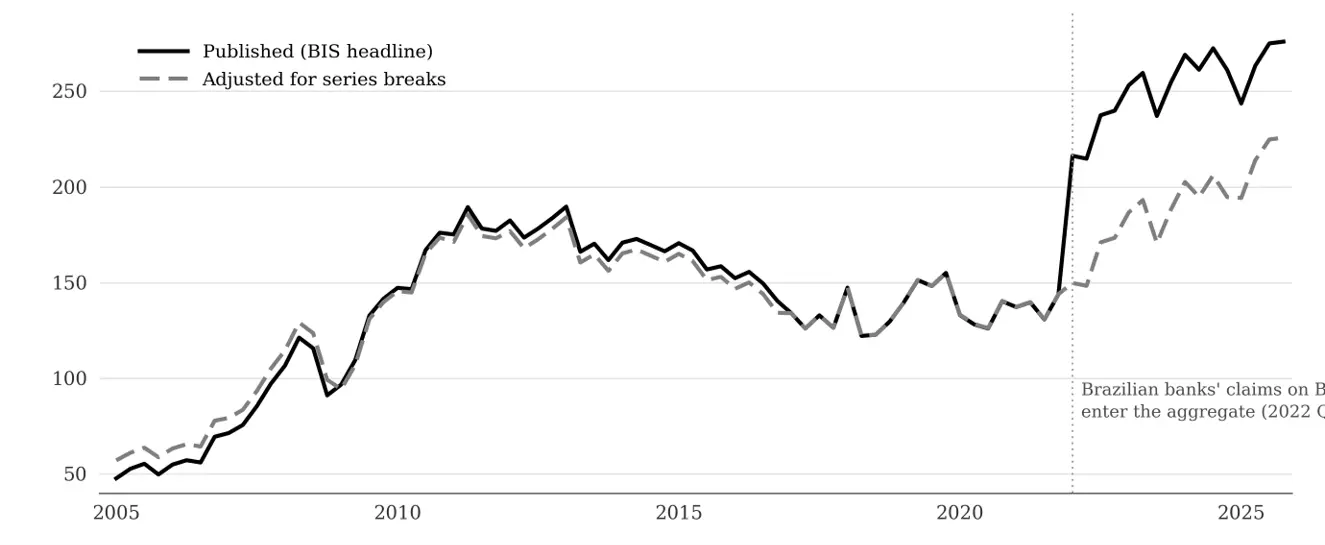
All BIS-reporting banks, 2005–24, $bn, quarterly
Source: BIS consolidated banking statistics, author’s calculations
Note: Adjusted series removes the BIS break in stocks from quarterly changes, chained from 2017 Q4.
Where the break comes from
The mechanism is traceable to a single quarter. Brazilian banks have reported to the Consolidated Banking Statistics since 2002. What changed in the first quarter of 2022 was not who reports but what the aggregate counts. From that quarter, the claims of Brazilian-headquartered banks on borrowers in Brazil entered the counterparty-country total for the first time.
International claims capture cross-border lending together with foreign-currency exposure, but exclude credit extended locally in local currency. Brazilian banks reported $1.76tn of claims on Brazil, of which $1.69tn was the domestic book in reais. The residual is $66.5bn. The break the BIS records in that quarter is not approximately that residual. It is that residual, to the last million reported.
Why the distinction matters
For a reserve manager, the distinction is not cosmetic. Read from the headline series, Brazil’s external bank funding has nearly doubled, and an exposure sized from that number is overstated by roughly a third. The composition also differs in kind. Three-quarters of the 2024 stock is what the statistic was built to measure: foreign banking systems’ claims on Brazilian borrowers, funded abroad and subject to rollover decisions taken in other jurisdictions. The remainder is Brazilian banks’ own international claims on their own country. That balance does not behave like foreign funding under stress, and it is not a channel through which a shock arrives from outside. Who supplies external funding, as economists Eugenio Cerutti, Stijn Claessens and Damien Puy have shown, shapes an emerging market’s sensitivity to global conditions more than the headline quantity of it does.
There is a constructive corollary. The same entry that contaminates the inward series makes the outward leg visible for the first time: the international claims of Brazilian banks on the rest of the world, some $71bn at end-2024. What sits inside that figure is a question for another occasion.
Host and home in the same series
The wider point concerns the frame. The Consolidated Banking Statistics were built, as BIS’ Patrick McGuire and Philip Wooldridge set out when the series was redesigned, to measure creditor banking systems’ exposure to a host country – the risk a lender runs against a borrower.
Brazil sits in both positions at once: host to foreign claims, and home to a banking system whose domestic book, once counted, shifts the host-country aggregate by a third. Neither role is new; counting them in the same series is. Brazil is the first large emerging market where that collision is this visible. It will not be the last, and how to read financial integration for a country that is simultaneously host and home is not a settled question.
João Gabriel de Araujo Oliveira is Assistant Professor at the University of Brasília, Visiting Professor at the State University of Londrina and Associate Fellow of the World Academy of Art and Science. He is also a macroeconomic consultant at the World Bank Group.
The views expressed are his own and do not necessarily reflect those of the World Bank, its Board of Executive Directors, or the governments they represent.
Join OMFIF on 23 September to discuss Brazil’s elections in regional perspective: implications for the global economy.

Interested in this topic? Subscribe to OMFIF’s newsletter for more.