

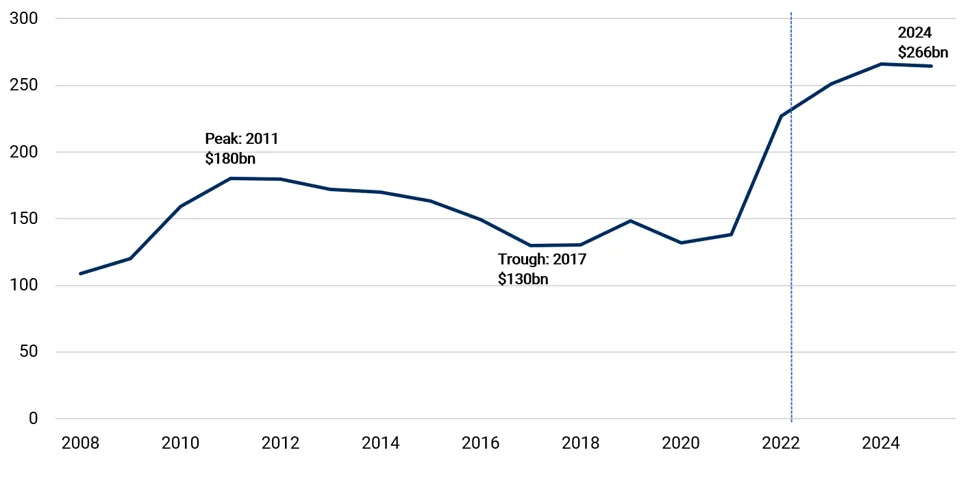
Throughout the 2000s, the direction of banking capital in Brazil was not in dispute. HSBC, Citibank, Santander, Deutsche Bank and dozens of smaller institutions built retail franchises in a market characterised by high interest rates, a growing middle class and a commodity cycle that suggested durable convergence with the advanced world. By 2011, the consolidated international claims of all Bank for International Settlements-reporting banks on Brazil had reached $180bn (Figure 1).
That figure did not hold. Over the following six years it fell by 28%, to $130bn, as several of the same institutions reversed course. HSBC Brazil was sold to Bradesco in 2016. Deutsche Bank wound down its retail operations. Citibank transferred its consumer banking business to Itaú. What looked, transaction by transaction, like individual portfolio adjustments was, in aggregate, something more structural: a systematic reduction of direct exposure to the Brazilian retail banking market by global institutions.
Brazil was not an isolated case of a market losing its appeal. It was part of a global retreat from universal banking. According to McKinsey’s Global Banking Annual Review, the number of global universal banks among the world’s 20 largest by market capitalisation fell from 10 in 2005 to six in 2015 and just four by 2025. Citibank alone exited consumer banking in 13 markets across Asia, Europe, the Middle East and Africa. What Brazil experienced was the local expression of a worldwide strategic reorientation.
Figure 1. International claims of BIS-reporting banks on Brazil
All BIS-reporting banks, 2008–24, $bn, annual average
Source: BIS Consolidated Banking Statistics, immediate counterparty basis, all currencies.
Note: Annual average of quarterly data. Series discontinuity in 2022 reflects change in reporting methodology
The reversal of direction
The timing coincides with Brazil’s 2015–16 recession, but the data suggest the withdrawal cannot be attributed to the cycle alone. Claims from US banks fell 28% between their 2011 peak and the 2017 trough; Spanish banks fell 39%; UK banks 34%. The breadth of the retreat across banking systems of different sizes, risk appetites and strategic orientations points to a structural reassessment of Brazil as a banking destination rather than a response to any single bilateral condition.
The exits clustered in a specific segment. Investment banking and wholesale operations were largely retained. What the departing institutions shed was the capital-intensive, regulation-sensitive, macro-exposed part of the business: mass-market current accounts, consumer credit, mortgage lending.
The movement in the other direction
While global banks reduced their Brazilian exposure, Brazilian institutions moved outward. Between 2008 and 2024, Itaú Unibanco expanded across Chile, Colombia, Peru and Mexico, eventually absorbing Citibank’s consumer banking operations in three of those countries. BTG Pactual acquired BSI Switzerland in 2014, establishing a direct presence in European wealth management. Nubank listed on the New York Stock Exchange in 2021 and acquired a Mexican fintech, Olivia, in 2023. XP Inc. registered with the US Securities and Exchange Commission and began directing advisory services at Brazilian diaspora capital in North America.
This shift is now visible in the way the BIS itself classifies Brazilian banks. In its December 2024 Quarterly Review, the BIS grouped the home offices of Brazilian banks alongside those of the US and Australia as institutions that import capital to the home country, sourcing intragroup funding from their foreign offices. A decade ago, Brazil would not have appeared in that category.
Banco Central do Brasil balance-of-payments data corroborate the direction: outward direct investment from Brazil reached a cyclical peak in 2022, at $44.5bn, even as inward flows remained below their pre-2012 levels on an adjusted basis. Total inward foreign direct investment reached a record $173bn in 2024, but the composition had shifted materially. Fintech venture capital – SoftBank into Inter, JPMorgan into C6 Bank, Goldman Sachs into NN Investment Partners Brazil – replaced traditional banking market entry as the dominant form of foreign financial capital entering the country.
What the standard framework does not capture
The conventional approach to assessing financial vulnerability in emerging markets focuses on the inward direction: how large is the exposure of foreign banks to a given market, and how quickly could it be withdrawn in a stress scenario? The BIS Consolidated Banking Statistics were constructed to answer precisely that question. Brazil’s experience over the past 15 years suggests that a second question has become equally relevant: what are the implications when the emerging-market bank is the one expanding abroad?
For the BCB, the internationalisation of domestic banks has extended the supervisory perimeter to an expanding list of host jurisdictions. Chile, Colombia, Peru, Mexico, Switzerland, the US, without a proportional increase in the bilateral supervisory arrangements through which cross-border banking risk is typically managed. The International Monetary Fund’s 2026 Financial Sector Assessment Program identified the strengthening of banking supervision, including addressing shortages in BCB staffing and reinforcing the legal protection of its supervisors, as a priority, precisely as the perimeter widens.
For central banks outside Brazil, the exposure has moved in a direction that standard EM monitoring does not systematically capture. The Nubank model – a Brazilian-origin institution operating across three countries, listed in New York and regulated under three distinct frameworks – represents a category of institution for which existing surveillance, designed around the inward direction of flows, provides incomplete information.
The recovery and what it conceals
By 2024, foreign claims on Brazil had recovered to $266bn, well above the $130bn recorded in 2017, and the momentum has continued. In the fourth quarter of 2025, Brazil received the largest cross-border bank credit inflow of any emerging market, at $14bn, and credit to Latin America grew 12% over the year, the strongest annual increase since 2008.
Yet a closer reading of the BIS data complicates the headline. Part of the recovery reflects methodological changes in BIS reporting in 2022, which expanded the universe of reporting institutions and altered comparability with the pre-2022 series. The traditional retail banking presence that characterised the pre-2012 period has not been re-established, and there is limited evidence that the institutions that departed intend to return in that form.
The more durable shift is in the composition of bilateral financial relationships between Brazil and the rest of the world. Brazilian institutions are expanding into markets where, a decade ago, they had no significant presence. Foreign capital is entering Brazil through instruments, venture equity, minority fintech stakes and wholesale facilities that do not show up in the BIS retail banking data in the same way that branch deposits and consumer loan portfolios did.
For those responsible for monitoring systemic financial risk, the question that the BIS Consolidated Banking Statistics have always answered is: how exposed are global banks to Brazil? Now it requires a companion question: how exposed is Brazil to the rest of the world?
João Gabriel de Araujo Oliveira is a financial economist and consultant advising on banking sector development including the World Bank Group. He is a post-doctoral researcher at the University of Brasília and an Associate Fellow of the World Academy of Art and Science. The views expressed are his own.
Join OMFIF in Mexico City on 30 September for the Americas transition finance summit.

Interested in this topic? Subscribe to OMFIF’s newsletter for more.