
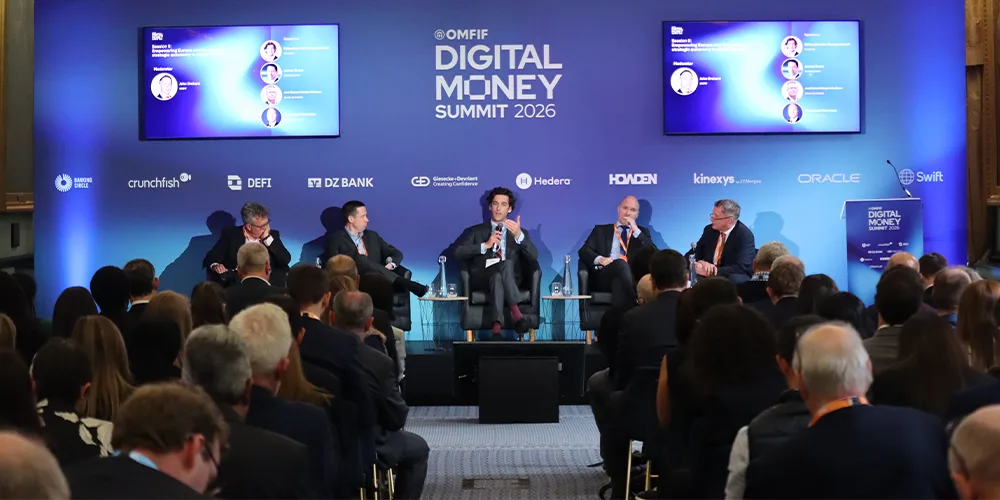
The European Central Bank first began investigating the prospect of issuing a digital euro in 2021. Five years later, the ECB is just three years away from launching it (pending the approval of legislation presently sitting with the parliament).
Eight years, as European projects go, is not really all that long. The euro was discussed in some form or other for 30 years before it was issued. However, some at OMFIF’s Digital money summit remarked that the ECB was not showing sufficient urgency to adapt in the face of increasing competition from dollar-denominated stablecoins.
Of course, creating a new format of public money takes time. There are still several thorny areas of policy to be ironed out – including the scale of holding limits and the pace of introduction for offline payments – and getting these questions right matters.
But complaints and unsettled questions notwithstanding, if the ECB is able to stick to its schedule, there will be a digital form of the euro for common usage before the end of the decade. What then?
How will the digital euro be received by Europeans?
This question is sometimes received with a shrug. The ECB has yet to provide European citizens with a convincing reason to use the digital euro, although it believes the rationale for issuing it is clear and coherent. Europe should be striving for monetary sovereignty and therefore its payments services and money provision should be predominantly provided by European institutions to reduce reliance on external bodies. The digital euro is also a conservative response to the decline of cash usage, preserving the central bank’s role in payments and ensuring that central bank money remains the anchor of the monetary system.
But while those reasons might be coherent from a geopolitical perspective, they do not relate to individuals’ decisions on what payment instruments they might use.
Since the introduction of the euro more than 20 years ago, the ECB has never had much need to market its services to the public. When it comes to the digital euro, third-party service providers will certainly be brought in to do the heavy lifting of promoting the instrument and its use, but this is a philosophical and policy challenge as well as a communications challenge.
The digital euro will be legal tender, and the ECB will do everything in its power to ensure that it is useable at the touch of a button, but will removing all the answers to ‘why not?’ be enough if it cannot find a convincing answer to ‘why bother?’. Although things on the back end can be improved, in general, the European experience of domestic retail digital payments is already very good.
Privacy remains a sticking point
One very particular ‘why not’ will become a major political football over the years approaching and following the digital euro’s launch: privacy. The belief that the digital euro will be used as a tool of state surveillance or control is going to be a tough one for the central bank to shift.
Protestations that the ECB will not hold personal data, that commercial banks will intermediate as they already do and that they will not build in ‘purpose-bound money’ functionality to restrict what the digital euro can be spent on will do very little to persuade citizens.
The fundamental reason that answers on privacy are unsatisfying is that the digital euro may not really worsen the privacy of European payments because there is so little of it anyway. Commercial payments providers are already able not just to offer payments data to law enforcement, but to commercially exploit it.
Since we have so little privacy in payments to protect, the central bank can say little that will comfort those who are concerned about surveillance, particularly those with a healthy European mistrust of the public sector.
The ECB and its corps of hired marketers will do what they can to combat this fear and give people a reason to use the digital euro, but there is an important step it must take as soon as possible: define its win conditions.
What does success look like?
What does the ECB actually want the digital euro to achieve? Success could look like a set percentage of overall digital payments that use the currency. Or the bank could devise some metric of monetary sovereignty to measure success – a reduction in market share for the US services providers, perhaps.
The ECB does not need to become the only game in town for digital payments. It does need to provide a credible alternative to stoke competition in private sector payments and make sure access to digital money is available as a public good. Perhaps the best thing would be for it to identify the changes in the market for private sector payments provision that it wants to see and to set those as targets to be achieved within, say, five years of the issuance of the digital euro.
At present, the digital euro is lacking both a rationale for citizens to use it and a well-defined strategic objective. Without both of these in place, it will be easy for its political opponents to brand it a failure, ruining any opportunity it might still have of provoking positive change in payments, wasting the political capital expended on the project and torpedoing the chances of further ECB-led payments innovation.
Lewis McLellan is Head of Content at OMFIF’s Digital Monetary Institute.
Join OMFIF next year for the Digital money summit.

Interested in this topic? Subscribe to OMFIF’s newsletter for more.