

Against the backdrop of concerns about further escalation of economic and military conflicts, discussions at the International Monetary Fund-World Bank annual meetings in Bangkok centred around one dominant theme: how can we preserve what we have achieved? How can we maintain the successes of the last 35 years in an increasingly unregulated and hostile world? Answers to these questions varied from country to country, and their persuasiveness varied too.
Weak showing from the US
The US, through its war against Iran, is significantly contributing to upheaval in the global economy, and its delegation provided little impetus in Bangkok. Treasury Secretary Scott Bessent has set himself ambitious targets: 3% economic growth, a budget deficit of 3% of gross domestic product and an additional 3m barrels of domestic crude oil production per day.
However, economic growth in the US remains at around 2%, crude oil production has hardly changed and, according to IMF calculations, the country’s budget deficit already exceeds 8% of GDP, with an upward trend. Meanwhile, the US current account deficit with China is growing despite the Trump administration’s punitive tariffs. Bessent has failed to stabilise yields on US government bonds below 5%. Consequently, his economic and fiscal policy has failed to achieve any of its targets.
Having regularly sought dialogue with institutional investors over the past two years, Bessent chose to stay away from the IMF meetings this time, sparing himself any critical questions. Federal Reserve Chair Kevin Warsh participated in a panel discussion with IMF Managing Director Kristalina Georgieva, discussing the investment boom in the US.
According to Warsh, this boom may have an inflationary effect in the short term, but it will curb inflation in the medium term by increasing the overall supply of goods and services. This is why monetary policy only needs to respond moderately to current inflation. The bond market reacted with relief to Warsh’s comments and continued to price out a possible interest rate rise in October. Whether the Federal Reserve will carry out any further interest rate hikes in this cycle remains to be seen.
China shock 2.0
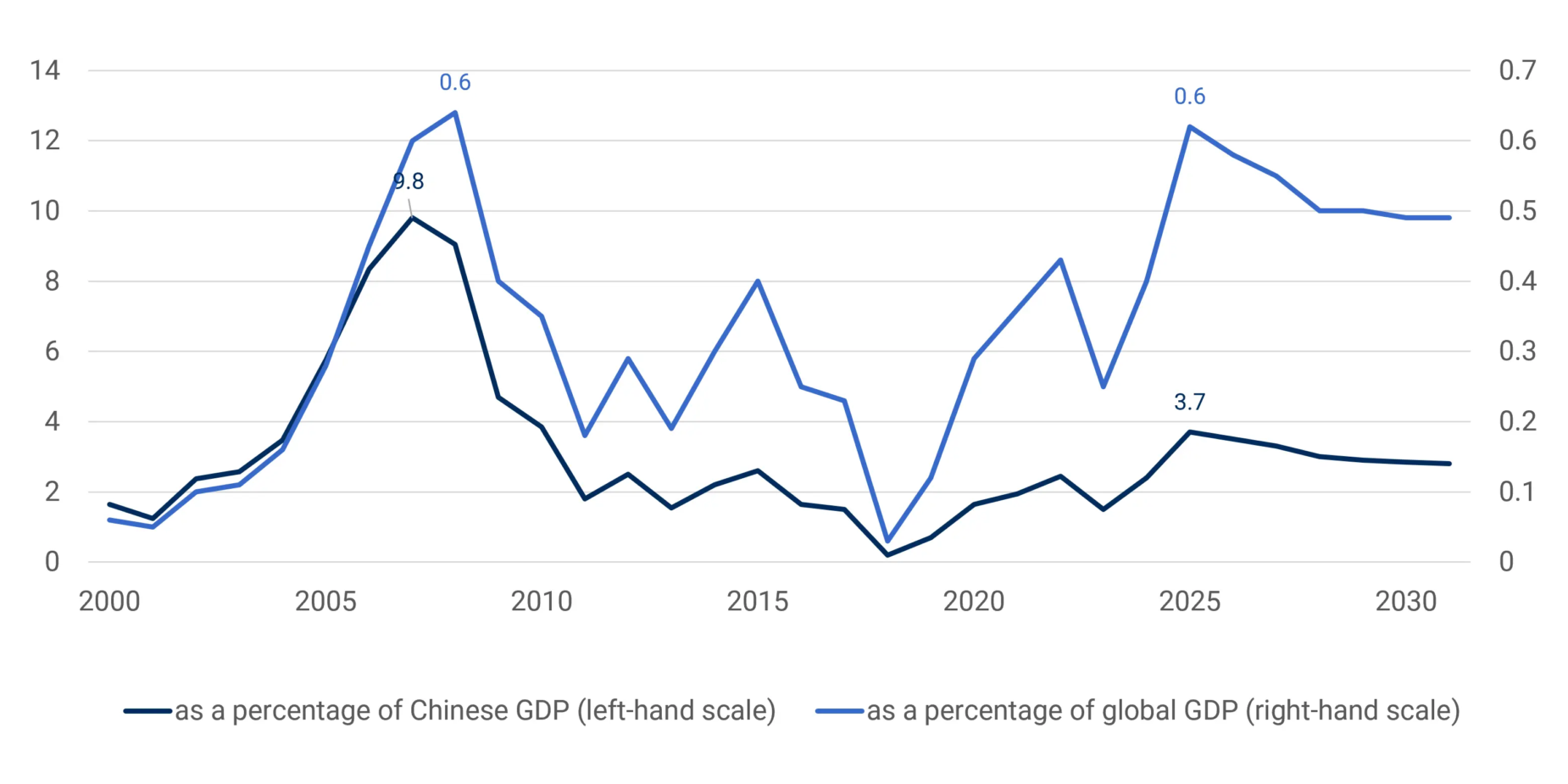
In Bangkok, there was widespread discussion about the growing imbalance in world trade, with China at its centre. Even official figures show that China’s current account surplus has surged to 3.7% of GDP. In reality, this surplus is likely to be significantly higher, as the Chinese authorities apparently do not fully report investment income from foreign assets, as Brad Setser of the Council on Foreign Relations has pointed out. China’s current account surplus now stands at around 0.6% of global GDP – a record high (Figure 1).
Figure 1. China’s current account surplus is at a record high
Source: Steven Barnett
The main reason for this substantial export surplus is weak domestic demand in China. A massive oversupply of residential property has triggered a crisis in the construction sector and a decline in domestic investment of around 4.5% of GDP. Consumer confidence has plunged and households are responding to the fall in the value of their properties and the weak labour market by increasing their savings out of fear of the future. The government is reluctant to stimulate consumption by raising wages or reducing the elevated tax wedge on labour income. In this situation, companies are turning to exports for salvation; these account for around three-quarters of China’s economic growth.
The question of Europe’s response to the ‘China shock 2.0’ was the subject of heated debates at the IMF meetings. There are indications that the trade agreement on hybrid cars negotiated between the European Union and China on 9 October 2026 could serve as a model for other sectors. It seems likely that the EU will impose punitive tariffs on imports of hybrid cars exceeding a threshold of 350,000 vehicles. This unilateral measure is not a fixed quantitative restriction. Furthermore, imports of hybrid cars from all other countries will also be subject to the same tariffs. By adopting this approach, the EU is keeping its single market partially open to Chinese suppliers while largely freezing China’s market share at last year’s level.
All eyes on France
Discussions on Europe centred primarily on the situation in France. All European participants agreed that intervention by the European Central Bank in the French bond market is not currently warranted. During a panel discussion, Klaas Knot, the former governor of De Nederlandsche Bank and a leading candidate to succeed Christine Lagarde as ECB president, summarised this view, stating that a sustained decline in the risk premiums on French government bonds requires the French government to pursue a sustainable fiscal policy and reduce its deficits.
The ECB could intervene to prevent widespread turmoil in the bond market, as this would hinder the transmission of its monetary policy. However, with a yield spread of just under 150 basis points compared with German Bunds, we are still a long way from the levels at which intervention would be required.
Several speakers emphasised that the turmoil in the French bond market is primarily a coordination problem within Europe. Neither France nor the euro area has a current account deficit, and the government’s budget deficit can be fully covered by the domestic private sector’s savings. Unlike in the US, there is no dependence on foreign buyers of government bonds.
What does this mean for investment?
What are the investment implications of these observations? Here are a few key points.
First, we must prepare for a prolonged period of high policy interest rates in the US and the euro area. While the Fed may not raise interest rates further, rapid cuts seem unlikely given the war in the Gulf and the resulting persistently high crude oil prices. Joyce Chang, chair of global research at JP Morgan, summed it up nicely: ‘90 is the new 65’ when it comes to the price of a barrel of crude oil.
Higher borrowing costs are casting doubts on investments in artificial intelligence. Currently, hyperscalers are spending approximately $1tn annually on the buildout of data centres. These investments are increasingly being financed by issuing debt. By next year at the latest, investors will be asking themselves whether these projects are actually profitable. A decline in margins and capital expenditure, coupled with a fall in the share prices of the hyperscalers, could pressurise financial markets, not least because it is unclear who ultimately bears the hyperscalers’ credit risks.
On the other hand, if investments in AI and data centres were to yield large profits for the hyperscalers, this would come at the cost of high additional expenses for other companies, which would in turn jeopardise their profitability.
Given these uncertainties and comparatively high yields, fixed-income investments are becoming increasingly attractive. However, public debt has reached worrying levels in some countries. This is particularly the case in the US: according to IMF forecasts, the budget deficit is expected to remain above 8% of GDP in the medium term, with interest payments already amounting to 3.6% of GDP. There are also concerns about French government bonds as fiscal consolidation is not yet in sight, although a turnaround in France is more likely than in the US.
As such, investment diversification is becoming increasingly important, with emerging markets taking on particular significance. But this asset class is no panacea. India and Indonesia appear to be under pressure, while the Chinese renminbi and the Hungarian forint may appreciate further. While France and the US could see a downgrade, the sovereign ratings of Argentina and Côte d’Ivoire could be upgraded.
The IMF-World Bank meetings have highlighted that geopolitical risks, high interest rates, widening government deficits and a less predictable US economic policy environment are shaping the investment landscape. In this context, fixed income remains an important portfolio component.
Christian Kopf is Head of Fixed Income Portfolio Management at Union Investment.
This article is an edited version of a longer article published by Union Investment.
Join OMFIF on 10 November in New York to examine the Fed’s reform agenda.

Interested in this topic? Subscribe to OMFIF’s newsletter for more.