
The Tropical Forests Forever Facility represents one of the ambitious attempts to pay for standing forest at scale. Launched at COP30 in Belém, Brazil and likely to feature substantially in the forest discussions at Antalya, Türkiye in November, it is a two-tranche blended fund with a target size of $125bn. At least 20% of the fund, some $25bn, comes from sponsor governments and philanthropies as junior capital, absorbing first losses and supporting the issuance of up to $100bn in senior bonds.
The combined base is invested through the Tropical Forest Investment Fund under World Bank administration. The concept note estimates that a portfolio generating between 247 and 325 basis points of gross spread over US Treasuries would be sufficient to fund payments in the early years and suggests the facility could mobilise around $4bn annually. Rather than donor appropriations, the spread reaches tropical forest countries, at $4 per hectare of eligible forest each year, as measured by satellite.
Countries enter with a deforestation rate at or below 0.5% and deductions then operate through an area discount rather than a cash penalty. For a country below 0.3%, each hectare cleared removes 100 hectares from the payment base; between 0.3% and 0.5% the ratio doubles on the excess and degraded forest carries a discount of 1:35. At $4 a hectare, a single cleared hectare can therefore forgo $400 or $800 of payment.
These characteristics distinguish the facility from three decades of forest aid. Payments are intended to be predictable, results-based, free of project cycles and not contingent on the annual appropriations of donor parliaments, which for recipient governments would represent a meaningful improvement on the instruments currently available. The facility left Belém with $6.7bn of its junior target and most discussion since has concerned how the remainder might be raised.
Uncharted terrain
A second question has attracted less attention, even though the concept note addresses it directly: what happens to a forest payment once it reaches a recipient country. Section 8 sets out four eligibility criteria governing the use of payments. Countries must demonstrate adequate public financial management systems, assessed using World Bank fiduciary methodologies; allocate at least 20% to indigenous peoples and local communities; publish an annual allocation plan; and show that payments supplement rather than substitute existing budgets.
The indigenous allocation carries real enforcement. A national steering committee must be operating, a dedicated account opened with defined signatory delegations, and the transfer completed within a year of accession, failing which a country becomes ineligible for payments the following year. Allocation plans list the policies expected to receive funds but not the amounts, the concept note states that the facility will not track or verify how payments are spent and the non-substitution test may be evidenced by whichever method a country considers suitable for its own systems.
All four criteria operate at national level, which is where a difficulty may arise in federal states. Payments reach national treasuries, and the non-substitution baseline is drawn against national public spending. In Brazil, as in most large federations, much of the work determining whether forest stays standing is carried out by state governments, which are fiscally autonomous and whose budgets form no part of the baseline being measured.
Brazilian budgets assign every line a functional code and environmental management carries its own, allowing spending to be measured rather than estimated. Across the four states of the Legal Amazon publishing sufficient detail, environmental management accounts for between 0.17% and 0.55% of total planned spending. Amazonas, which holds more standing rainforest than any other state, budgets around $23m for it, a tenth of what the same budget sets aside as an unassigned contingency reserve.
Figure 1. Environmental management is a rounding error in Brazil
Share of total planned spending, four states of the Brazilian Legal Amazon
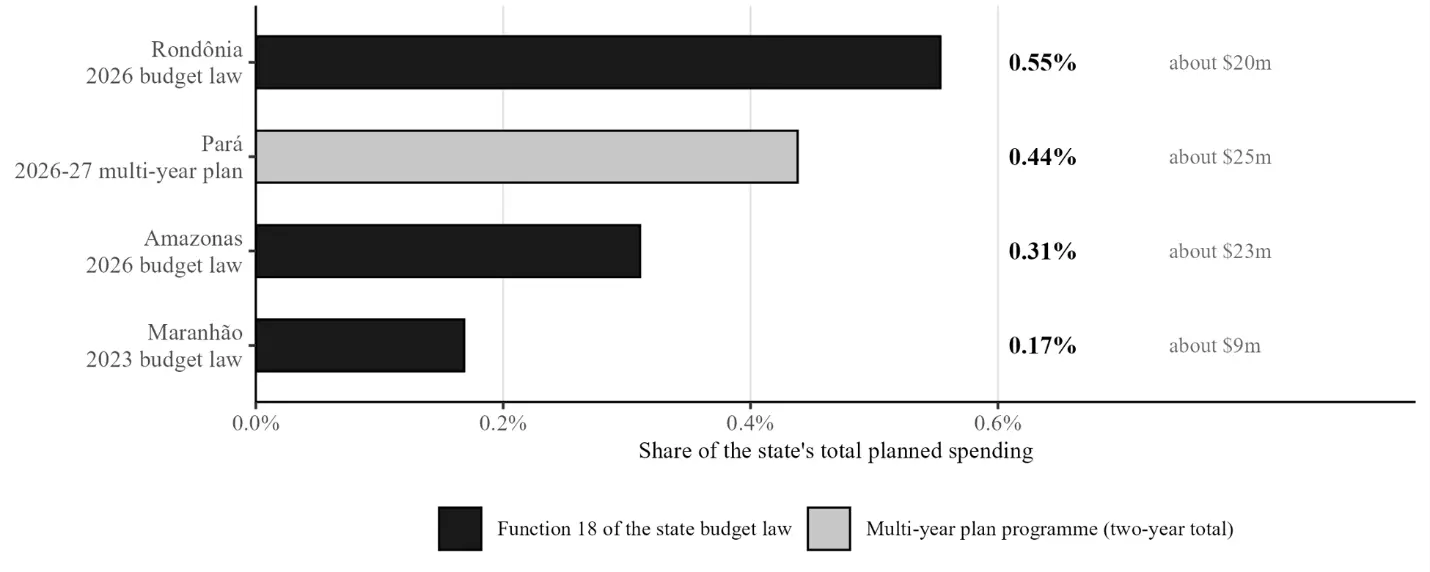
Source: State budget laws and multi-year plans; authorised appropriations rather than money spent.
The direction of travel is equally relevant to a non-substitution test. In Maranhão the environmental function fell 56% in real terms between 2020 and 2023, and in Amazonas 49% between 2023 and 2025. A national baseline could be held constant while declines of that order continued at the level where environmental licensing, land-tenure regularisation and monitoring actually take place, and the facility would have no visibility of the erosion.
The concept note observes that finance ministries could deploy intergovernmental fiscal transfers and budget allocations in support of forest conservation, and cites India, where ecological fiscal transfers to state governments accompanied a reported halving of dense forest loss after 2014. The instrument is named and the evidence cited, but none of it is made a condition. Transmission of funds to the level of government that performs forest management is left to national discretion, while the indigenous allocation receives an account, a committee, a deadline and a sanction.
The facility has shown that it can build binding allocation machinery where it judges the case strong enough. Sponsors retain some leverage while the junior tranche is filling, and might ask that the non-substitution methodology be extended to the subnational level in federal states, and that allocation plans indicate the share reaching subnational environmental budgets. Once the tranche is full and the senior bonds priced, the design becomes considerably harder to revisit.
João Gabriel de Araujo Oliveira is a post-doctoral researcher and lecturer in economics at the University of Brasília and an Associate Fellow of the World Academy of Art and Science.
Join OMFIF on 29 October for a virtual roundtable on Insurance: a catalyst for financial resilience.

Interested in this topic? Subscribe to OMFIF’s newsletter for more.