
‘It’s my strong personal view that the international order will be rebuilt, but it will be rebuilt out of Europe.’ – Mark Carney, Canadian prime minister, May 2026.
Can Europe survive? The question is metaphysical. The continent will survive as a land mass, but will it prosper? The new extended paperback edition of my book on Europe’s past, present and future makes clear that a Europe that stagnates will not be stable.
Further questions include: which Europe are we talking about, and what kind of Europe do we want? The answer must be a flexible Europe that encompasses countries beyond the present membership of the European Union. An intergovernmental approach, frequently sidelining the European Commission (a far from effective body in recent years), must play a larger role.
Organisational frameworks will be needed allowing different countries, inside and outside the EU, stretching as far afield as Canada and Australia, to go forward at different speeds, pursuing different goals. We need an upsurge of the ‘pragmatic federalism’ espoused by Mario Draghi, former Italian prime minister – harking back to the ‘variable geometry’ espoused by Jacques Delors, European Commission president in 1985-94.
That should be the response to President Donald Trump’s frequently bellicose extension of ‘America First’ across a wider radius of world affairs. ‘Pragmatic federalism’ can also help settle Europe following the post-April 2027 departure of French President Emmanuel Macron – whose 2024 speech stating ‘Our Europe is mortal’ provided the inspiration for this book’s title.
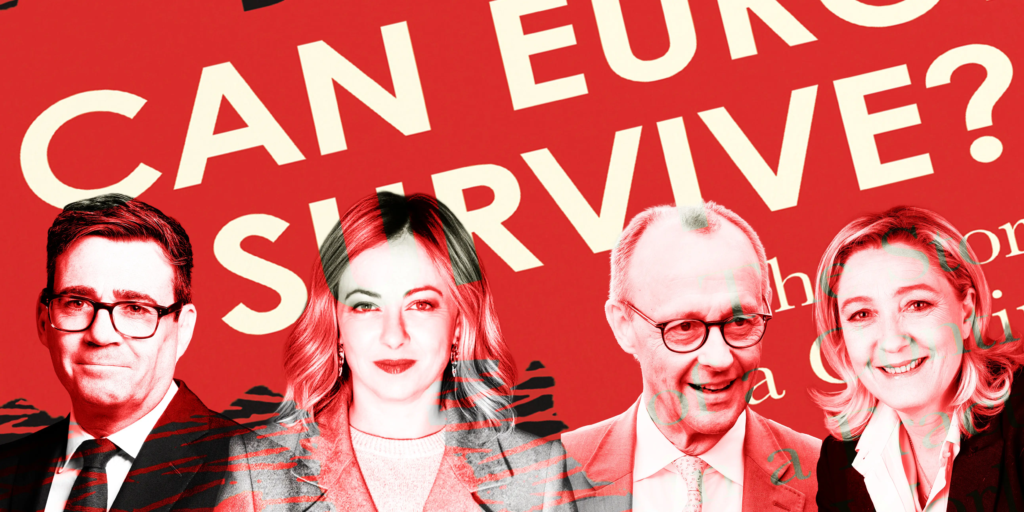
Rebuilding Franco-German partnership with a possible National Rally (RN) President Marine Le Pen will be a prime task for German Chancellor Friedrich Merz. This is one of the many reasons why I expect him to stay on despite his domestic unpopularity and the rise of the far-right Alternative for Germany (which happily is being cold-shouldered by France’s RN). An intriguing conundrum for 2027 is how a possible President Le Pen will co-exist not only with Merz but also with Italian Prime Minister Giorgia Meloni (also stemming from a far-right background and facing her own elections next year) as well as Britain’s new leader Andy Burnham.
The new edition of my book probes whether the transatlantic relationship is dead or simply undergoing a major upheaval (I favour the latter reading); whether, as Draghi has stated with trademark bleakness, ‘we are truly alone together’ against an America that has grown ‘more adversarial and unpredictable’; and what can be recovered and nurtured from the disorder.
A greater European pooling of forces to offset the often-competing influences of America and China is desirable and feasible in the four great spheres of political economy – energy, defence, industry and money.
If Europe is fortunate, then a wave of European solidarity will unleash beneficial change at the right time.
In a spectacular example of counterproductive political behaviour, President Trump has contributed mightily to the diversity of actors on the world stage resisting his influence. They range from President Xi Jinping of China, Canada’s Carney and Pope Leo XIV to British King Charles III and former Federal Reserve Chair Jerome Powell (who, thanks to Trump’s adversarial nature, remains on the Fed board in what can only be described as a watchdog role).
Protracted strains on social and economic structures
Europe is facing the most protracted strains on its social and economic structures since the second world war – a product of accelerating technological advancement (especially artificial intelligence), the post-pandemic build-up of government debt, intensified industrial competition from China and the impact of the Russo-Ukraine war.
Away from the headlines of wars and transatlantic perturbations, the further rise of the trade deficit with China has represented the biggest single negative influence on Europe in 2025-26. Most concerning has been the mammoth international expansion of Chinese presence and leverage in sophisticated product categories such as advanced machinery, chemicals and green technology, including electric vehicles – as well as in the critical minerals needed for many high-tech processes.
China has moved further to extend its influence on the rest of the world. Simultaneously, it has been making itself globally far less dependent on others – for example, by investing heavily in supply chains for critical minerals from Africa and elsewhere, and building up reserves of oil and other strategic resources.
All these factors have fuelled further growth in (largely) right-wing ‘populism’ in many countries – potentially fostering a hard-to-break disruptive cycle, within and among nations.
A vainglorious and reckless Trumpian America is throwing off (not always successfully) the self-restraints of checks and balances supposedly anchored within the US constitution. And a timorous and disunited Europe appears unable to translate its undoubted economic and technological prowess into global political leverage. Yet Trump’s grip has been palpably waning. Europe’s perilous passage brings an abundance of trials and travails, but the Old Continent has the chance of surmounting its ills. There is a striking paradox about Europe’s position. As well-known commentator Marco Annunziata – who generously described my book as ‘an essential read for Europhiles and Europhobes alike’ – has put it, ‘Just as France struggles to stay afloat, the line to join – or rejoin – the EU keeps getting longer.’
As Europe seeks to apply the lessons of the Trump era, an ‘age of resilience’ will not be easy to achieve, but it lies within reach. European policy-makers should keep three key precepts uppermost in their minds.
Three precepts for ‘age of resilience’
First, Europe – the wider continent and not just the EU – has to set up effective means to rediscover its strengths through broadening and institutionalising the principles of ‘variable geometry’. A smaller number of like-minded nations can team up in different policy sectors, allowing individual groupings to move forward with greater speed and efficiency than the EU as a whole, which could be the key to finding a new model for growth by capitalising on the dynamism of the internal European market. This requires harnessing Delors’ principles to the new geopolitical conditions of an AI-orientated world. This is in turn necessitates a further creative rapprochement between the EU and countries like the UK that are outside the EU and will probably remain so for the foreseeable future.
One important step – a major consideration for Burnham – would be to modify rules on free movement of people. This is likely anyway in view of qualms over immigration in many countries. Severing the legal linkage at the heart of the EU between cross-border flows of people and goods would be a crucial step in allowing the UK, while outside the EU, to participate in the single market.
Second, in the field of public spending Europe needs to adapt the machinery of ‘public money’ to take a value-enhancing approach to government finance for public services and industrial and economic renewal. This will be key to adopting the recommendations of the 2024 Draghi competitiveness report across economic and technological spheres that can help to restore higher growth.
Supply-side measures ranging from educational reforms to raising the retirement age are necessary in many countries and can be galvanised by a joint sense of European commitment in the wake of pressures generated by Trump’s ‘America First’. An essential cornerstone will be a restructuring of welfare spending in many counties. Without such radical resetting of priorities, Europe will be inexorably exposed to the fatal tyranny of the ‘six D’s’ – the competing challenges of deglobalisation, demographics, decarbonisation, digitalisation, defence and debt.
Third, in dealing with the rest of the world, Europe would be well advised to forsake the language of ‘strategic autonomy’. Instead, it should strive for ‘strategic balance’. This requires redoubling efforts already underway over lowering dependence on America for defence and technology, a unified and tougher-minded approach to competing and partnering with China, and active measures to enhance economic and financial ties with a wider group of important countries, ranging from Canada, Australia and Japan to Brazil, India and Indonesia. In other words, a worldwide approach to ‘variable geometry’.
The positive surprise stemming from the technological and organisational dynamism of the Ukraine defence industry – aided by copious, continuing funding from the West – can be turned into a substantial European advantage, especially if it promotes an at least half-way benevolent outcome to the Russo-Ukrainian war. Europe should be seeking not complete independence but balanced and mutually beneficially linkages with other centres of economic and financial weight.
The more solid and united the platform from which Europe (with allies like Canada) launches these undertakings, the greater will be the effects. This will be significantly supported by reinforcing European interconnectedness in defence, energy, industry, transport and capital markets – including recalibrating EU ties with Britain.
Optimistic case for Europe
The optimistic case for Europe rests on the premise that a wave of European solidarity has been set in motion that will unleash beneficial change. The crest will arrive just at the time when another wave – the Trumpian one – is petering out. Europe’s need for positive change has long stood in inverse proportion to its ability to enact it. But a constellation may be now approaching when necessity and realisability can be aligned. This can be aided by a US move, over time, towards a more considerate and knowledgeable form of political leadership, although still one that fiercely defends and promotes America’s interests in the world.
The UK’s King Charles, in Washington in April 2026, recalling Trump’s quip that, but for US intervention in two world wars, Europe would be speaking German, responded with his own bon mot: without the British, the Americans would be speaking French. The priority now for Americans and Europeans is to find a common language that recognises and tries to resolve both the circumstances of Europe’s decline in the world and America’s task of remaining at least level with an upstart but still vulnerable China.
Americans, it is often claimed, can always be trusted to do the right thing after they have exhausted all other possibilities. A key condition for that happening is that the Europeans, too, do ‘the right thing’. Credible leaders are becoming ever scarcer and time does not wait. The pressures on Merz, Burnham, Meloni and (most likely) Le Pen will be enormous. By this time next year, we may know whether they can stand withstand the test.
David Marsh is Chairman of OMFIF. This article is an edited extract from the Preface and Afterword of the paperback edition of Can Europe Survive – The Story of a Continent in a Fractured World (Yale University Press)
OMFIF is making available signed copies of the hardback and paperback edition (15 of each, total of 30) through a special pre-Christmas rate of £880. Please contact [email protected] for more information.

Interested in this topic? Subscribe to OMFIF’s newsletter for more.