
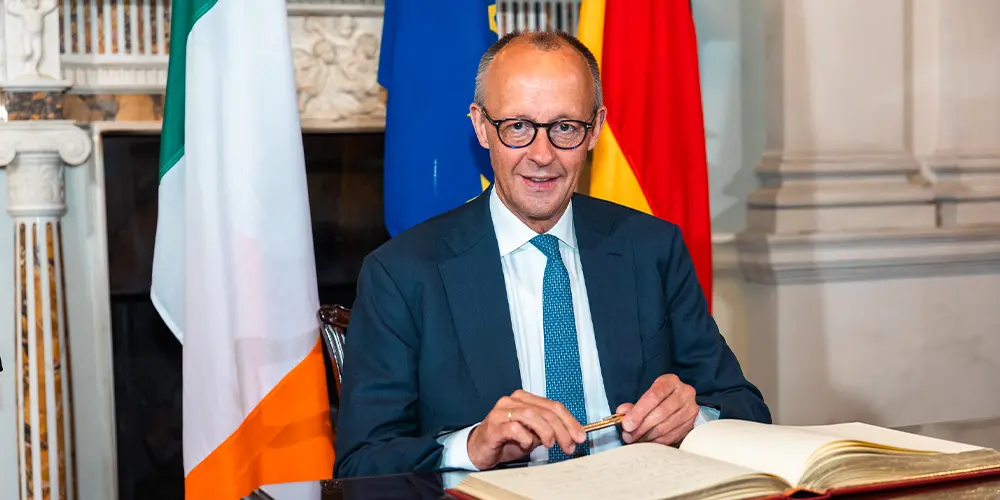
Friedrich Merz, German chancellor since May 2025, is a lacklustre leader presiding over a fractious coalition, plummeting popularity, a still-stagnating economy and a damaging surge in support for the far-right main opposition party. Some German pundits, looking at new UK Prime Minister Andy Burnham’s speedy takeover from Keir Starmer in July, are speculating on Merz’s replacement within the next few months by a rival from within his conservative party grouping.
That is unlikely. For Merz, the political and economic risks are rising on all sides – a symptom of the challenges confronting leaders in all the main industrialised countries. Yet there is no Burnham-like figure in Germany likely to enter the chancellor’s office any time soon.
A probable further rise for the far-right Alternative for Germany (AfD) in key September elections in eastern Germany portends fresh problems for Merz’s Christian Democratic Union–Christian Social Union alliance and his Social Democratic Party (SPD) coalition partners. If the AfD succeeds in winning control of the east German state of Saxony Anhalt, achieving for the first time representation in the Bundesrat, the upper house of parliament, this will send shock waves through the German political system.
The east German elections take place weeks before Germany organises an investment summit on 19 October, seeking – according to Economics Minister Katherina Reiche – at least €3.75tn in private capital by 2040. Reiche has warned that the AfD’s rise could counter Berlin’s efforts to portray Germay’s strengths and stability to foreign investors.
AfD and faultlines over Russo-Ukrainian war
The AfD, opposed to the European Union, the euro and immigration, contains some strong neo-Nazi elements. It has maintained support for Russan President Vladimir Putin, intensifying faultlines in Germany over the Russo-Ukrainian war. A fresh AfD victory would deal a grave blow to Merz and would also have international repercussions.
Many foreign governments, led by Moscow and Washington, would see this as weakening Germany’s support for Ukraine. Some military analysts believe an AfD government in Saxony-Anhalt could impede vital Nato supply lines to the east in case of a confrontation with Russia. This would effectively negate a key part of the 1990 German unification treaty on deployment of Nato forces in eastern Germany.
Within Germany, at national and regional levels, Merz would come under further pressure to amend the ‘firewall’ strategy ruling out any CDU–CSU and AfD co-operation. The chancellor would face an intractable dilemma.
Easing the ‘firewall’ would recognise the reality of the AfD’s popularity. It is polling well ahead of the CDU–CSU nationwide as well as in eastern Germany. But Merz would lean towards maintaining his anti-AfD line to avoid awarding the party fresh legitimacy, dampen further unrest in his coalition with the SPD and limit media controversy, at home and abroad, about parallels with Adolf Hitler’s rise in 1933.
Last month Merz gained an opportunity for advantage by orchestrating the resignation of party rival Jens Spahn, replaced as head of the CDU–CSU Bundestag grouping by Merz ally Thorsten Frei. The chancellor seriously spoiled the aftermath by botching a set of subsequent ministerial changes, drawing withering criticism from his own party.
Safeguards against Weimar-type government changes
The German constitution contains safeguards against destabilising government changes that plagued the Weimar republic before the 1933 Nazi takeover. On just six occasions since the post-war Federal Republic was founded in 1949, Germany has seen a change of government initiated during a legislative period: in 1963, 1966, 1974, 1982, 2005 and 2024-25.
For this to happen, several conditions must be fulfilled, including: a severe build-up of unpopularity of the current chancellor; the leader’s willingness to resign; possibility of other coalition constellations within the current parliament; and availability of candidate(s) of stature within the chancellor’s own party. Of these conditions, only the first is met in Merz’s case.
Disappointments about his tenure focus on the economic front, where he was earlier thought most competent. The setbacks include general complaints about cost-of-living increases, broken promises not to increase debt and inability thus far to make significant changes in energy policy and taxation. In addition, Merz and his party are grappling with big job cuts across Germany’s industrial heartlands (especially automobiles) caused by high energy costs and competition from China, and delays (despite a big fall in immigration numbers) in cutting migration-related social payment transfers (a strong pull factor for illegal immigration). All these factors are driving voters to the AfD.
Probable Commerzbank takeover adds to job cut fears
In the autumn, the probable takeover of Germany’s second-largest stock market-quoted bank, Commerzbank, by Italy’s UniCredit will provoke fresh job reductions in the relatively well-paid financial services sector.
The German government owns a 12% stake in Commerzbank. In his first year in office Merz defended Commerzbank against a long-running unfriendly bid from Italy’s largest lender. But he has in recent weeks softened his opposition as UniCredit’s well-orchestrated tactics have started to bear fruit.
So Merz faces a stream of bad news – and the possibility that it may get worse. But there are five reasons why Germany and Europe are likely to see the chancellor fighting on against adversity.
1. Reforms are coming through
Merz is finally succeeding in pushing through much-needed, oft-delayed economic reforms designed to overcome economic weakness that has held back Germany since 2018. The chancellor won agreement last month within his fragile centrist coalition for a batch of changes in the taxation, pensions, old-age care and healthcare systems. Some of these are facing parliamentary opposition.
In particular, these stem from east German CDU leaders struggling to ward off unpopular pensions cuts and secure votes on 6 September in Saxony-Anhalt and 20 September in Mecklenburg-Lower Pomerania and Berlin. Complaints about threats to social welfare in the CDU and CSU are bound to trigger further unrest in the SPD and endanger the party’s own leadership as well as the CDU’s.
Yet, even if watered down, a package of amendments to the German welfare and tax system – individually modest and technical, but cumulatively important – is set to become law in the autumn. They provide a springboard for a moderate pickup next year in Germany’s energy-intensive economy that remains battered by uncertainty over President Donald Trump’s tariffs, the summer drought and the continuing wars in Iran and Ukraine.
2. No major alternatives
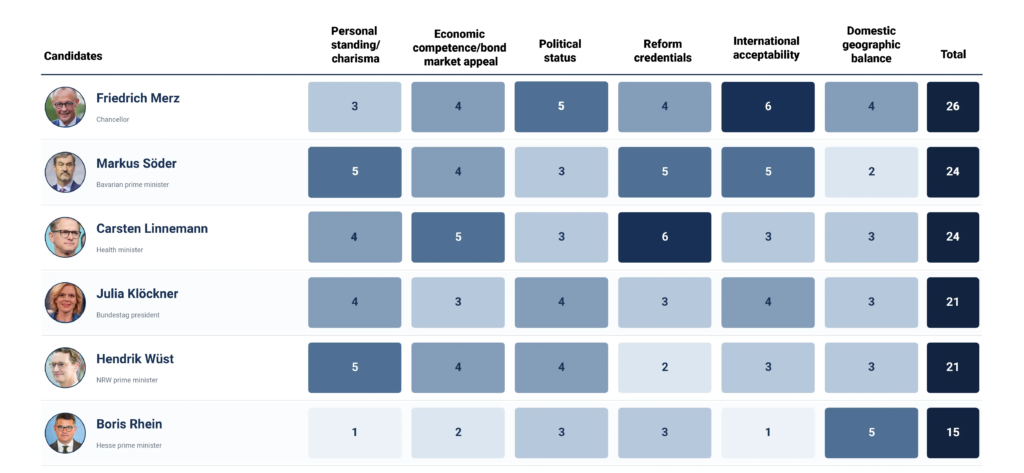
None of the potential CDU–CSU contenders for Merz’s job is likely radically to improve government fortunes. These are Markus Söder, CSU chairman and prime minster of Bavaria; Julia Klöckner, CDU president of the Bundestag; Carsten Linnemann, health minister and a Merz ally; and two CDU state premiers, Hendrik Wüst from Germany’s most populous state of North Rhine-Westphalia and Boris Rhein from the prosperous state of Hesse. Figure 1 measures their characteristics on six criteria.
Figure 1. Contenders for Merz’s job
1 = poor, 6 = excellent
Source: OMFIF analysis
Despite Merz’s mediocre performance, especially his poor communications showing and a damaged economic policy reputation, the chancellor’s overall score significantly exceeds that of his rivals. Based on these criteria, Söder would have a better chance of displacing Merz than Wüst, often touted as the chief contender.
3. Incentives to stay
Merz has substantial incentives to weather his unpopularity and stay until the next general election due in 2029. The barriers for a change of government leader midway through a parliamentary session are much higher than in France and Italy – and also the UK. Eight of the 12 British prime ministers since 1976 have entered 10 Downing Street because of a mid-legislature party personnel reshuffle rather than a general election. This partly reflects Germany’s constitutional checks and balances.
Additionally, despite the headwinds, Merz does not seem to be growing tired of his job. He spent well over a decade in de facto political exile after Angela Merkel, his long-time rival, chancellor from 2005 to 2021, sacked him from the CDU–CSU parliamentary leadership in 2002. He signalled endurance by becoming CDU chairman in 2022 on the third attempt. He has no wish to quit early and become the shortest-tenured German chancellor since the second world war.
4. Lessons from history
Wider patterns of history point to Merz remaining. Circumstances are different to the only two previous occasions, six decades ago, when a CDU chancellor was replaced during a legislative period by an internal rival. Konrad Andenauer was dispossessed by Ludwig Erhard in 1963; and Erhard was unseated by Kurt-Georg Kiesinger in 1966, in a coalition change after the junior Free Democrat (FDP) partner left the government. Neither is there a parallel to the switch in SPD chancellors between Willy Brandt and Helmut Schmidt in 1974, and to Schmidt’s replacement by Helmut Kohl in 1982 when the FDP left the SPD-led coalition, shifting to the CDU–CSU.
German chancellors can provoke snap elections by calling a parliamentary vote of no confidence, as with Gerard Schröder and Olaf Scholz, the two previous SPD chancellors, in 2005 and 2024. But this is highly unlikely in Merz’s case. Neither the chancellor nor his deputy, Lars Klingbeil, finance minister and SPD chairman (like Merz, battling against unpopularity in his party and in the wider electorate), wants early elections that would probably result in further AfD gains.
Speculation that Merz might dissolve parliament and fight an early national poll based on an alliance with the Greens, the fourth party in parliament after the 2025 elections, is wide of the mark. The Greens do not have sufficient seats to form a majority with the CDU–CSU in the present parliament, depriving Merz of leeway in refashioning his coalition.
5. International role
On the international stage Merz will attempt to maximise the benefits of a potential further three years in office. With national elections due next year in France, Spain and Italy, Merz – despite his significant difficulties – faces a less fraught period than many foreign counterparties. He will have ample time to build a relationship with Burnham, paralleling constructive ties with Starmer. His relative success in dealing with Trump may provide important leverage if the US president loses elements of domestic power after forecast Republican setbacks in the November midterm congressional elections.
Merz will be called upon to play a major role in European stabilisation following a French presidential change after the April 2027 elections. There is a high chance that Marine Le Pen, leader of the far right Rassemblement National, at present leading French opinion polls, could take over from Emmanuel Macron. The RN maintains a pro-Russian line, like the AfD, but has distanced itself from the German party on the grounds of the latter’s neo-Nazi associations.
Important decisions on European affairs await Merz’s attention. They include settling a bitter dispute over the multiannual EU budget, further boosting European defence efforts within Nato and resolving complications over choosing the next president of the European Central Bank. These are all areas where Merz can stamp his hallmark. Leaving early is not – at least for the time being – part of the plan.
David Marsh is Chairman of OMFIF. Andreas Meyer-Schwickerath is a Berlin-based OMFIF adviser.
Join OMFIF in London on 17 September for a lecture with Olli Rehn, governor of the Bank of Finland, on monetary policy and Europe’s economic outlook.
Image Credits: Government of Ireland

Interested in this topic? Subscribe to OMFIF’s newsletter for more.