
More than 2,000 years ago, Heraclitus of Ephesus remarked that everything is in constant flux. This is more than a philosophical idea; it can also be a useful way to understand economic progress. The sources of prosperity change. Technologies become outdated. Economic models that served countries for decades lose their effectiveness. The international order under which businesses and economies operate changes.
Europe is experiencing several such transformations at the same time: globalisation is being reshaped, technological change is accelerating, alliances are fragmenting (and new ones are being formed) and the rules-based international system is weakening. How can Europe turn these shifts into an opportunity?
I would like to approach this question by looking at four transformations. Together, they point towards a central proposition: in a world that never stands still, Europe’s prosperity will depend on its ability to adapt, innovate and act collectively.
1. From lowest cost to security
For decades, the international economic order was shaped by a straightforward principle: lowering costs as much as possible in international trade. Trade barriers were torn down. Countries specialised according to their comparative advantages. Companies optimised their production networks. Supply chains became longer, more complex and more geographically dispersed. Trade expanded, capital moved freely and economic interdependence deepened.
Europe benefitted strongly, and particularly central, eastern and southeastern Europe. Over the past 25 years, average per capita income in CESEE (at purchasing power parity, EU member states) increased from about 40% to about 80% of the western European average. Austria benefitted too. Its location, business networks and historical ties to CESEE helped Austrian firms integrate early with neighbouring markets and share in their growth.
But the assumptions underpinning this model have changed, unfortunately. The pandemic exposed vulnerabilities in supply chains. Russia’s war against Ukraine demonstrated the costs of excessive dependence on critical suppliers. Geopolitical rivalry, export controls, industrial subsidies and tariffs have weakened confidence in our rules-based system of trade.
Security has since become a more important consideration in economic decision-making. Friend-shoring, near-shoring and strategic autonomy are concepts that reflect a fundamental reassessment of how economies organise production and manage dependencies.
Of course, this does not mean that globalisation is over. Nor that Europe should seek self-sufficiency. Interdependence remains a source of prosperity. But the balance between costs, resilience and security has shifted. And there is an apparent danger. If every country protects its own industries, subsidises its own champions and secures its own supply chains, the resulting fragmentation will raise costs, reduce competition and undermine prosperity.
The challenge, therefore, is not to choose between openness and security. It is to make openness more resilient. That requires diversification, co-operation with trusted partners and active risk management. It also requires a pan-European approach. Secure supply chains and strategic autonomy are easier to achieve in a single market of 450m people than in a single small country.
2. From stagnation to technological acceleration
Europe’s productivity growth has disappointed for a long time. The rise of artificial intelligence could change this picture fundamentally. Advances in computing, machine learning, robotics and automation have the potential to turn our economies upside down. AI could accelerate scientific discovery, optimise industrial processes and enable entirely new products and services.
But there is an important difference between past technological transformations and the one unfolding today: the advent of AI is progressing much faster and outcomes remain highly uncertain. Where will AI complement human labour and where might it displace it? Will its benefits spread widely or concentrate among a few? And will Europe develop transformative technologies on its own or mainly use those developed elsewhere?
One lesson is already clear: Europe cannot afford to approach this transformation defensively. It must invest in research, digital infrastructure and skills. It must create conditions in which innovative firms can grow. And it must ensure that workers can adapt to changing tasks and occupations. Most importantly, Europe needs to recognise that technological progress does not automatically translate into economic strength. Strength depends on our ability to diffuse innovation throughout the economy, raise productivity in established industries and create new sources of competitive advantage.
3. From convergence to renewal
CESEE’s economic progress is one of the great achievements of European integration. After 1989, countries opened their economies, reformed institutions and integrated into European production structures and networks. EU accession reinforced this process by anchoring reforms, improving market access and attracting investment. FDI brought capital, technology and expertise. Export-orientated manufacturing expanded. Productivity rose, incomes increased and living standards moved closer to western European levels.
But successful growth models are not necessarily permanent ones. The model that served the region so well relied heavily on the expansion of international trade, cost competitiveness, foreign investment and integration into manufacturing chains. Today, these drivers face new constraints. Geoeconomic fragmentation threatens production networks, competition from China is intensifying and ageing populations and labour shortages are pushing up labour costs.
None of this means that an export-orientated growth model has lost relevance. Quite the contrary: for small and highly integrated economies, openness, international investment and access to large markets will remain essential or necessary. But they are no longer sufficient.
CESEE’s economies must further evolve from a competitive production location into a stronger source of innovation, technology and entrepreneurship: not only as Europe’s workshop, but a contributor to its technological frontier.
This requires several changes. First, greater investment in research, innovation and digital capabilities, combined with stronger links between universities, research facilities and businesses. Second, more leading domestic firms that develop their own products, technologies and brands. Third, better institutions and a business environment that supports competition and entrepreneurship. Fourth, deeper capital markets that enable innovative companies to grow. And finally, investment in people, in their skills, education and ability to adapt to technological change.
The next stage of convergence will therefore depend less on replicating existing patterns and more on creating new capabilities.
4. From sheer size to sizeable capabilities
Size matters in international competition of new technologies that are more scalable than ever: large economies benefit from economies of scale in production, finance, innovation and trade. They are less reliant on non-domestic inputs. But size alone does not guarantee strength. Europe is a major economic power. Yet its economic scale does not consistently translate into equivalent technological leadership, geopolitical influence or strategic autonomy. One reason is fragmentation.
Firms still face barriers when expanding across markets. Capital markets remain divided. Regulatory differences and administrative burdens make it hard for businesses to operate on a truly European scale. And in several critical technologies, Europe remains dependent on external suppliers.
Europe needs to transform (its theoretical) economic scale into strategic capability. That means integrating capital markets so that European savings can finance European innovation. It means strengthening our capacity to develop, produce and deploy critical technologies. It means completing the single market and simplifying rules where complexity deters investment and innovation. And it means pursuing the green transition in a way that strengthens Europe’s industrial competitiveness, energy security and technological position.
These goals reinforce each other. A deeper single market can help innovative firms scale up. Stronger capital markets can finance technological development. More competitive industries can support the economic base needed for resilience. And a more productive economy can finance the green transition.
There is, however, a fundamental political choice to make. Europe can respond to international competition by multiplying national strategies, protecting national markets and subsidising national champions. Or it can build common capabilities by integrating its markets, coordinating investment and pooling resources where collective action creates greater value.
Enlargement and deepening: two sides of the same strategy
Enlargement and deepening of the European market are sometimes presented as competing priorities. I believe this is wrong. A larger EU can be a stronger EU – but only if it also has the institutions, market structures and decision-making capacity to act effectively.
EU enlargement makes the single market bigger, strengthens economic ties, supports stability and gives countries a credible anchor for reforms. It also strengthens Europe’s geopolitical position and reduces the risks associated with a fragmented continent.
But enlargement must be accompanied by deepening. A union that expands without strengthening its ability to make decisions risks becoming larger without becoming more capable. Conversely, a union only focused on its existing members risks weakening its influence in the wider European neighbourhood and missing economic opportunities.
We therefore need both: enlargement to expand Europe’s reach and deepening to strengthen its capacity to act. This does not mean that enlargement should come at the expense of institutional standards or the rule of law. Nor does it mean that every policy must be centralised at European level. It means identifying where common action creates a clear added value.
Europe must adapt to a world in which the sources of prosperity, security and influence are changing. We must reconcile openness with resilience. We must turn technological acceleration into productivity. We must renew our growth model. And we must transform economic scale into strategic capabilities.
If everything flows, resilience cannot mean keeping things unchanged. Resilience means actively shaping change rather than merely reacting to it.
Martin Kocher is Governor of Oesterreichische Nationalbank.
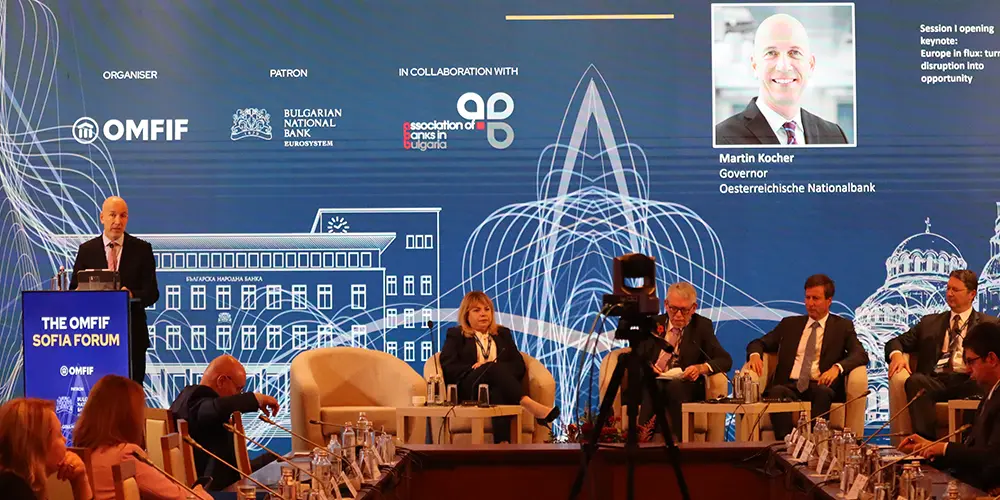
This article is an edited version of a keynote speech delivered by Governor Kocher at the OMFIF Sofia forum. Read the full transcript here.

Interested in this topic? Subscribe to OMFIF’s newsletter for more.