
In 2007, Indermit Gill and Homi Kharas of the World Bank gained fame for coining the term ‘middle-income trap’, whereby well-performing emerging-market economies faced obstacles in moving to higher-income country status. Advanced economies are now facing a high-income trap, unable to achieve greater prosperity.
Productivity growth is key for long-term growth and real-income gains. Yet, the declining long-term downward trend in overall and total factor productivity is well established (Figure 1).
Figure 1. Downward trend in long-term productivity
Average annual productivity and TFP growth in advanced economies (1960–present)
| Decade | Labour productivity growth (average annual %) | TFP growth (average annual %) | |
| 1960s | ~4.5-5.0 | ~3.0-3.5 | |
| 1970s | ~2.5-3.0 | ~1.2-1.5 | |
| 1980s | ~2.0 | ~0.8-1.0 | |
| 1990s | ~2.2 | ~1.1 | |
| 2000s | ~1.5 | ~0.6 | |
| 2010s | ~1.0 | ~0.4 | |
| 2020s (so far) | ~1.2-1.5 | ~0.5-0.7 | . |
Source: International Monetary Fund World Economic Outlook data
A range of factors are at play. Among them, human capital development is weakening, according to Organisation for Economic Co-operation and Development PISA studies. Non-OECD members such as China, Taiwan, Singapore and Hong Kong appear to be the highest performers. Advanced economy OECD countries lag.
Many tout the coming of artificial intelligence as the great elixir, allowing society to grow its way out of various ills. Such views seem optimistic. AI should indeed boost productivity, but it isn’t showing up in productivity data yet. Major technological innovations generally take years to diffuse into daily economic life. AI may also shake up labour markets – there is a reason Luddites destroyed machinery. (Of course, if AI manages to kill humanity in a decade, we need not worry about productivity trends.)
Advanced-economy population growth has also slowed. Baby booms have turned into baby busts. One way to sustain population growth would be through higher immigration. However, advanced economies have turned sharply away.
The fiscal Grim Reaper cometh
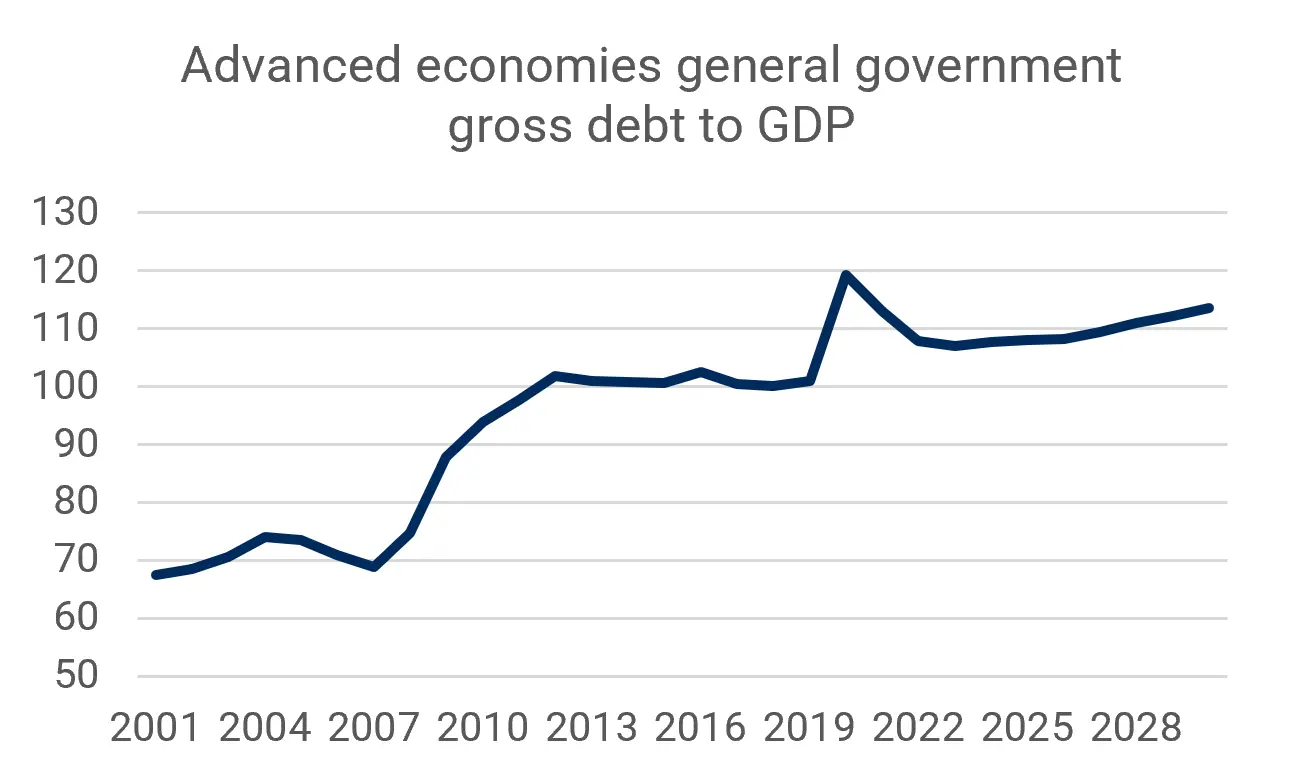
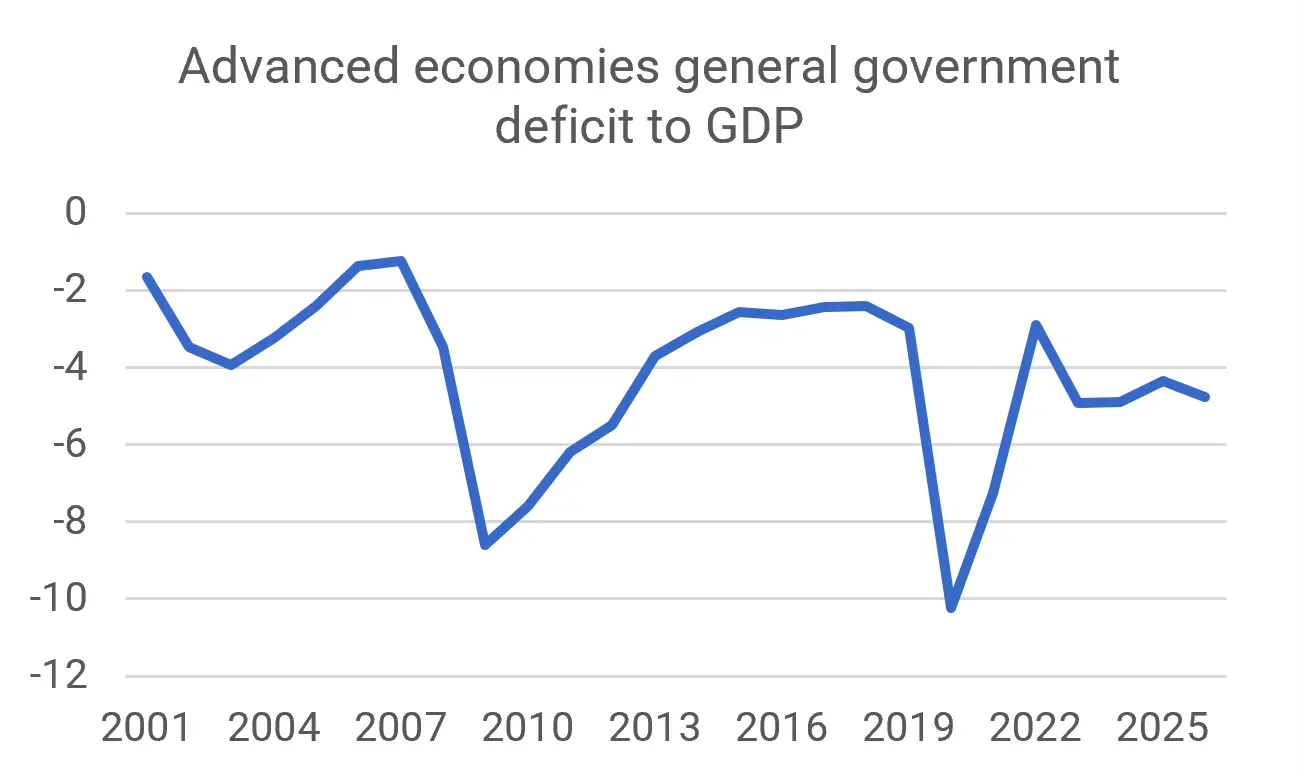
Fiscal debt and deficits are rising sharply, often leading to crowding out or impeding dynamism (Figure 2).
Figure 2. Debt and deficits are rising in advanced economies
Source: IMF data portal
Prospects for revenue gains are limited by anaemic growth. Many European societies face constraints in raising revenue and GDP due to high taxation. Political animus towards higher taxes is widespread, even in lower taxed jurisdictions such as the US, which mindlessly carries on as if it can eternally defy fiscal gravity.
Demands for more spending on social protections, including entitlements for the ageing and defence, are rising. Older populations are politically powerful, resistant to entitlement cuts, notwithstanding the ensuing unfair inter-generational inequities.
So are interest bills, especially as low interest rates associated with the post-2008 financial crisis and pandemic era are seemingly coming to an end. In the US alone, the interest bill now exceeds 3% of GDP, more than is spent on defence.
Rising income inequality in some countries adds to strains. It is associated with increased social conflicts and diminished opportunities for the lower quintiles. World Bank Gini coefficient data point to rising US income inequality, but also major advanced EU economies. This reality is reflected in debates about affordability, the ‘K-shaped’ economy and ‘kakistocracy’ – a government run by the worst and least qualified people.
Government debt managers face tougher times given the magnitudes of paper markets need to digest. That will invariably underpin higher long-term interest rates, which are key for investment. Trying to reduce weighted average maturities and twist the yield curve through buybacks are unlikely to offer much solace.
The upshot is that advanced economies are feeling squeezed and unable to deliver increased benefits at the very time fiscal space is ever more sharply constrained. There is less pie to distribute even though society wants to have its cake and eat it too.
Geopolitics and the demise of Pax Americana
As the productivity data show, the post-second world war 20th century was a golden period. That reflected the Pax Americana: strong American growth, the multilateral economic framework created under the Bretton Woods System and a security umbrella afforded by the US and Nato. It facilitated the rebuilding of Europe and Japan. In the 1990s following the Soviet Union’s dissolution and cold war’s end, advanced economies performed well: debt levels were slashed during the Bill Clinton presidency, inflation was held in check by the Great Moderation and information technology and computers boosted productivity.
A quarter of a century later, those gains have fallen to the side. China’s rise at first provided a favourable global economic supply shock. But as China prospered and advanced along the technological frontier, it became a rival and challenger to advanced economies. That helped spawn de-globalisation, a move to technological blocs, tariffs, supply chain disruptions and fragmentation. The International Monetary Fund estimated that, if the world devolved into blocs, global GDP could be 7% lower than otherwise.
Needless to say, the current Middle East war and Russia’s ongoing brutal invasion of Ukraine add to woes. So will the Donald Trump administration’s retreat from multilateralism.
On balance, with slowing productivity growth, limited fiscal space and real-income gains, and geopolitical strife, advanced-economy policy-makers are highly constrained in meeting rising societal demands. That spawns polarisation, protectionism and nationalism, as seen in the rise of the Alternative for Germany party, National Rally in France, the Reform Party in the UK and Trump. It is likely to portend more turnover and more weakness in leadership – five UK prime ministers in the last five years, some of Emmanuel Macron’s key reforms unwound, German chancellors considered weak and Trump’s deep unpopularity.
Advanced economies are transitioning into a high-income trap. But the solutions are politically challenging.
Mark Sobel is Vice Chair and Chief Economist of OMFIF. Thanks to Marco Annunziata for helpful comments.

Interested in this topic? Subscribe to OMFIF’s newsletter for more.