

Gold has been gaining relevance over the past couple of years, with 2026 set to continue the trend. OMFIF’s Global Public Investor 2026 survey, drawing on responses from over 70 central banks, confirms that gold is no longer a peripheral asset sitting at the bottom of the reserve stack, but is now seen as central to how reserve managers think about protection, diversification and the future shape of the international monetary system.
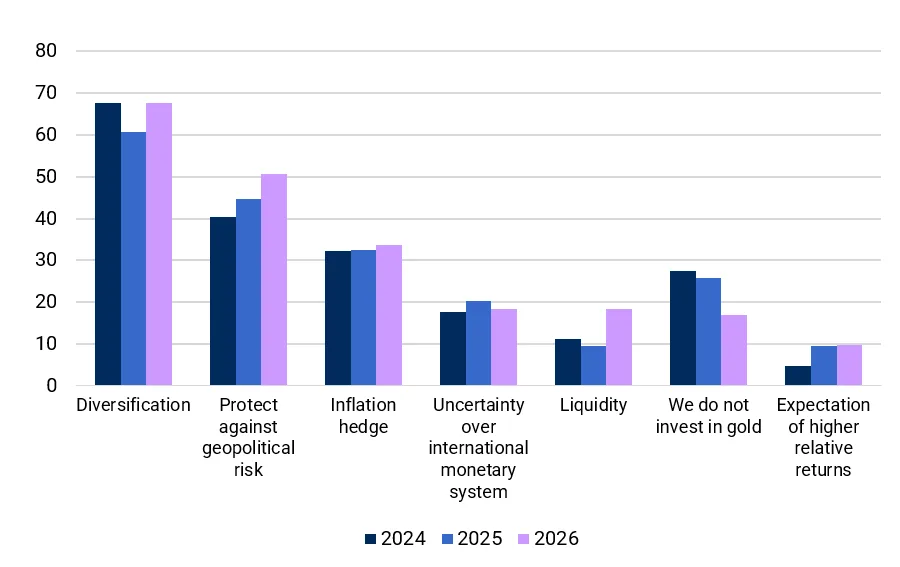
According to GPI, 82% of central banks surveyed now hold physical gold, up from 71% a year earlier. A net 30% plan to add to their holdings over the next one to two years, and gold leads short-term buying intentions among all reserve assets. Perhaps more revealing is the reasoning behind the buying: 51% of respondents cite protection against geopolitical risk as a motivation, up 11 percentage points from 2024 (Figure 1).
Figure 1. Why are central banks investing in gold?
Why do you invest in gold? Share of respondents, %
Source: OMFIF Global Public Investor surveys 2024-26
Reserve managers have spent the past few years navigating a world in which the old certainties about safe assets no longer hold so firmly. Amid sanctions, trade disruptions and threats of war, the current state of the monetary system has altered how reserve managers assess counterparty risk for sovereign holdings.
Gold, as pointed out by one of the GPI survey respondents, ‘serves as a critical sovereign risk-free reserve asset’. Unlike a foreign currency deposit or a government bond, it carries no counterparty risk. Nobody can freeze it, sanction it or default on it. In a fragmenting, multipolar financial system, that quality has become more valuable.
The GPI 2026 data also show, for the first time, a marginal net intention among central banks to reduce dollar holdings over the coming decade, even as the dollar retains its dominant 58% share of global reserves. This speaks to the desire for long-term diversification, with gold as a natural part of the story, as 68% of survey respondents cite diversification as the main factor to invest in gold. Gold is the one major reserve asset that carries no national flag. For central banks looking to diversify but also ‘protect against black swan events’, as mentioned by a survey respondent, neutrality is a major point.
Is everything as bright as it looks?
A new International Monetary Fund Note on gold in central bank reserves offers a cautious look into gold as a reserve asset. The IMF authors note that much of gold’s re-emergence in reserve portfolios reflects valuation gains from higher prices rather than large-scale accumulation. A rising gold price mechanically inflates gold’s share of the reserve pie even if a central bank has not bought a single additional ounce.
The IMF’s broader argument is that gold should be treated as a high-risk reserve asset, not a safe one in the conventional sense. It agrees that gold carries no credit risk. Still, it is highly volatile, offers only conditional diversification benefits and is poorly suited to the liquidity tranche of reserves that a central bank might need to draw on quickly in a crisis.
Read together, the GPI and IMF findings do not contradict each other; rather, they describe two sides of the same asset. Gold is being bought for strategic reasons that make sense in a geopolitically fractured world, and reserve managers are right to want a sovereign risk-free asset. However, central banks need to be cautious when treating their gold allocation as a like-for-like substitute for high-quality liquid assets.
Understanding the role of gold better
Gold’s strategic appeal and its practical limitations as a reserve asset are exactly the terrain OMFIF’s forthcoming Gold and Precious Metals Working Group has been convened to explore. The series will bring reserve managers together with market practitioners across four meetings, each pressing on a question raised by the GPI data.
The working group builds on OMFIF’s 2024 Gold and the new world disorder report, published in partnership with Commodity Discovery Fund and Gold Republic. The report presented a historical summary of gold and how its role has changed within central banks, reshaping reserve holdings and playing a larger role in emerging markets. It also explored alternatives to gold-backed digital currencies and anticipated the upcoming shift in the monetary system, highlighting gold’s renewed role in a more fragmented environment. Commodity Discovery Fund and Gold Republic will return as partners in the working group, joined by GBI and Goldman Sachs.
During August, the working group will ask reserve managers how they currently use their gold and what, if anything, a formal high-quality liquid asset designation would change in practice. It will also explore the desire for diversification, asking how deliberate the shift towards gold really is, either looking for sanctions-proofing, geopolitical hedging or a broader diversification instinct that varies by region.
The following meetings will move from geopolitics to market structure. The working group will delve into tokenised gold, as well as infrastructure and implementation challenges. On the retail side, the group will discuss soaring demand for physical gold driven by bars, coins and exchange-traded funds, and the difference between retail demand and institutional flows, asking central banks what it means for regulation and market depth as retail participation broadens.
Taken together, the four sessions aim to clarify gold’s usefulness as a strategic, sovereign risk-free asset and to address the practical questions of collateral treatment, liquidity, market infrastructure, and financial stability. A report with the findings will be published in November 2026.
Andrea Correa is Head of Research at OMFIF.

Interested in this topic? Subscribe to OMFIF’s newsletter for more.