

The publication this week of the International Monetary Fund’s 2026 External Sector Report and an essay in The Economist by Gita Gopinath, Pierre-Olivier Gourinchas and Hélène Rey are cause for taking stock of the IMF’s external sector and exchange rate work.
The IMF was created against the background of the beggar-thy-neighbour exchange rate policies of the 1930s. At the heart of its mandate is members’ avoidance of the pursuit of harmful exchange rate policies and currency manipulation and the bilateralisation of exchange rate disputes.
After the IMF failed to do its job in the early 2000s, instead hiding behind constant rewrites of its surveillance and exchange rate principles without actually bearing down on the mandate’s core, the US pushed for the Fund to produce the ESR. The IMF eventually agreed, though not without struggle.
The 2026 report
Over the years, the report’s quality has improved. But it still has far to go.
This year’s ESR is appropriately framed around the return of global imbalances, correctly observing that they are largely a function of US and Chinese domestic policies.
China’s growth model relies on heavy investment and state-led support for industrial policies amid weak domestic demand, creating excess production and a reliance on net exports to meet growth targets – an undervalued currency is part of the growth model. America’s huge and misguided fiscal deficits add to its savings and investment gap, swelling its current account deficit and, alongside the attraction of US financial markets, impacting dollar overvaluation. Other countries, especially in Asia, matter as does the euro area, but the US and China dominate the landscape.
Figure 1. US and China dominate global imbalances
Global current account surpluses and deficits, % of world GDP
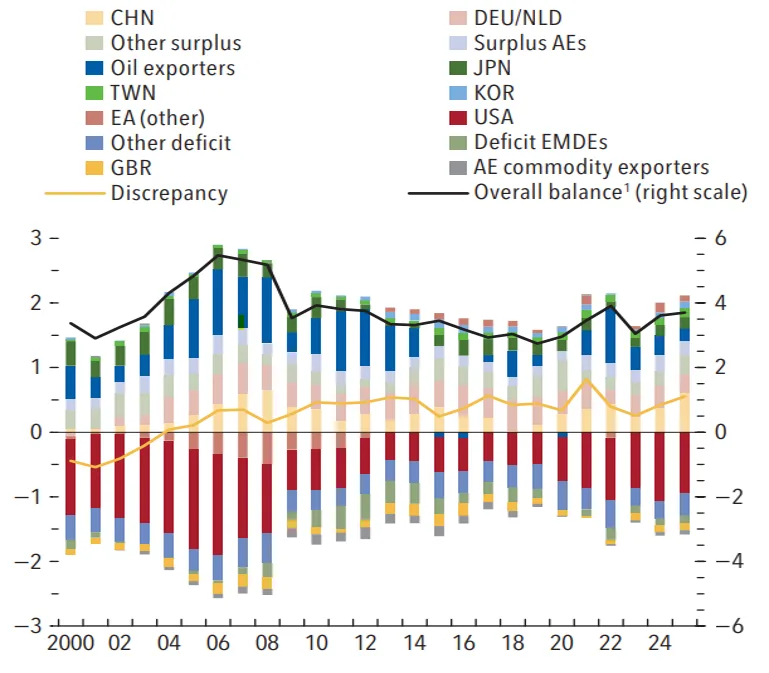
Source: IMF 2026 External Sector Report
This year’s ESR highlights that renminbi undervaluation and dollar overvaluation are both in the order of a staggering 20% (Figure 2). But it shies away from a full-throated discussion of these startling figures.
Figure 2. Renminbi undervaluation and dollar overvaluation in region of 20%
| 2025 | 2026 | |
| China | ||
| Current account/GDP | 2.0 | 3.6 |
| Current account norm | 0.8 | 0.6 |
| Current account gap | 1.2 | 3.0 |
| Renminbi undervaluation | -8.5 | -21.3 |
| US | ||
| Current account/GDP | -3.6 | -3.5 |
| Current account norm | -2.2 | -1.3 |
| Current account gap | -1.4 | -2.2 |
| Dollar overvaluation | -11.9 | +19.9 |
Source: IMF 2025-26 External Sector Reports
Note: CA/GDP is cyclically adjusted. The 2025 report is based on 2024 data; 2026 report on 2025 data. Currency valuation estimates are derived from applying an elasticity estimate to a country’s current account gap.
A few ESR weaknesses merit flagging. First, the ESR could benefit from a detailed discussion of currency market developments. Second, taking its cue from the US Article IV, it pulls its punches in castigating America for its reckless fiscal policies.
Third, the ESR’s underlying model continues to flail on the impact of countries’ net foreign asset positions in deriving current account norms and thus estimating over- and undervaluation. A large country running persistent current account surpluses should see its NFA position continuously rise; the progressively larger NFA in turn lifts the country’s norm, minimising its currency valuation’s out-of-lineness. IMF staff have long recognised this problem, and while this year’s ESR highlights the intention to tackle it, it has not yet done so. Recognising the problem this year would have further added to undervaluation estimates, upsetting some surplus countries.
Fourth, it is widely recognised that China’s current account surplus may be largely understated. Customs data signal a much greater surplus than the balance-of-payments data used by the IMF and the truth may well lie between. China runs an income deficit despite having a substantial NFA creditor position. Both of these points are acknowledged by the IMF. Even if central bank reserves are largely flat, China appears to have used state-owned commercial banks to intervene and slow renminbi appreciation towards the end of last year and this year, though China also resisted depreciation beforehand.
This year’s ESR is an improved product, but the Fund has further to go in strengthening the value of this flagship product.
The Economist essay from Gopinath, Gourinchas and Rey
It is worth reading the 2026 ESR in conjunction with the essay by Gopinath, Gourinchas and Rey, all three of whom are world-leading macroeconomic thought leaders and intellectuals. The essay makes many valid observations, including: it takes two (or more) to tango when it comes to global imbalances; the imbalances are mainly a reflection of domestic policies; US fiscal policy is reckless; China’s growth model is flawed and the key thing to do is to fix that model, which would also boost the renminbi.
But in suggesting the emphasis on renminbi undervaluation is a ‘knee jerk reaction’ or a ‘gimmick’, the essay creates a straw man. It caricatures those who would agree with their valid observations, but still believe exchange rates matter for global imbalances, though not as significant as getting houses in order. A stronger renminbi would also boost domestic demand and disincentivise exports.
Even if those imbalances are best tackled by addressing domestic economic weaknesses, that does not mean under- or overvaluation estimates don’t convey critical information in and of themselves. It cannot be stressed highly enough that the renminbi is a highly managed currency. Nor are those paying attention to exchange rate valuation metrics alongside domestic economic policy flaws necessarily calling for exchange rate ‘coordination’ – a topic that is overly romanticised based on exaggerated if not mistaken analysis and nostalgia for the 1985 Plaza Accord.
The IMF has a long history of rightly carrying out detailed analyses of fiscal and monetary policy. But somehow it has also historically muffled its voice on exchange rates, as was highlighted in 2005 when the Fund was called ‘asleep at the wheel’. Despite the improvements made in recent years, the ESR – as mirrored in The Economist essay – still needs to take exchange rates more seriously and be prepared to voice tough exchange rate judgments.
Exchange rates are not the be-all and end-all, but they do matter.
Mark Sobel is Vice Chair and Chief Economist of OMFIF.
Join OMFIF on 21 September for a conversation with Austan Goolsbee, president of the Federal Reserve Bank of Chicago, on monetary policy in an uncertain world.

Interested in this topic? Subscribe to OMFIF’s newsletter for more.