
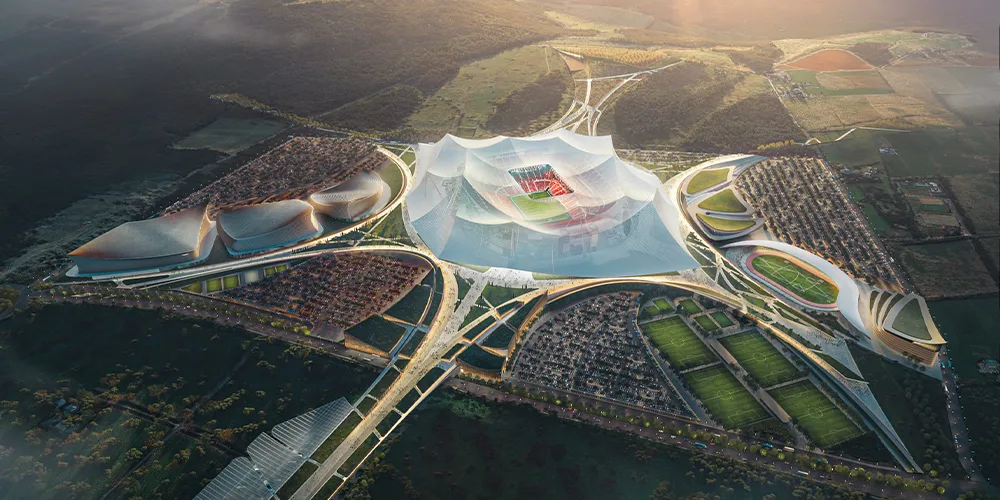
At a time when global attention has been fixed on football, African governments are looking beyond on-pitch performance to the economic value that sport might generate off the field. Stadiums, hosting bids, federation funding and sports infrastructure are increasingly being framed not only as cultural assets, but as tools for tourism, job creation, urban regeneration and soft power.
One nation ahead of the curve is Morocco. With the country co-hosting the 2030 FIFA World Cup, alongside Portugal and Spain, there have been sizeable investments into sports infrastructure. Through a partnership between the prime minister’s office and the Deposit and Management Fund, the Moroccan government is said to have invested large-scale funds into upgrading six stadiums in preparation for last year’s African Cup of Nations. According to Ryad Mezzour, minister of industry and trade, the economic impact on the economy exceeded €1bn, with most of the uplift generated from tourism.
Morocco sets the pace
Morocco’s experience can offer lessons for other African economies. Nigeria is one market where the case for sport infrastructure investment is particularly strong. With 70% of its population under the age of 30, the country has a large potential base of athletes, consumers and spectators. The federal government of Nigeria has set a target for sport to contribute 5% of gross domestic product by 2050, up from roughly 1.2% today, with the sector expected to support both direct and indirect job creation.
To support this ambition, the Nigerian government passed the 2026 Appropriation Act, which included over $150m for the development of the sports industry. In terms of stadium infrastructure, ₦18.8bn ($13m) was earmarked for rehabilitation of the 60,491-capacity seat Moshood Abiola National Stadium in the capital city of Abuja. The stadium initially cost over $300m in 2003.
Returns are still hard to measure
Despite the scale of the capital deployed, real economic returns are hard to measure. In the short term, construction and rehabilitation activity of sports infrastructure should generate on-the-ground employment, which will cut across the local supply value chain. Recent data from Shehu Dikko, chairman of the National Sports Commission, put the 2025 jobs created by the sports industry at 140,000. This points to the sector’s potential but also shows how far it has to go if it is to become a serious driver of broad-based employment.
For Morocco, it is too early to see what returns the investment in the African Cup of Nations will have on long term employment. But with the country set to co-host the FIFA World Cup in 2030, there is likely to be continued investment in transportation, tourism, hospitality and football-related infrastructure, which should see an uptick in labour for the Moroccan people. Nevertheless, the Moroccan government is still under pressure to show that sports-related investment delivers real economic returns for citizens. The 2025 protests led by younger Moroccans, who called for greater investment in healthcare and education, show why the opportunity cost of stadium spending matters.
This is where the question becomes less about sport and more about public investment discipline. Stadiums can be economic assets only if they sit within a wider economic strategy. For African economies with large infrastructure gaps, public money spent on stadiums are judged against competing demands in transport, energy, healthcare and education. Sport should not be dismissed as a development sector, but governments need clearer tests for whether stadium projects can deliver lasting returns, through regular commercial use, tourism, urban regeneration and benefits that extend beyond the tournament itself.
Financing sport infrastructure
The financing model is just as important as the construction itself. Public funding may be necessary for major national venues, but governments should avoid taking on costs that could be shared with private investors or development partners. To make that possible, projects need credible revenue plans, open procurement processes and governance standards that investors can trust.
Recent developments in African financial markets show that more sophisticated infrastructure financing is possible. OMFIF’s 2025 Absa Africa Financial Markets Index notes that Tanzania issued its first sovereign sukuk to fund infrastructure and social development projects, while its Samia infrastructure bond was heavily oversubscribed. Kenya has also approved an asset-backed security to help finance Talanta Sports Stadium, an early example of structured finance being applied directly to sports infrastructure.
These examples shift the debate from whether governments should fund sport to how sports infrastructure should be financed and governed. Direct public spending may still be necessary, especially for national facilities and major event preparation. But public capital should be used to attract wider investment where possible and not substitute it.
Linking stadiums to the wider economy
For both the Moroccan and Nigerian economies, the question now is how local and foreign investors can be incentivised to participate in these investments. One way is to have sports institutions go through a modernisation process. Another is for governance and transparency to take centre-stage across all sports-related economies. Investors want an environment that creates certainty, which creates a pathway to measurable returns.
Without a closer link between the investment in infrastructure and the local commercial sporting ecosystem, African nations may see that the impact of government spending will continue to remain limited. But with better project selection, clearer financing models and stronger governance, sport can become more than a source of national pride and a serious part of Africa’s infrastructure and investment story.
Yara Aziz is Senior Economist at OMFIF and Ibrahim Musa is Managing Director of Berlin Growth Advisory.

Image Credits: Picture copyright Populous
Interested in this topic? Subscribe to OMFIF’s newsletter for more.