
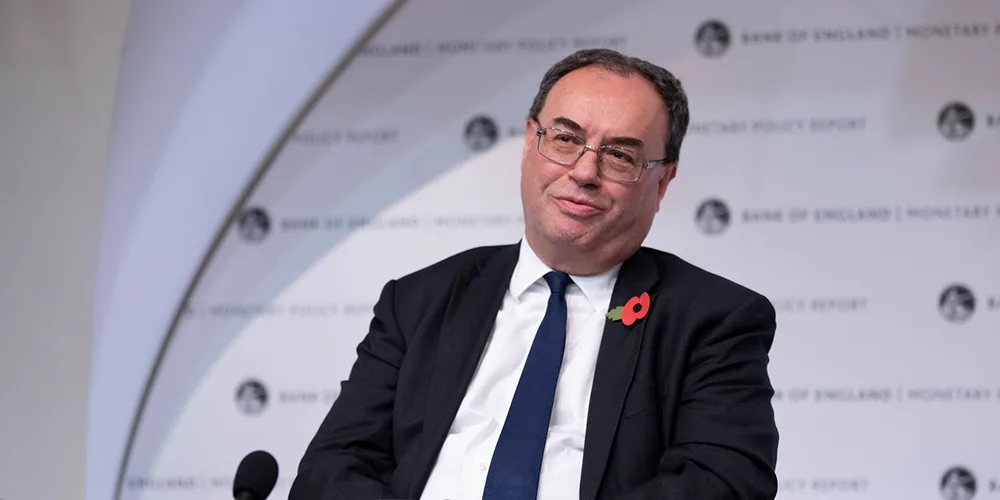
In a speech in April 2026, Bank of England Governor Andrew Bailey addressed Columbia University and offered his renewed thoughts on central bank independence. He shifted the narrative away from a narrow inflation-control story and towards a broader defence of money itself. But the argument can be taken one step further.
For much of the last three decades, central bank independence has been defended in familiar terms: governments face incentives to stimulate excessively, to inflate away burdens or to sacrifice long-term stability for short-term gain. Independent central banks solve that problem by providing a commitment device for price stability.
While that logic remains valid, Bailey has argued it is no longer sufficient. The more difficult issue is financial stability, where objectives are harder to define, harder to measure and far more entangled with private interests and wider public policy. That is why, in his view, the case for independence in financial stability is less robust than in monetary policy.
Value of money
Bailey’s most important contribution is his effort to reunify these two domains under a single idea: the value of money. In monetary policy, this means preserving money’s real purchasing power, while in financial stability, it means preserving its assured nominal value through confidence in bank deposits, convertibility into central bank money and the smooth functioning of the payments system. Beyond being an elegant reframing, this is an attempt to show that financial stability is not tangential to the central bank’s mission, nor a distraction from price stability, but part of the same monetary task.
This move, however, can be made even more compelling if we ask a prior question: what is the central bank money whose value is being defended? Here, the ‘accounting view of money’ becomes highly relevant. State-issued fiat money – including central bank money – is not debt in the ordinary sense. It does not represent a claim on some underlying asset that the issuer is obliged to redeem, as a conventional liability would. Rather, it is a singular monetary instrument: net wealth for its holder and net worth, or equity, for its issuer. Under the accounting view, money is not borrowed value, it is publicly constituted monetary value.
This matters because it strengthens Bailey’s framework at precisely the point where central bank independence is most conceptually vulnerable. If central bank money is treated as just another liability on the central bank’s balance sheet, the institution can too easily be seen as a technocratic agency that issues debt instruments, steers interest rates and intervenes from time to time to contain instability.
Defending the integrity of money
Price stability appears as the central bank’s only fully coherent mandate, while financial stability measures look secondary, discretionary or even quasi-political. Actions to preserve deposit convertibility, settlement finality or the singleness of money can then be cast as exceptions to the central bank’s ‘real’ task rather than as part of the same monetary responsibility. The liability view therefore blurs the very unity Bailey is trying to recover. It hides the fact that both monetary policy and financial stability ultimately serve a common end: protecting the integrity of money itself.
But if central bank money is understood as issuer of equity capital, the picture changes fundamentally. The central bank is no longer merely managing liabilities. It is safeguarding the integrity of the monetary base that anchors the entire hierarchy of money in the economy. In that sense, central bank money is not just a balance-sheet item to be administered, but the foundational public monetary asset on which convertibility, settlement and par exchange depend. The central bank’s role is therefore not simply to target inflation at the top and supervise finance at the margins. It is to preserve the quality, singleness and reliability of money. Financial stability is not an auxiliary mission; it is an integral part of defending money’s institutional and capital integrity.
This also sharpens the rationale for central bank independence. Independence is stronger when it rests on a clear public-good function, which is not to favour banks, markets or particular classes of creditors, but to protect the unit in which contracts are written, savings are held and payments are settled. The more clearly central bank money is understood as a foundational public monetary asset rather than an ordinary liability, the easier it becomes to explain why the central bank must sometimes act beyond the narrow confines of rate-setting while remaining within a single coherent mandate.
Seen this way, Bailey’s argument is not just that financial stability should be ‘added’ to central bank independence. It is that central bank independence should be re-grounded in a deeper conception of money. Price stability preserves the real value of monetary capital. Financial stability preserves its nominal integrity across the banking and payments system. Both are dimensions of the same mission. This strengthens Bailey’s case for central bank independence. It suggests that independence should rest not only on financial stability, but on the central bank’s deeper role in preserving money itself. Price stability protects the real value of money, while financial stability protects its nominal integrity. Rather than separate goals, they are complementary parts of the same public function.
The digital money debate
On the discussion surrounding digital money and stablecoins, Bailey is right to insist that if stablecoins are to operate at scale in payments, they must meet the ‘test of money’. But that test should be formulated consistently. Stablecoins are often judged against an impossible benchmark: perfect convertibility at all times without institutional support. Yet commercial bank deposits themselves do not meet such a benchmark. Their par value is not spontaneous. It is produced by regulation, central bank liquidity, deposit insurance and settlement infrastructure.
That insight reinforces Bailey’s position. If the central bank’s responsibility is to defend the value of money, then the relevant question is not whether new private forms of money are naturally perfect but whether they can be admitted into the monetary system without compromising its singleness, its convertibility and its settlement integrity. Once central bank money is understood as the equity anchor of that system, the policy standard becomes clearer: private monetary instruments can innovate at the margins, but they cannot be allowed to weaken the integrity of the public monetary capital at the core.
This is why the accounting treatment of central bank money is not a technical side issue. It affects the way central bank purpose is understood. It affects how we think about seigniorage, about the monetary hierarchy and about the legitimacy of interventions aimed at preserving convertibility and trust. Most importantly, it affects the intellectual foundation of independence itself.
Central banks as custodians
If central banks remain publicly described as institutions that issue liabilities and then occasionally rescue the system that uses them, their broader role will always seem contingent and contestable. If instead they are understood as custodians of the monetary capital on which the entire payments and banking order rests, then independence has a much firmer conceptual basis.
Bailey has opened the right door. He has argued that central bank independence must be rethought around the value of money. The next step is to make explicit that this value is rooted in the special nature of central bank money itself. Once that is recognised, price stability, financial stability and the governance of digital money no longer appear as distinct or competing terrains. They become different expressions of one institutional responsibility: preserving the integrity of money as a public monetary standard.
Biagio Bossone is an adviser to international financial institutions and national central banks.

Interested in this topic? Subscribe to OMFIF’s newsletter for more.