
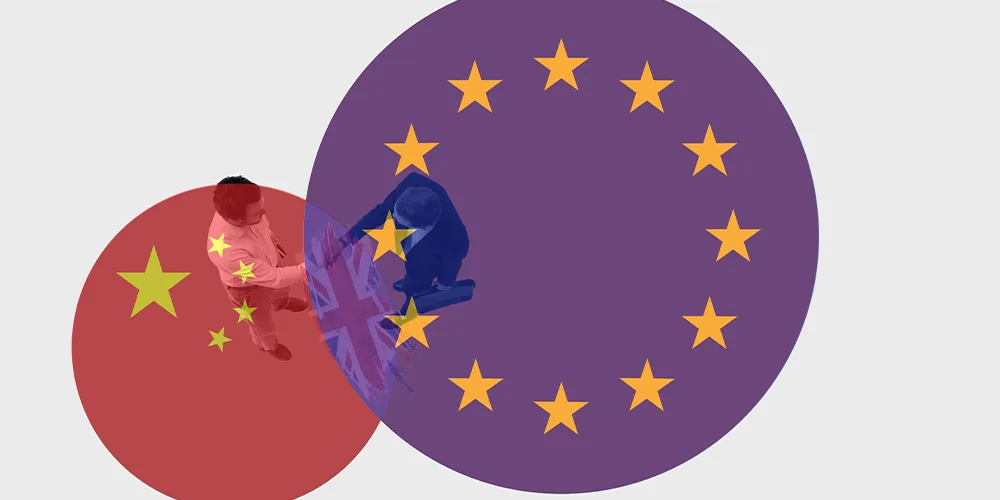
The war in Iran and further signs of waywardness and unpredictability by the US administration are heightening motivations for increased economic and technological co-operation between Europe and China. The UK has its own reasons for enhancing a rapprochement with the European Union that it left in 2020. So, Britain is in a good position to take a lead in promoting a new spirit of European-Chinese partnership.
Europe faces an uphill struggle. Improving co-operation with China, in view of the country’s economic size and antagonism with America in key areas, not least in defence and security, brings risks and challenges, but it can help alleviate the burden.
Problems facing Europe
The US benefits from its geopolitical status, strategic reach, oil and gas independence and deep financial markets. Since Russia’s full-scale invasion of Ukraine in 2022, Europe’s vulnerability to American might in the four vital spheres of political economy – energy, defence, industry and money – has risen dramatically.
China’s strength, too, has become Europe’s weakness. The Old Continent’s relative competitive position has deteriorated over two decades, in line with greater Chinese self-assertiveness. The shift has accelerated further as a result of the Ukrainian conflict, Trump’s tariffs and the economic slowdown in China, which is making Chinese companies more active in turning to foreign markets to boost profitability and compensate for domestic economic difficulties. For both positive and negative reasons, enhancing mutual understanding between Europe and China represents, for the Europeans, a potential lifeline.
There is a further complicating factor. The invasion of Ukraine and its aftermath strengthened a Russia–China partnership that – despite Beijing’s caution about US sanctions-induced disturbances to its international economic and financial position – could grow into a formal alliance, much to the West’s discomfort and detriment. And it increased further the oft-stated, long-ignored need for the Europeans to care and pay far more for their own security.
All these factors have been further intensified by the Iran war. But they have also increased the incentives for Europe, at last, to take countervailing action. And the panoply of measures now under consideration could include a reassessment and recalibration of ties with China. China and the US look set to extend their importance as repositories of economic and political power. Both countries, at vastly different stages of political and social maturity, face immense domestic trials – but they also have greater potential than a fractured Europe to emerge stronger from their manifold challenges.
Geopolitical shock waves
The geopolitical disturbances of the 2020s have taken place at a dire time for the Old Continent, struggling with faltering economies, strained budgets, Atlantic alliance disruption, socially divisive immigration pressures and the weakest political leadership since the 1930s. Europe’s tasks are daunting: deglobalisation, demographics, decarbonisation, digitalisation, defence and, ominously, debt, epitomised by the rising cost of Europe’s welfare systems and the huge public borrowing necessary to finance them. All of these problems (including the question marks over leadership, notwithstanding – or perhaps partly reflecting – China’s one-party system) are shared to a greater or lesser extent with China.
The shock waves permeating the world economy from the Middle East will have a dampening effect on growth and will heighten inflation fears in both Europe and China. In view of its energy independence, the US is receiving a short-term boost in relation to other parts of the world. But the fresh damage to America’s long-term standing as a partner and ally – adding to the depredations already witnessed in the first year of President Donald Trump’s second administration – has been immense.
Some of this damage can still be repaired, particularly if worries about the Republicans’ performance in the midterm elections in November lead to some steadying of the Trump administration’s zig-zagging policies, One big worry for the West is that the renewed focus of American interest on the Middle East may encourage the Beijing leadership to advance aggressive solutions for achieving the long-term aim of reunification with Taiwan.
Opportunities for growth and investment
In existential questions of war and peace, whatever the short-term headaches of dealing with the mercurial Trump, the West and Britain will have no choice but to side with America. However, short of doomsday scenarios, there are a number of areas where co-operation can be improved for the good of all sides. Many of these are in fields of money and technology to which OMFIF pays particular attention, including supporting the digital infrastructure for growth and investment between and within Europe and Asia.
Supporting China in its ambitious plans in building renminbi market infrastructure could be a special priority for the City of London. The general expectation is that China will accelerate promotion of two-way capital exchanges. China is speeding up introduction of a retail-level central bank digital currency, being made available to banks generally across the country. This is an area where co-operation with UK and European payments companies as well as the Bank of England and European Central Bank can be propitious.
The People’s Bank of China is setting up a funding mechanism to facilitate reserve managers’ access to the Chinese market. This is another area ripe for the UK in particular to show a clear lead.
Facing up to home truths
Europe does not need systematically to side with the Americans in all fields of Chinese interaction. But adopting risk-mitigation policies would be facilitated if Europe can somehow strengthen its position vis-à-vis the US. Balancing the twin exigencies of co-operation with and competition against China requires a huge effort of analysis and resolve.
Europe together with the UK has to face up to some home truths over China. It is best if they do that together. China is already taking a leading position in artificial intelligence and related areas. In many technology fields, in terms of price and quality, China has moved comprehensively and probably irreversibly ahead. China has shown itself well prepared for the Trump tariff conflict – and has the financial and commercial resources to ride out future squalls.
In the system of regionalised trading blocs likely to open up in coming years, European countries will need to strengthen their trade relations and cross-border investments with Asia. The Association of Southeast Asian Nations plus three – China, Japan and Korea – will be building a ‘managed free trade zone’, with the possible participation of Australia and New Zealand (as well as, at the fringes, India). Europe, including the UK, can seek to co-operate with all these countries to help craft production, service and supply lines to make the best of the fragmented global trading regimes that seems likely to represent one of Trump’s many unsettling legacies.
Under agreements that will need to pay due regard to defence and security imperatives, working with China on common trade and investment projects – especially in the energy, technology, transport and environmental fields – can be propitious for the UK and other European countries. Co-operation over China could mitigate competitive problems, bring mutual advantage in the fields of finance and technology and help offset political complications with Trump’s Washington.
There is a great deal at stake. Britain, with the rest of Europe, has a lot to play for. The potential rewards, and the perils if calculations go awry, are of equal significance.
David Marsh is Chairman of OMFIF.
OMFIF is hosting its fourth China-UK investor forum in London on 24 March. The event brings together perspectives from both the public and private sectors. It features senior representatives from sovereign funds, public pension funds, asset managers, wealth managers, technology developers, banks, insurance companies and private investors. With this diverse assembly, the forum aims to foster meaningful discussions to encourage innovation, collaboration and investment.

Interested in this topic? Subscribe to OMFIF’s newsletter for more.