
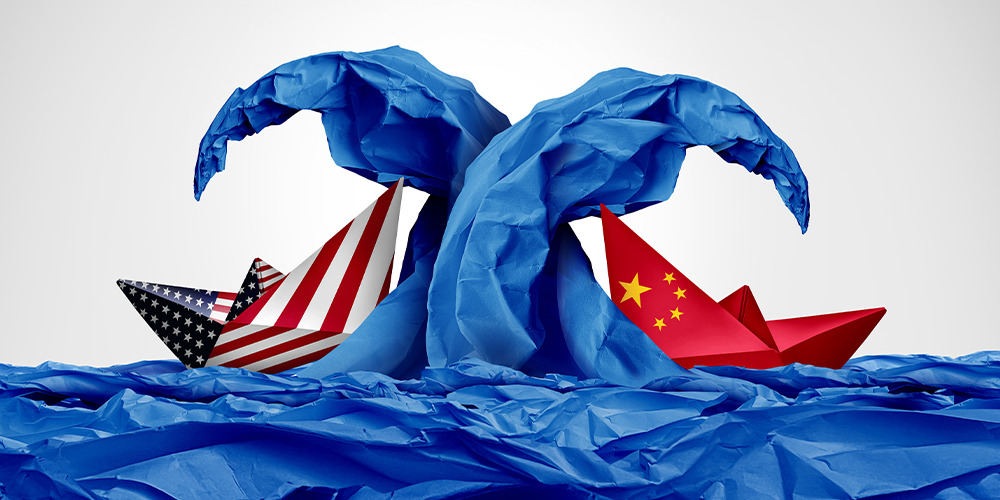
Trade is like water running down a mountain stream. Rocks and branches may redirect flows, but the snowmelt eventually reaches the sea. Tariffs and export controls may reroute the path of global goods and services, but they rarely stop a seller from finding a buyer altogether.
Notably, given the headlines from Washington, global trade grew about 7% last year, setting a new record, according to UN Trade and Development. Manufactured goods led the way, with electronics flows especially strong. Geographically, trade in East Asia and Africa rose rapidly. While China’s exports to the US fell by 29% last November from the previous year, overall exports still grew 5.9%. In just the first 11 months of 2025, China posted a record trade surplus of $1tn.
But before exploring this year’s central challenge, it’s worth recalling just how hard US President Donald Trump worked to reshape world trade last year.
Reshaping world trade in 2025
First came new tariffs on Mexico, Canada and China. Then there were more tariffs on China. Then came ‘Liberation Day’, followed by a climbdown, a UK trade framework and a reduction in Chinese tariffs. Spring brought 50% tariffs on the European Union, quickly followed by another climbdown. By summer, new tariffs were imposed on Canada, Mexico and copper, followed by deals with Indonesia, Vietnam, Japan and Europe. Winter approached with steep new tariffs on goods ranging from pharmaceuticals to furniture, soon followed by a broad set of exemptions and a deal with Switzerland.
By New Year’s Eve, America’s effective tariffs based on all these announcements had risen from historical lows near 2% to above 14%, higher than at any time since the Great Depression. And yet the US economy still managed to clock growth of a whopping 5.4% as 2026 dawned, if you believe the Federal Reserve Bank of Atlanta’s GDPNow estimates, and the stock market reached record highs.
Expert predictions of recession and financial disaster were wrong in part because companies stockpiled supplies in anticipation of tariffs and in part because of the president’s rapid climbdowns and generous carve-outs. Also, because the US is such a large economy, imported goods only represent about 14% of gross domestic product.
What was especially striking last year was that even as the US walled itself off, some 72% of the world’s trade was still conducted under World Trade Organization rules. As Washington imposed lopsided tariffs on key trade partners, the UK finalised a new free trade agreement with India, and Europe concluded lengthy negotiations with Mercosur. The Comprehensive and Progressive Agreement for Trans-Pacific Partnership, which the US abandoned in the first Trump administration, was in talks with Costa Rica, Uruguay, Indonesia and the United Arab Emirates. (The UK joined in 2024.)
Focus is shifting to China
Looking ahead, the US may not be the big trade story in 2026. There remains considerable uncertainty around US tariff policy, but tariffs are likely to fluctuate within the current range. A looming Supreme Court decision could invalidate President Trump’s reliance on the International Emergency Economic Powers Act to impose tariffs. Still, the administration seems prepared to recreate similar measures under different legal authorities. Companies face continuing uncertainty over specific tariff lines that remain under negotiation within many of the agreed ‘frameworks’, but overall US tariff levels won’t change much.
The real drama ahead involves what key jurisdictions might do to confront China over its massive surplus in manufactured goods, which now exceeds 12% of the country’s own huge economy. With more than 28% of the world’s total manufactured output, China manufactures more than the US, Germany and Japan combined.
Economic and political incentives within the country prioritise topline sales and employment rather than profitability. This means that, with domestic demand weak and domestic prices falling, regional officials and corporate managers have redoubled their efforts to sell abroad. China’s car exports may jump to 8m in 2026, from 6m last year, according to Brad Setser of the Council on Foreign Relations. Exports of batteries and solar panels have also surged.
Who will lead the response?
With the US having abdicated its role in leading a global response to China, coordinated resistance will have to come from elsewhere. The EU has already imposed tariffs on certain Chinese electric vehicles and launched anti-dumping investigations into steel and solar panels. India, Turkey and Vietnam are just a few of the many developing countries that have imposed tariffs on Chinese autos. Under pressure from Washington, Mexico and Canada have matched many of the US tariffs on China.
It’s hard to imagine China altering course significantly even if there were concerted US leadership to coordinate the resistance. Not only does Beijing hate giving in to pressure, it’s far from clear that its economic leaders can dramatically slow the flows of exports without triggering a huge domestic recession.
But big trade stories of 2026 will not come from the White House or Trump’s Truth Social account. They will be told in the mounting resistance to China’s surplus and any signs that Beijing is beginning to recognise the problem.
Christopher Smart is Managing Partner of Arbroath Group, the geopolitical strategy firm, and a former senior economic policy advisor in the Obama administration.
Join OMFIF on 23 March for the China-UK investor forum 2026.

Interested in this topic? Subscribe to OMFIF’s newsletter for more.