

This is a time of immense dynamism in the financial world, both in the rich innovation of public blockchain products and the pace with which traditional finance is adopting the infrastructure. But some in the regulatory community believe that blockchain represents unique risks. They are responding by putting in place rules that limit the adoption of public blockchain, particularly at commercial banks.
Eschewing the traditional technology-agnostic approach, regulators have drawn lines around public blockchains and the assets transacted on them and highlighted them as particularly dangerous. This attitude among regulators prevents the market from properly testing and determining the value that blockchains offer financial markets.
It is perhaps not surprising that regulations have not all kept pace with technical developments. However, it is vital that regulations adapt to ensure that innovation can flourish and standards are preserved in financial markets.
Changing attitudes
Under the Donald Trump administration in the US, the attitude towards blockchain is changing. The political will now is to ease the path for banks to make use of blockchain, which requires new rules to govern the way in which banks interact with new technology.
The Federal Deposit Insurance Corporation and Office of the Comptroller of the Currency have issued new guidance on how commercial banks can interact with blockchain-based assets, which other jurisdictions may look to emulate.
Internationally, the picture is less clear. Many regulators still view blockchain architecture with scepticism and have regulatory frameworks that could make it challenging for banks to interact either with cryptoassets, or with tokenised versions of traditional assets.
Ideally, rules on how banks treat a technology should be set with some reference to a global standard. Since capital markets operate internationally, if one national framework is out of step with the global consensus, it risks compromising the flow of capital.
While the continued safe, orderly functioning of capital markets remains paramount, improvement is only possible if participants can experiment and engage with new systems. Balancing the tension between facilitating this innovation and protecting financial stability is the central challenge for regulators in this field. It can only happen with close and constructive dialogue between both sides.
Key policy recommendations
OMFIF has created the Public Blockchain Working Group with the support of Aptos, Hedera, Minsait (Indra Group), Ripple and Stellar Development Foundation. The group met with six financial and bank regulators to examine the challenges involved in regulating the use of public blockchain at commercial banks.
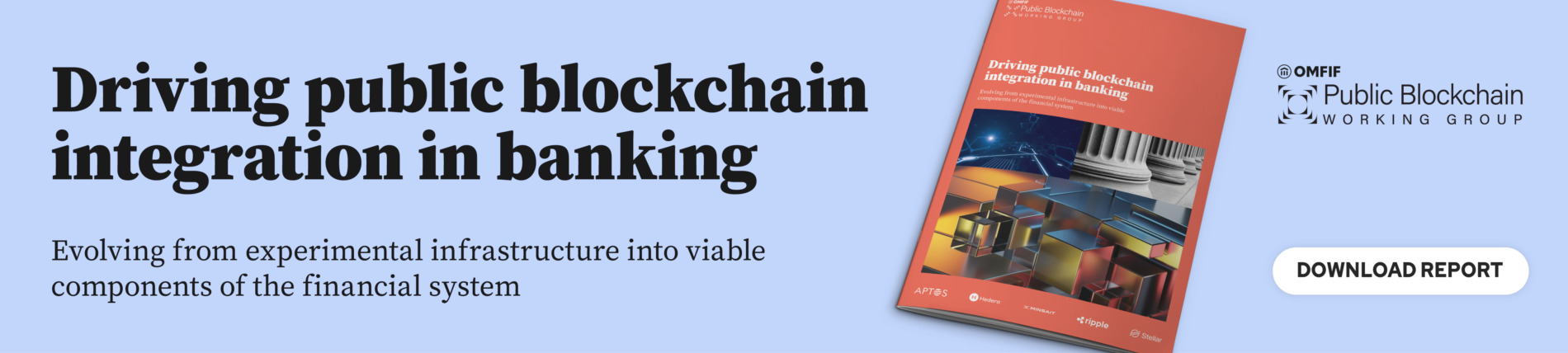
The results of those conversations have informed a new report published by the working group. Driving public blockchain integration in banking puts forward a set of policy recommendations that are designed to encourage innovation while protecting the integrity of financial markets.
Accountability/governance: The controls and responsibilities that regulators need to be able to exert can be achieved through regulations on issuers of tokenised securities and other operators of regulated financial services on the blockchain.
Operational resilience: Public blockchains typically exhibit extremely high resilience, but regulated institutions that leverage blockchain technology for financial infrastructure for regulated financial instruments should have fall-backs in place to ensure business continuity.
Asset control: Regulators should mandate that blockchains used as financial infrastructure enable regulated token issuers to implement controls to meet their regulatory obligations, such as white-listing for know-your-customer requirements, freezes, clawbacks and transfers.
Settlement finality: Regulators should mandate that transactions in regulated financial instruments on blockchains are technically settled quickly and finally, fulfilling also the requirements for legal settlement.
Confidentiality: Regulators should consider ways that regulated financial instruments can transact in ways that protect users’ confidentiality without compromising banks’ ability to detect unlawful transactions.
Interoperability: Regulators should promote infrastructure for regulated financial instruments that enables seamless cross-chain migration of assets, improving resilience and liquidity.
Throughput and fee stability: Infrastructure for regulated financial instruments must be able to comfortably support peak levels of traffic, even accounting for increased traffic made possible by reduced transaction costs.
Validator considerations: Regulators should make clear whether financial institutions have any responsibility to know the composition of the community of validators.
The report argues that the products and tools exist to ensure that public blockchains can deliver the features required of the technology that underpins financial market infrastructure, and that any novel risks the architecture presents can be effectively mitigated. Financial institutions should therefore be able to decide for themselves what protocols best fit their needs.
Throughout the report, we feature thought leadership from the working group members, introducing distinctive features of the blockchains they support or highlighting the importance of shared technical standards. OMFIF is indebted to the working group participants and to the regulators and bankers who participated in the meetings.
These discussions are part of the process of constructing a shared understanding between technologists, financial services professionals and regulators. This understanding is crucial to develop a policy framework that both allows innovation to flourish and protects the integrity of financial markets.
Lewis McLellan is Head of Content, Digital Monetary Institute, OMFIF.
Download Driving public blockchain integration in banking.
Interested in this topic? Subscribe to OMFIF’s newsletter for more.