Driving public blockchain integration in banking
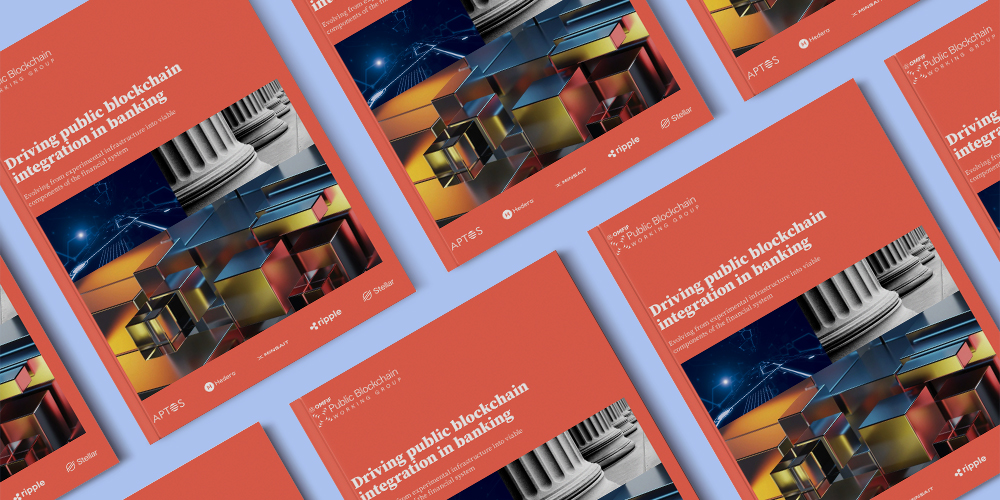
First report from OMFIF’s Public Blockchain Working Group
While the financial world is eager to embrace the promise of public blockchain technology, some in the regulatory community believe that it represents unique risks. They are responding by putting in place rules that limit the adoption of public blockchain, particularly at commercial banks.
This stance is far from universal: US regulators are keen to see public blockchain adopted and are rapidly dismantling regulatory obstacles, leaving the world’s banks on an uneven playing field.
OMFIF has created the Public Blockchain Working Group with the support of Aptos, Hedera, Minsait (Indra Group), Ripple and Stellar Development Foundation. The group met with six financial and bank regulators to examine the challenges involved in regulating the use of public blockchain at commercial banks.
This report is the result of those conversations. It argues that the products and tools exist to ensure that public blockchains can deliver the features required of the technology that underpins financial market infrastructure, and that any novel risks the architecture presents can be effectively mitigated. Financial institutions should therefore be able to decide for themselves what protocols best fit their needs.
Enter your details on the right to read the report.
Key recomendations:
- Accountability/governance: The controls and responsibilities that regulators need to be able to exert can be achieved through regulations on issuers of tokenised securities and other operators of regulated financial services on the blockchain.
- Operational resilience: Public blockchains typically exhibit extremely high resilience, but regulated institutions that leverage blockchain technology for financial infrastructure for regulated financial instruments should have fall-backs in place to ensure business continuity.
- Asset control: Regulators should mandate that blockchains used as financial infrastructure enable regulated token issuers to implement controls to meet their regulatory obligations, such as white-listing for know-your-customer requirements, freezes, clawbacks and transfers.
- Settlement finality: Regulators should mandate that transactions in regulated financial instruments on blockchains are technically settled quickly and finally, fulfilling also the requirements for legal settlement.
- Confidentiality: Regulators should consider ways that regulated financial instruments can transact in ways that protect users’ confidentiality without compromising banks’ ability to detect unlawful transactions.
- Interoperability: Regulators should promote infrastructure for regulated financial instruments that enables seamless cross-chain migration of assets, improving resilience and liquidity.
- Throughput and fee stability: Infrastructure for regulated financial instruments must be able to comfortably support peak levels of traffic, even accounting for increased traffic made possible by reduced transaction costs.
- Validator considerations: Regulators should make clear whether financial institutions have any responsibility to know the composition of the community of validators.
Partners