

Since 2018, about one in 20 high risk ratings under the International Monetary Fund and World Bank debt framework for low-income countries was followed by distress within two years. An early warning should come before the crisis. But the rating also helps decide whether a country gets grants or loans, how much money is available and the conditions for borrowing.
A debt sustainability assessment does three jobs, as the IMF’s Plamen Iossifov and the World Bank’s Mellany Pintado explain on an episode of OMFIF’s ‘Invested’ podcast. It warns that trouble is coming; it helps determine the terms on which official financing is provided and when a country can no longer pay, it anchors the relief needed to restore sustainability. The 2026 revision is unusually candid. One task remains before it takes effect in late 2027: explaining how the finer diagnosis should change financing.
What the review got right
With the old framework, sustainability rested on judgment. The framework paired an external stress model with a public debt benchmark. The revision adds a model of overall public debt stress with new liquidity thresholds, and a separate model of the risk of unsustainable debt within five years. Terminology separates stress from unsustainability. The stress rating assesses the risk of public debt stress; it is not a credit rating.
The self-assessment is honest. Every new ‘in debt distress’ rating since 2018 followed a high risk rating, yet over a third of assessed countries carry it each year. One high risk rating in five rested on judgment without a projected threshold breach, mostly for long-term climate risk. The review finds that judgment often improved assessments. But when used alone for sustainability, or to include long-term risks in stress ratings, it ‘has contributed to concerns about even handedness and transparency of DSAs and the higher rate of unexplained false positives in the near term’. Outsiders had said this before, but the institutions have now said it themselves.
Different decisions, different costs
A warning not followed by a crisis is not always wrong. Some risks are far off; some warnings prevent the crisis. But a high risk rating needs interpretation before it affects financing. An early warning can help avoid missed crises. A financing decision must balance the cost of limiting sound financing against the risk of adding debt that cannot be repaid. In restructuring, the parties negotiating must be able to check the assumptions. One analysis guides all three decisions and each has different effects.
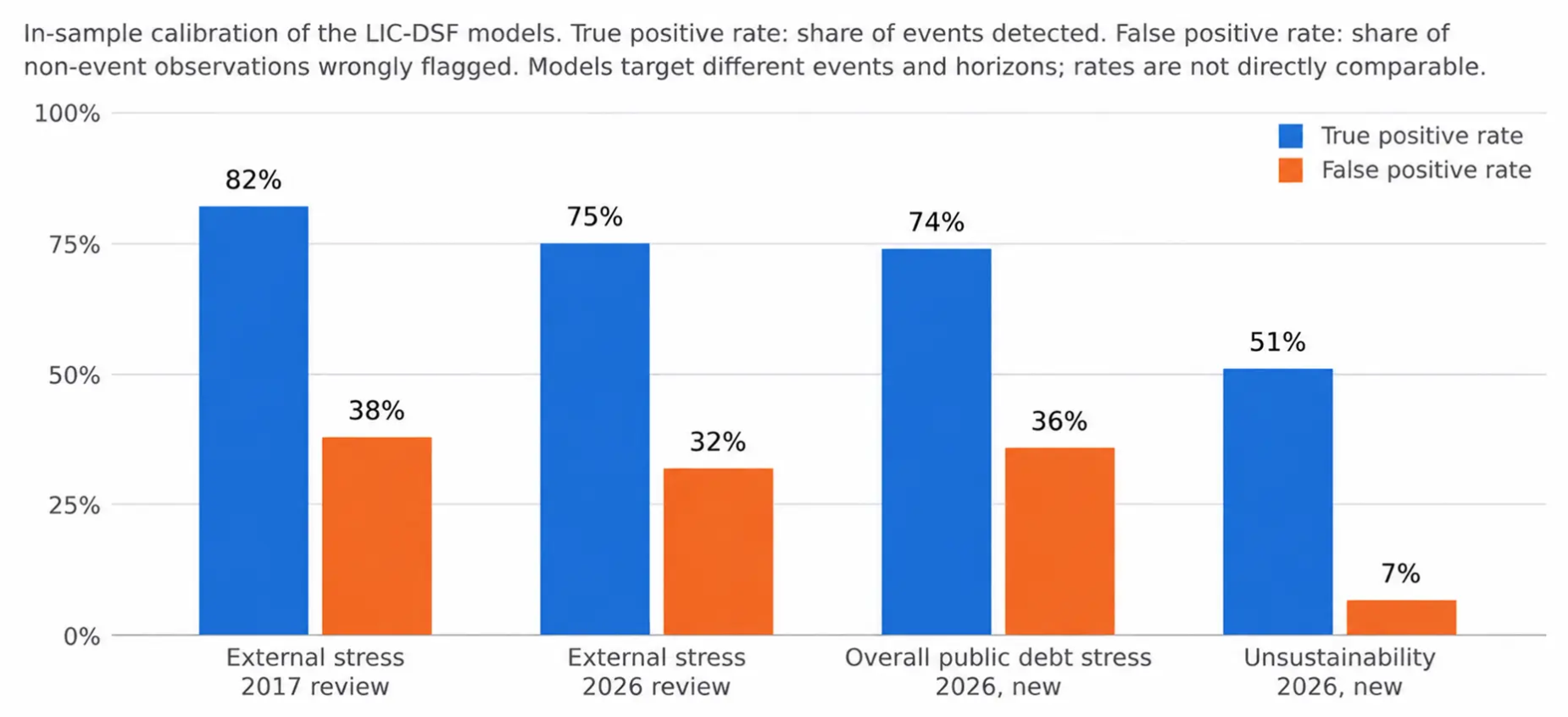
The models already recognise that different signals require different tolerances for error. The existing external thresholds were set with twice the weight on the missed-crisis rate as on the false-alarm rate. The new stress thresholds accept an in-sample false alarm rate of 32% to 36%. The chosen unsustainability calibration identifies about half of true events at a false alarm rate of 7%, below the 10% ceiling. The lower ceiling reflects the risk that a wrong flag ‘can become a self-fulfilling prophecy if the country consequently loses access to external financing’. The stated reason is the cost to the borrowing country. The sustainability signal therefore tolerates fewer false positives. The review leaves open how its finer distinctions within high risk should affect financing.
Figure 1. Two tolerances, one framework
In-sample true and false positive rates of the framework’s models
Source: IMF and World Bank (2026), paras 30 and 32; Annex I, Table I.9. Author’s chart
Note: the 2017 and 2026 external-stress results use different samples and event definitions; their difference does not isolate the effect of the model revision.
The money still follows the broad rating
Official creditors, development banks and donors use the framework to guide lending and grants. A high risk external debt rating shifts eligible International Development Association-only countries to grants, which the paper calls ‘pre-emptive debt relief’. Under IDA21, performance-based allocations to grant recipients generally carry a 10% volume discount. Exemptions apply, and eligible countries may instead receive a 60-year credit. Through a separate channel, countries at high risk of external debt distress normally face a zero ceiling on new non-concessional external borrowing, with exceptions. The review concedes the rating ‘may inadvertently influence access to financing’ where lenders rely on it mechanically.
Ratings themselves will change under the new thresholds. The more important question is what the new distinctions change. Two countries can hold the same rating while one faces immediate debt-service pressure and the other longer-term climate risk. The review classifies high risk cases by how severe and lasting the breaches are. Yet World Bank policies linked to the framework ‘are not expected to be significantly affected, as the diagnostics and outputs that inform them are retained’.
The third job – restructuring – raises a separate question of scrutiny. The unsustainability model’s method is public. Its probability cut-offs and each country’s signal are not. The staff note explaining them is among the documents the Fund does not publish. The restriction is on public disclosure, to protect access to financing; the board gets the note. But the review itself called the lack of ‘a clear mechanical signal’ an obstacle to ‘building consensus’ in restructurings. Published material will not let outsiders reproduce the classification or trace how it relates to the final judgment. Directors asked staff to set out criteria and a timeline for revisiting the restriction. The published board statement gives neither.
Who holds the error
The financing rules and the decision to publish raise the same basic question: who pays the cost when an assessment is wrong? Call this assessment risk: the chance that uncertainty or error in the diagnosis produces financing consequences out of proportion to the actual vulnerability. It can limit sound financing or allow debt that cannot be repaid. How often assessments are wrong matters. So does who faces the consequences. Both should shape financing rules.
Three changes follow. First, when the Bank reviews IDA terms and its sustainable development finance policy, it should explain how the severity, persistence and horizon of a breach will affect financing volume, the degree of concessionality and borrowing limits. Second, the forthcoming guidance note should set a common reporting format. It should show the mechanical signal, the final assessment, the reason for any departure and staff’s reply when the authorities disagree. It should also define the non-publication review: what the authorities receive, what may be shared in confidence during a restructuring and when the decision returns to the board. Third, the institutions should report separately on how well the framework works as an early warning, as a financing input and in restructuring. One measure of accuracy cannot show whether each job carries the right tolerance for error.
A separate question lies beyond the framework: whether countries can convert the fiscal and investment space it identifies into productive and sustainable assets. The review has made the analysis more discriminating. The financing rules must now explain what those distinctions change.
Udaibir Das is Vice Chair at OMFIF.
Listen to the latest episode of the OMFIF ‘Invested’ podcast: The IMF and World Bank’s most candid debt review here.

Interested in this topic? Subscribe to OMFIF’s newsletter for more.