
Since becoming the 21st member of the euro area on 1 January 2026, Bulgaria has entered a new economic and financial era. Its accession deepened the country’s integration with Europe at a time of geopolitical strain globally, giving it a seat at the decision-making table.
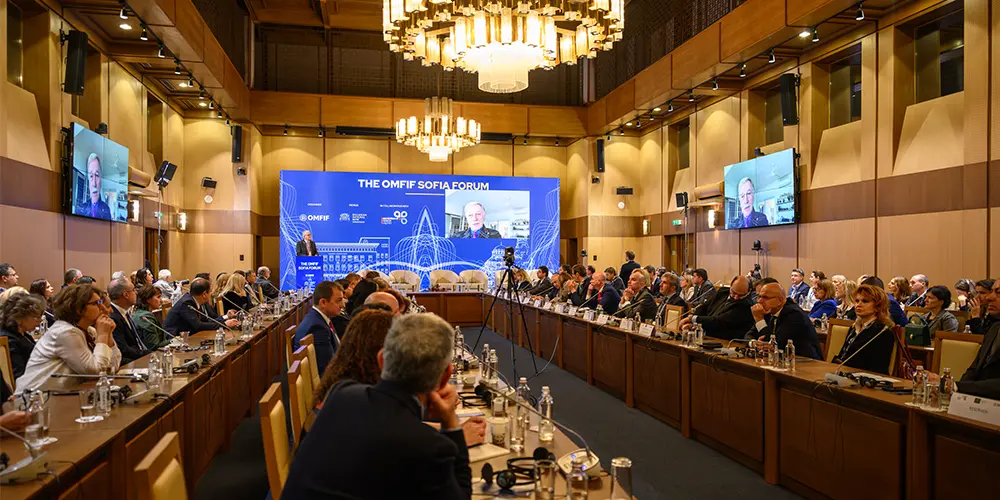
To examine the next stage in Bulgarian and European financial development, OMFIF collaborated with the Association of Banks in Bulgaria to organise the OMFIF Sofia forum. Under the patronage of the Bulgarian National Bank, the event brought together senior policy-makers, central bankers, investors and financial sector leaders from across Europe to examine the forces reshaping the economic and financial landscape.
Dimitar Radev, governor of the Bulgarian National Bank, said: ‘Bulgaria’s accession to the euro area has brought new responsibilities – both in shaping our common monetary policy and in safeguarding the stability of our national financial system. In the present environment, the central task is to preserve confidence: confidence in monetary policy’s ability to deliver price stability, in the sustainability of public finances and in the resilience of the banking system.’
Radev dropped a broad hint of possible credit tightening at the European Central Bank’s next policy-setting meeting in December, saying, ‘The inflation outlook has deteriorated since September, and this must be reflected in our assessment of the appropriate monetary policy stance. The October pause [on interest rates] was a decision to assess the evidence, not a conclusion that monetary policy tightening is over.’
Bulgaria’s position at the crossroads of central, eastern and southeastern Europe makes it a gateway for regional investment and co-operation. Under the guidance of the Bulgarian National Bank, the country has an opportunity to spur growth, drive competition and attract innovation. Bulgaria can also strengthen European financial resilience through its high-performing banking sector, making this a bilateral opportunity with mutual benefits.
Petia Dimitrova, chairperson of the executive board, ABB and chief executive officer and chair of the management board of Postbank, said, ‘Bulgaria’s accession to the euro area opens a new chapter for investment and economic development. Our banking sector enters this new stage from a position of strength, with the capital, liquidity and expertise to turn the opportunities of deeper European integration into real investment, business growth and greater competitiveness.’
Strength in numbers
In addition to the Bulgarian National Bank, the forum brought together four central banks, all at different stages of their relationship to Europe and the euro. Martin Kocher, governor of Oesterreichische Nationalbank, Anca Dragu, governor of Banca Naţională a Moldovei, Dániel Palotai, deputy governor of Magyar Nemzeti Bank, and Michael Faulend, vice governor of the Croatian National Bank, offered their perspectives. Together, they provided the full range of the euro experience – from Austria, as one of the initial member states to adopt the euro, to Moldova, as an aspiring member of both the EU and euro area, with Hungary in the process of preparing to adopt and Croatia having done so in 2023.
In a keynote address, Kocher observed that Europe is experiencing multiple transformations simultaneously – in technology, geopolitical alliances, trade and global influence. On its eastern edge, the Russia-Ukraine war is threatening the resilience and prosperity of nearby countries and positioning greater European co-operation as a strategic benefit and source of protection. ‘In a world that never stands still, Europe’s prosperity depends on the ability to adapt, to innovate and to act collectively,’ Kocher said.
All four central bankers were convinced by the advantages of greater European integration. Palatoi shared how, in Hungary, there has been strong buy-in from capital markets as a result of the country’s euro ambitions, while Faulend reflected on how Croatia has profited from euro area accession, both financially and in building resilience. For Moldova, Dragu said the constant threat of war on its border affects investment, but that the country had managed to provide stability and peace despite this, conducting 70% of its trade with EU member states.
Mutual benefits for Bulgaria and Europe
During a panel with the chief executive officers of leading Bulgarian banks, the participants all agreed that Bulgaria’s adoption of the euro was as one of the smoothest of any country that has adopted the currency. Tsvetanka Mintcheva, chief executive officer and chairperson of the management board at UniCredit Bulbank and deputy chairperson of the executive board, Association of Banks in Bulgaria, said this was a great example of co-operation, especially during a time of change in the government.
‘But this transition is just the start,’ Mintcheva said. ‘It’s really important now being part of this community that Bulgaria reaches deeper integration. Predictability is an important factor for investment decisions.’
Despite facing fiscal strains nationally, Bulgaria’s banking sector is flourishing. Banks are well-capitalised and liquid, able to support economic growth by providing loans and investing in innovation. There is also a high presence of international banks and groups in Bulgaria’s banking sector, and the panellists viewed this as a strength, not a risk.
‘Being part of the European banking union and euro area provides additional certainty that, whatever is going on worldwide, we are part of something that is much stronger,’ said Dimitar Shoumarov, deputy chief executive officer and chief financial officer at Postbank.
This is also a two-way benefit. Mintcheva said: ‘Being a small and well-developed market, it allows us to run some innovations here to the benefit of all the international groups.’ This flexibility is much needed in Europe. The region has fallen behind other regions in terms of productivity, competitiveness and investment in key sectors like technology and defence.
Christof De Mil, chief executive officer and chairman of the management board at United Bulgarian Bank, summed up both the challenge and the opportunity for the region: ‘There is a risk that Europe remains a laggard, but we all have it in our own hands to make sure that it does not happen.’
Optimism and pragmatism
The first year of Bulgaria’s participation in the euro area has brought advantages and challenges to the country at a time of global turbulence. The discussions at the OMFIF Sofia forum were clear that the former far outweighed the latter, but speakers remained practical about what still needs to be done to counter Europe’s deep-rooted problems of stagnation and fragmentation.
‘We hope the Sofia forum will generate fresh precepts on how expansion to the southeast of Europe can help improve dynamism and resilience in Europe as a whole,’ said David Marsh, chairman of OMFIF. ‘But adherent countries – whether already inside the European Union and monetary union or wishing to join – must realise that European integration is not a one-way street to paradise. There are hard tasks facing newcomers not only in overcoming the hurdles to become part of the EU or EMU but in also living up to the challenges that follow as a result.’

Interested in this topic? Subscribe to OMFIF’s newsletter for more.