

Geopolitical pressures are driving Europe to rearm. Nato allies have agreed to spend 5% of gross domestic product annually by 2035, with at least 3.5% going towards core defence requirements. Of this, at least 20% is meant to go to major equipment and research and development. An additional 1.5% of GDP should then be allocated to resilience and innovation. This rise in defence demand could help revive European manufacturing as the industry adjusts to a changing global landscape. It can also support the modernisation of defence capabilities and improve resilience.
However, how this investment will be funded remains unclear. Governments have limited fiscal space to pay for rearmament, while private investment in defence remains subdued. In the UK, for example, the large manufacturing sector could benefit from a shift towards defence, but public finances are precarious. Venture capital could help bridge the funding gap by giving defence tech and dual-use firms the resources they need to grow. This requires the public sector to commit to a credible plan for increasing investment in targeted areas.
A credible and effective strategy would be to turn defence spending into a source of long-term growth. This is the central aim of the next phase of The future of public money, a collaboration between EY and OMFIF, which examines how to make public investment more productive, highlighting opportunities for better economic outcomes and innovation through a defence lens.
Defence as an engine for growth
Defence spending can transform British industry by fuelling growth. The priority should be deploying capital into projects that support long-term GDP growth beyond the initial fiscal boost.
One argument against giving defence a larger role in British industry is its limited direct contribution. According to the Aerospace Defence and Space Group and Oxford Economics, it accounts for about 0.6% of the UK’s gross production. However, that estimate excludes spillovers to other sectors and the industry’s growth potential. With governments committing to higher spending targets, the defence market is set to expand. Countries with spare industrial capacity are best placed to capitalise on this rising demand. They are also more likely to limit the share of spending that goes on imports, thereby maximising the fiscal boost.
Another critique is the ‘guns versus butter’ debate, which highlights the risk that higher defence spending crowds out civilian expenditure. Yet a study by the Kiel Institute finds little evidence of cuts to social spending during military build-ups. In peacetime, governments have typically financed rearmament through a mix of higher taxes and borrowing. The question for growth is whether the gains in industrial capacity and productivity outweigh the burden of higher taxation. Stronger security has value in its own right, and the economic benefits can extend beyond the defence industry when military research finds civilian applications. The internet and GPS are two famous examples of breakthroughs that grew out of defence R&D.
The composition of defence spending matters for long-term growth. When there is spare capacity, higher government expenditure boosts GDP in the short term by bringing output closer to potential. Estimates of the fiscal multiplier, which measures the change in GDP in response to a change in government spending, range from 0.6 to 1. For defence to transform industry, spending must also expand the economy’s long-term productive capacity. Giving research and development priority over routine personnel spending would help achieve this goal.
Investment in digital and technology can also boost productivity and fiscal competitiveness. As reported in last year’s OMFIF-EY report, Investing for a productive state, strategic allocation towards digital and technology investment in western European countries can generate a multiplier effect of around three, while reducing debt-to-GDP ratios. The additional Nato commitments to resilience and innovation through protecting critical infrastructure, ensuring civil preparedness and strengthening the defence industrial base therefore become a clear priority in this context.
Defence could address both emerging security threats and structural economic issues in Europe. How that investment is financed, however, matters as much as choosing which projects to invest in.
Making the fiscal space for defence
European governments face mounting fiscal pressures as defence needs grow. Highly indebted countries are increasingly likely to turn to spending cuts or tax rises, while those with more fiscal space can borrow on bond markets.
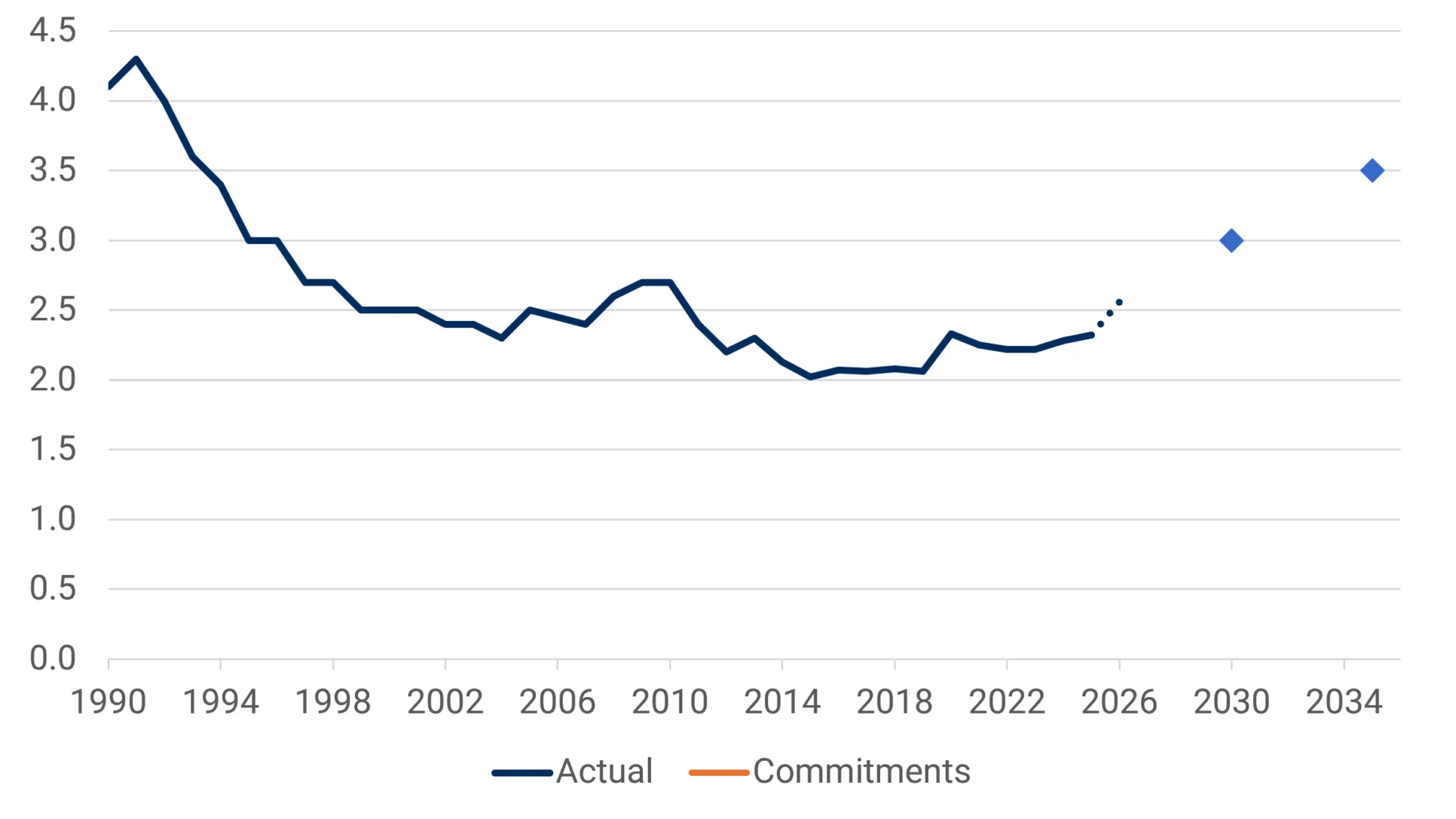
The UK’s latest budget in late October 2026 addressed the funding of its Defence Investment Plan, which is expected to raise defence spending by 0.1 percentage points as a share of GDP. This brings spending to 2.6% this fiscal year and 2.7% thereafter. The plan amounts to £3.8bn in additional annual funding, most of which will come from cuts to all other departments’ capital budgets.
Figure 1. UK defence spending set to reach a multi-decade high
UK defence expenditure, % GDP
Source: Nato historical defence expenditure data, UK government commitments
Note: The measure considers Nato-qualifying defence expenditure for each fiscal year, which may differ from national estimates.
How the government will fund its more ambitious commitments of 3% in 2030 and 3.5% in 2035, however, remains uncertain. The Institute for Fiscal Studies estimates the cost of the additional 0.3 percentage points of GDP needed to reach the 2030 target at around £11bn a year, a substantial sum against the current £15bn fiscal buffer. The unfunded gap for 2035 is even larger. Next year’s spending review will set out a roadmap for reaching these targets, but the figures already point to the need for budgetary reform.
Some countries have turned to more borrowing to finance defence needs. Germany, for instance, has exempted defence from its debt limit through constitutional reform. Its debt stands at a relatively healthy 63% of GDP, just above the Maastricht Treaty benchmark. However, UK public debt stands at 93% of GDP, its highest level since 1962, while fiscal credibility is continuously being questioned. In those circumstances, relying on additional borrowing indefinitely would be unsound. An immediate security threat would justify a temporary increase in gilt issuance, but the UK faces no such emergency. Although borrowing could help smooth the transition to fiscal consolidation, off-the-books borrowing, which is reportedly being considered, should also be avoided.
Another solution is spending cuts. John Healey, chancellor of the exchequer, has repeatedly signalled difficult choices in the years ahead, making fiscal consolidation more likely. Reforming the state pension triple lock, one of the most contested policies, illustrates the scope for savings. Since the triple lock was introduced, the state pension has grown faster than average wages, increasing pressure on public finances. The government’s decision to soften the policy is intended to curb this compounding effect.
In this year’s budget, Healey announced that the reform would take effect from 2030. The government estimates that this could save £15bn a year by the late 2030s, though earlier savings would be smaller because they build over time. Bringing the reform forward to next year could help meet a significant share of the additional defence spending sooner. Acting in this parliament would also lend credibility to the government’s commitment to curb spending.
Raising tax revenues is the final alternative, though the tax burden is already high. The Office for Budget Responsibility forecasts that tax revenues will exceed their historical record of 37.2% of GDP next fiscal year and continue to rise thereafter. The National Institute of Economic and Social Research estimates that income tax has the least negative effect on GDP among the main taxes that the government relies on. In fact, income tax has historically been a major funding source for military build-ups, as the Kiel Institute illustrates. Raising income tax, however, would carry a political cost. New progressive sources of taxation could be considered, but should be designed to minimise their impact on GDP.
Public demand, private capital
The public sector is effectively the sole customer in the defence market, but public funding alone is insufficient. Capital markets can help bridge the financing gap, but only if firms have a clear route to growth and revenue.
Venture capital could play a vital role in developing Europe’s defence industry by backing innovative start-ups. Defence tech and dual-use firms have the greatest growth potential. Europe’s problem in scaling its defence industry is not capability but funding. Britain, with its world-class research capabilities and talent, is well placed to succeed in this sector. Yet it relies on the financing architecture needed to mobilise private capital.
Many defence small and medium-sized enterprizes struggle to move from early-stage grants to long-term debt financing. Although grants can support early-stage development, they do not translate into longer-term financing, which is essential for commercialisation. The government can help firms make that transition by providing a clearer route from innovation to adoption. Procurement is part of the problem. The UK process is seen as slower and more complex than its US counterpart. Beyond acquiring material, procurement should help bring new technologies into use. Awarding more contracts to SMEs would let them test and improve their technologies, and generate the cash flow they need to secure financing for further growth.
Rearming Europe presents both a formidable challenge and a significant opportunity. Achieving the dual aims of enhanced security and economic renewal depends on forging a new partnership between public and private sectors and on prioritising investment in innovative sectors. This requires mobilising not just government resources, but also unlocking private capital and innovation. Only by aligning fiscal reform, targeted investment and smarter procurement can Europe ensure defence spending strengthens its industrial base to support growth and deliver lasting resilience amid geopolitical uncertainty.
To advance these discussions, OMFIF and EY are hosting a seminar on 17 November in London. It will convene senior representatives from governments, defence organisations, industry, institutional investors and financial institutions to examine how increased defence spending can strengthen long-term economic resilience, industrial competitiveness and technological leadership.
Andrea Correa is Head of Research and Christos Panourgias is an Economist at OMFIF.
Join OMFIF on 17 November in London for The future of public money: Defence investment for growth, resilience and innovation.

Interested in this topic? Subscribe to OMFIF’s newsletter for more.