

When Vespasian taxed Rome’s urinals, his son objected. The emperor held up a coin and asked whether it smelled. It did not.
Money carries no trace of its origin or destination. That is its function. Money settles claims because units of the same currency are accepted at par. Capital is different: claims on future output, each with its own issuer, risk, currency, maturity and rank. A claim derives value from its differences; money from suppressing them at settlement. Purpose could live in the claim but could not live in the money.
That boundary is now in question. Finance is writing purpose more deeply into claims and, at the frontier, into money itself. Once purpose enters mandates and settlement systems, it changes who supplies capital, what it costs and whether identical units remain interchangeable.
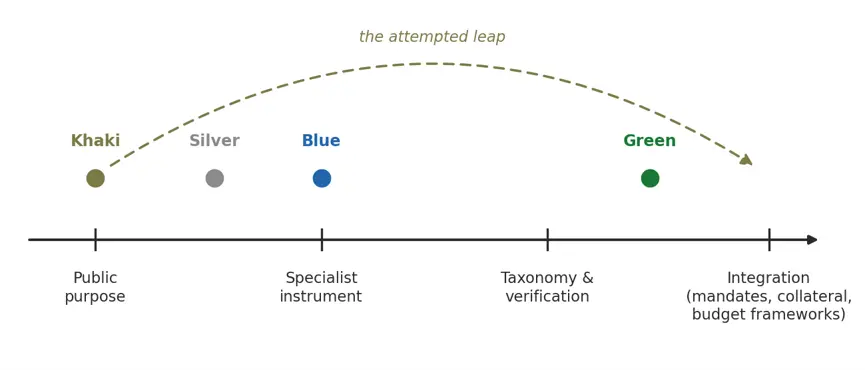
Markets now institutionalise purpose through four political economies shaped by distinct failures: environmental externalities, fragmented rights and public goods, weak appropriability, and national security (Figure 1). The failure sets the route. None yet touches money. The question is how long that remains true.
Figure 1. Four political economies of capital
Source: author’s framework
Note: the axes show market architecture and dominant allocation mechanism. Positions are conceptual.
Green capital responds to environmental externalities, and its architecture is the most developed. Aligned sustainable debt reached a cumulative $6.8tn at the end of 2025, including $653.5bn of green issuance during the year; by June 2026, 62 sovereigns had entered the labelled market.
Blue capital addresses ocean public goods but faces a harder bankability problem: overlapping jurisdictions, uneven data and unpredictable cash flows. Issuance was $3.22bn in 2024 and more than doubled in 2025. Blue will lean on sovereign and multilateral intermediation.
Silver is the label for space capital: a $626.4bn economy in 2025 with no common financial taxonomy. Large spillovers and dual-use benefits are hard to appropriate privately, so procurement and public support matter more than labels.
Khaki corresponds to defence and security capital, and it begins with the state. Procurement, guarantees and official lending sit alongside secrecy and strategic urgency. Nato Allies have committed to investing 5% of gross domestic product annually by 2035, while Security Action for Europe provides up to €150bn in long-maturity loans for defence procurement.
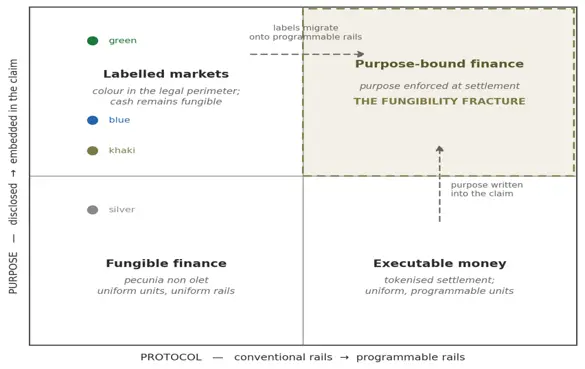
The routes follow the failures: green is standards-led; blue, intermediation-led; silver, procurement-led; khaki, strategy-led. They share institutionalised purpose, deepening from labels through mandates and collateral rules to settlement, where it touches the property that makes money what money is.
The ladder is colour-blind. Green has already paid its fixed construction costs. Could khaki build an equivalent apparatus around eligibility and guarantees rather than disclosure? Nothing in the economics says no.
Figure 2. The purpose-protocol matrix: from labels to settlement
Source: author’s framework
The effects begin with allocation. Purpose-sensitive mandates can lower financing costs for favoured activities and raise them elsewhere without an explicit subsidy. That may correct a market failure but can also become financial repression when regulators direct balance sheets towards official priorities.
The second is market structure. Weak claims can imitate strong ones, so labels need verification. The European Green Bond Standard pairs taxonomy alignment with supervised review; in its first year, more than €22bn had used it. Since June 2026, external reviewers must be registered with and supervised by the European Securities and Markets Authority. Certification is becoming regulated infrastructure. That strengthens credibility but also increases dependence on the certifier. Mandates also create preferred habitats. Matched green and conventional bonds can show little or no greenium. Add restricted demand, differentiated collateral and thin arbitrage, and similar claims need not remain substitutes. Liquidity can fragment; one sovereign curve becomes a family of curves.
The third consequence reaches central banking. The Eurosystem’s climate factor already adjusts the collateral value of certain corporate bonds for transition risk and will extend to corporate credit claims no earlier than end-2027. This is risk management, not preference for a label. Its significance lies in the principle. An attribute of the borrower’s activity is entering monetary operations. The same machinery could, technically, process a strategic attribute. Economics alone cannot police the line between pricing risk and directing credit. Governance must. This rarely announces itself, and it is not reversed quickly.
At the outer boundary lies money. Singapore’s Purpose Bound Money wraps conditions around the money, freely usable once they are met. The Bank of England draws the line cleanly: programmable payments are executed under conditions the user approves; programmable money keeps its restrictions after transfer. Only the latter produces the full fungibility fracture. The singleness debate asks whether money differs by issuer. This is a different divide: money can be differentiated by purpose within a single issuer and on one balance sheet. Capital can wear colour. Money cannot.
Programmability can also create value. Chiu and Monnet show that it can ease commitment problems and that a ban may lower welfare. The less visible cost falls on safe assets. Colour brings back the question: is the bond still green, is the contractor still cleared, what does the collateral schedule say this morning? Quality is continuous; eligibility can be binary, making a label loss a cliff. Obligations under one sovereign name can form a hierarchy that enters monetary transmission.
Why would a finance minister accept this? Because coloured capital offers allocation power without a visible fiscal cost. It can steer private capital towards defence, transition or space without an immediately visible tax, debt or budget line. It looks like sovereignty for free. It is not. Costs appear later in spreads, lower liquidity, compliance, guarantees and pressure on regulated institutions. Someone must certify the claim, supply the data, run the protocol and govern the exit. The state buys allocation power and assumes infrastructural dependence in one transaction. The sovereignty premium acquires an infrastructural dimension.
The task is to watch dependency, not colour. Map exposures and certifier concentration. Spell out the legal effects of decertification and stress-test failure of the data feed or oracle. Treat verifiers and settlement protocols as the financial infrastructure they are becoming. Surveillance first. Standards next. Rules last.
Vespasian’s coin had no smell, no colour and no memory. The next generation of money may keep the first and give up the other two. Can capital take on purpose without money losing the fungibility on which markets depend? The question must be asked while the machinery is still being chosen.
Udaibir Das is Vice Chair of OMFIF, Member of the Bretton Woods Committee, Distinguished Fellow at the Observer Research Foundation-America, Visiting Professor at the National Council of Applied Economic Research, and Senior Adviser of the International Forum for Sovereign Wealth Funds.
Join OMFIF in Bangkok on 15 October for a roundtable to discuss Shifting world, shifting money: fiscal and monetary challenges.

Interested in this topic? Subscribe to OMFIF’s newsletter for more.