
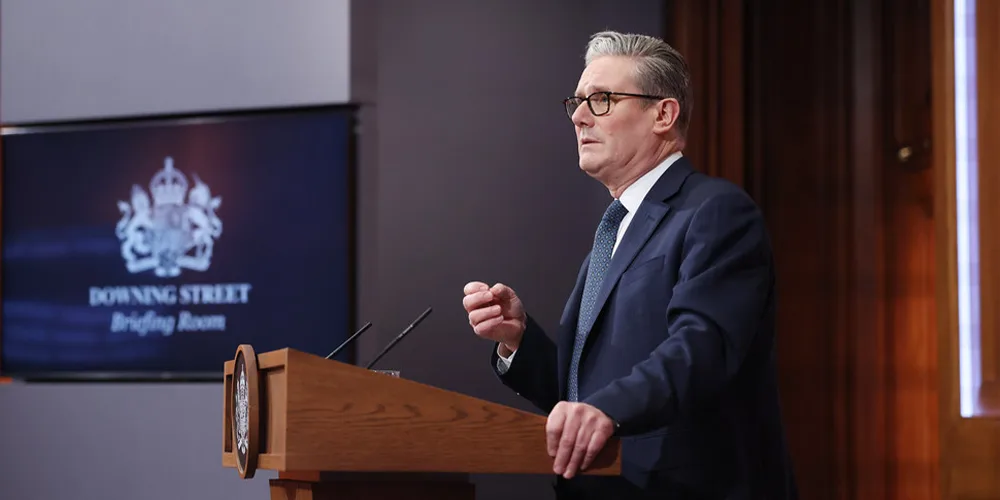
Two years after Prime Minister Keir Starmer’s landslide electoral victory in 2024, the sense of renewal that came with the Labour party’s return to power has long dissipated. Following Starmer’s decision to resign in June 2026, Britain now prepares for yet another change of leadership – a remarkable turnover that will leave the UK with seven prime ministers in 10 years.
This political volatility comes at an awkward moment as Labour faces mounting pressure to revive growth, raise productivity and preserve fiscal credibility. Participants at an OMFIF roundtable on Labour’s second year in government pointed to a fundamental source of tension. On the one hand, the new team under probable Prime Minister Andy Burnham wishes to promote reforms to improve the UK’s long-term growth outlook – including greater devolution, public investment and changes to property taxation. But they also face the immediate short-term pressures of improving the budgetary position, creating room for higher defence spending and addressing persistent cost-of-living concerns.
The newly unveiled 10-year Defence Investment Plan, intended to prepare the UK’s armed forces for modern warfare, is shaped by the government’s ‘Nato first’ mantra. Burnham stands to inherit Downing Street, potentially a new office in Manchester (No 10 North) as well as a daunting set of geopolitical liabilities.
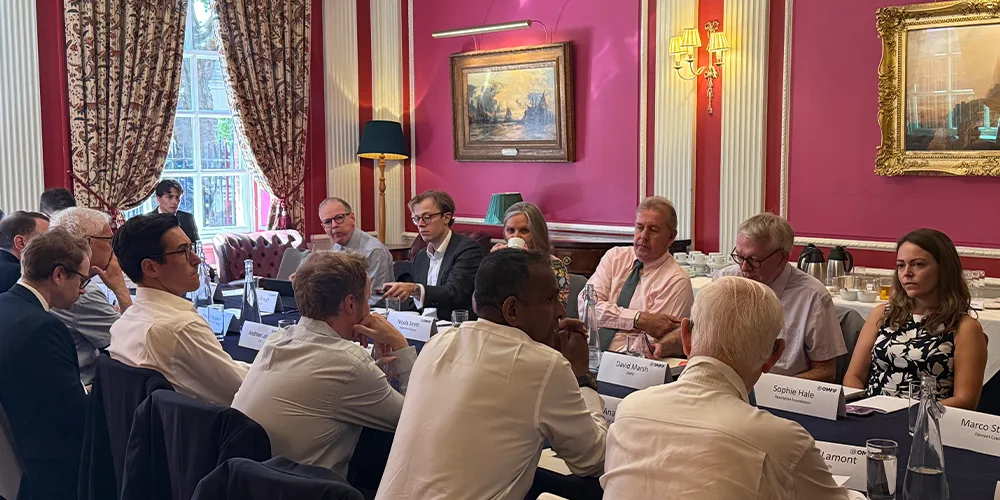
At the roundtable in London, which convened parliamentarians, trade union representatives and policy experts, the discussion moved beyond a general assessment of Labour’s second year, towards Burnham’s immediate prospects. His priorities – while not yet fully articulated – are clearly discernible: devolution, defence and public investment.
No Europhile
Starmer suffered local election setbacks and mounting internal party pressure that ultimately undermined his position. Yet, one panellist highlighted his diplomatic instincts and success in improving relationships with European leaders in national capitals and in Brussels.
Participants were not convinced that this approach would survive under Burnham, stating that Europe will instead be deprioritised. The panellist went on to say that there is little in Burnham’s political history to suggest he is a Europhile, so the UK-EU economic relationship will remain as it is for the foreseeable future.
How Burnham’s relationship with Donald Trump will play out was a point of speculation. Initial reactions from the US president have denigrated the former mayor as ‘extremely liberal’ and merely the ‘mayor of a town’. To this, panellists emphasised that Trump’s political alliances have a curious habit of deteriorating over time – see Italy’s Giorgia Meloni and Israel’s Benjamin Netanyahu. Should relations sour, Burnham joins a crowded club.
Also on the agenda was the UK’s fiscal future. Burnham faces a huge challenge as the UK attempts to keep a European social security system alongside a tax system that doesn’t quite match those of continental welfare states. Defence commitments are likely to intensify those pressures further. Some participants spoke about fiscal rule changes that would allow greater focus on the valuation of public assets. Allowing a market valuation of assets on the government’s balance sheet, one panellist argued, could reduce measured net debt and create additional borrowing capacity to support growth without unsettling bond markets.
Guns and butter
The extra £15bn committed to the ministry of defence under the government’s long-awaited Defence Investment Plan means, as Starmer acknowledged, that some other areas of government spending will be slashed in order to fund defence, most likely with cuts to road and energy projects. Yet several contributors challenged the prevailing assumptions around defence spending.
Some at the roundtable warned against viewing defence primarily as a growth strategy, stating that taxes on wealth and property should all be seen as part of an overall reform package and not just as something to generate funds in the short term. To remedy this, another participant called for more realistic long-term projections for defence expenditure and cautioned against seeing the MoD merely as a branch for industrial strategy.
Others challenged the metrics of military credibility. Measuring defence credibility solely through inputs – particularly spending as a share of gross domestic product – risks overlooking the leaps and bounds in technological advancements reshaping modern warfare in recent conflicts.
A think tank participant observed how the benefits of decades of declining defence spending in the UK have not flowed into working-age welfare and households. The ‘peace dividend’, as elsewhere, has been absorbed by health and pensions spending.
Another added that the consequences are increasingly visible in the economic prospects of younger generations who are expected to rent into retirement while simultaneously undersaving for pensions. Persistent inflationary pressures, falling interest rates, elevated youth unemployment and the rise of the far-right Reform party have created a volatile political coalition that Labour must rebuild from both directions.
Manchesterism
The discussion saw locked horns on the subject of devolution – a central pillar of Burnham’s vision to transfer the balance of power away from Westminster. One panellist started by clarifying that it is not about London taking all of the country’s growth but about there not being growth elsewhere in the UK.
Another panellist dismissed the overall approach as a fashionable solution whose benefits remain unproven. A ‘No. 10 North’ in Manchester, Burnham’s political proving ground, was seen to some in attendance as less a national growth strategy than an extension of his own personal and political interests. The argument: not simply to create more Manchesters, but to identify what growth might look like in other parts of the country.
What lies ahead for Labour depends on its ability to navigate these tricky trade-offs. For instance, balancing Nato commitments with demands for tax reform will require deft manoeuvring. Speculation continues over whether Ed Miliband, now secretary of state for energy security and net zero, will become chancellor of the exchequer.
One panellist argued that whoever becomes chancellor must do something significant to show they’re not making the same mistakes as the preceding government. The margin for error is diminishing. So is public tolerance for another change at the top.
Janan Jama is Content Editor at OMFIF.

Image credits: Number 10
Interested in this topic? Subscribe to OMFIF’s newsletter for more.