
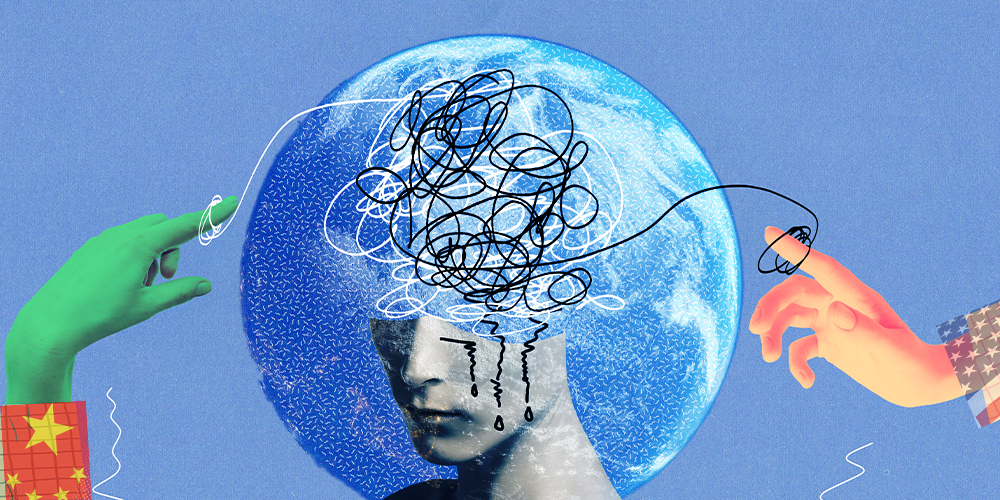
A bleak picture of the world economy under pressure from misaligned policies in both the US and China has been served up at a meeting of OMFIF’s advisory council.
The gathering was told by one non-US member that the international community should be prepared for a disruptive dollar crisis resulting from US current account and fiscal imbalances. At the same time, China was imposing on the world an excessive stream of exports resulting from its weak domestic economy, state-run industrial structure and undervalued currency.
The session on 9 February assembled council members from Europe, Africa, Asia, Australia and the east and west coasts of the US. The group debated two questions. First, whether the ‘rules-based’ order of the post-second world war period could survive its setbacks – or whether it ever existed. Second, if 80 years of Euro-Atlanticism had ended.
The answer to the first question was, broadly, that long-term erosion had already been underway well before the re-election of US President Donald Trump. ‘The system didn’t suddenly collapse; it has been deteriorating for years,’ as one US speaker put it – partly because US relative power has been declining since its post-cold war peak.
But the shifts had to be put into perspective. Pointing to a spate of trade deals involving industrialised and emerging market economies, one Indian delegate said: ‘Although relatively small, these would not have happened without US developments. So the question is whether we can have a rules-based order without the US.’
The second question, too, drew mitigated responses. The consensus was that the US-European relationship was under great strain, but had not ended. ‘Despite the noise, US public opinion remains broadly pro-Ukraine and pro-Europe. Trade conflicts are chaotic, but commerce continues; tariffs meet resistance at home. China has learned how to counter Trump’s tactics. The IMF and World Bank still function quietly as crisis responders. So the system is damaged but not dismantled.’
A ‘non-system’
Since the break-up of the Bretton Woods fixed exchange rate system in 1971-73, the world had lived in a ‘non-system’, it was argued. Extensive current account disequilibria and misaligned exchange rates had been allowed to build up without correction.
The advisory council’s deliberations were given additional weight from French President Emmanuel Macron. In remarks on 10 February, he warned of ‘permanent instability’ with the US, urged Europe to become a global power and said that tensions with the US over Greenland, technology and trade were not over.
Tangible signs of European weakness
The council voiced concern about policies in both China and the US as well as Europe’s apparent inability to face up fully to its challenges. Lack of progress over capital markets union, fiscal integration and making the euro truly global was cited as a tangible sign of European weakness. ‘Europe cannot act as a serious counterweight in a world drifting toward US-China bipolarity,’ said one speaker.
Furthermore, a French delegate affirmed the likelihood of a far right leader taking power after the presidential election in April 2027, marking the end of Macron’s two successive five-year terms. Top French chief executives were now openly courting politicians from the National Rally (Rassemblement National) party, which is ahead of Macron’s centrist bloc and other rival parties in the opinion polls.
All sides had made mistakes leading to the present morass. ‘We got ourselves in a situation where everybody is profitting from the system, but knowing that the system doesn’t really work,’ opined one leading ex-central banker on the council.
Considering a post-Trump world
Another speaker said ‘a return to the rules-based world ‘as we knew it’ was highly unlikely. ‘It has to either change or disappear entirely. We are living through the continued backwash of the 2008 financial crisis. We’re moving towards a world of intense political movements, populism and reacting to an economy seemingly driven by financial elites. There’s a lot we need to address before we can start discussing a post-Trump world.’
A council member with wide experience of international financial organisations pointed out that reforming the governance of an imperfect international monetary ‘system’ had been largely neglected. ‘A reformed governance framework is a sine qua non, something that payment architectures, central bank digital currencies and other digital currency experiments can deliver.’ He added: ‘The international system will face its own reckoning as an artificial intelligence native global economy rewrites how information and capital move.’
Considerable criticism of Trump – threatening ‘rupture not just erosion,’ ‘siding rhetorically with authoritarian leaders’ and throwing ‘capricious trade tantrums’ – coincided with recognition that Europe could not ‘automatically assume leadership’.
Delegates heard that China was generating a ‘second supply shock’ – in addition to the globalising influence of the last 30 years when rapid industrialisation paved the way for an inflation-lowering burst of exports to the West. This time, the outcome was far less benign, with Beijing’s policies weakening leading industrial economies, exporting deflation and intensifying polarisation between ‘haves and have-nots’.
Past changes in international industrial and technological structures – such as the industrial revolution or mass industrialisation after the second world war – had brought higher productivity and living standards, but the next wave of technological renewal would have more negative repercussions.
At the heart of the debate was an intellectual and political struggle over who was responsible. ‘We have a wide increase in inequality, which has sent the message that the system is really not working well for the people. Politicians have just moved to blame the “other”, being foreigners or billionaires, but don’t answer the core questions,’ one Asian member added.
Andrea Correa is Head of Research and David Marsh is Chairman at OMFIF.

Interested in this topic? Subscribe to OMFIF’s newsletter for more.