
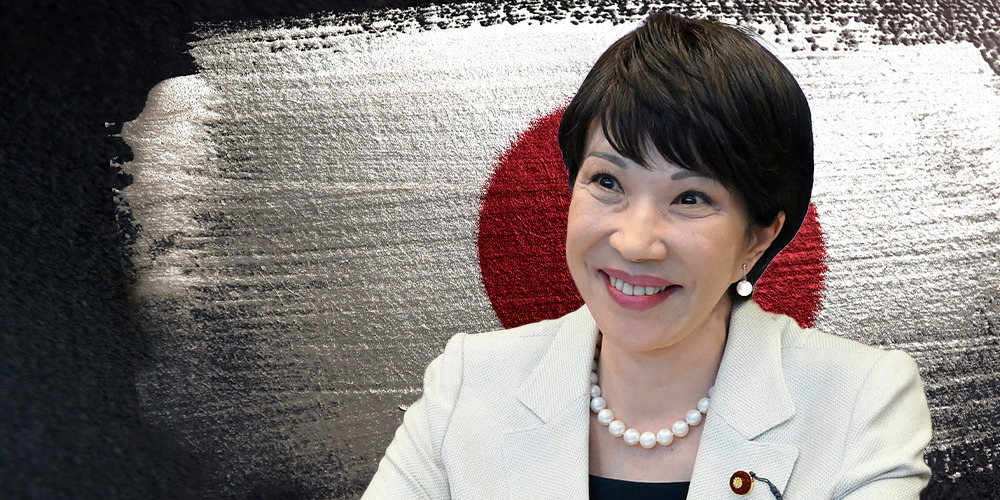
Sanae Takaichi begins her tenure as prime minister of Japan with a rare combination of political momentum and market confidence. Her inaugural public-support rating exceeds that of her recent predecessors, and equities have risen nearly 10% since she became leader of the Liberal Democratic Party. There is optimism that, as Shinzo Abe’s heir, she will launch Abenomics 2.0 of aggressive monetary policy easing, flexible fiscal policy and structural reform.
But rather than reviving Abenomics’ reflationary approach, Takaichi must adapt its framework to today’s demographic, environmental, fiscal and geopolitical realities – integrating Fumio Kishida’s ‘new capitalism’ to achieve resilient growth.
The economic backdrop looks very different
When Abe took office in late 2012, consumer prices were falling, the yen was relatively strong in real, effective terms and economic growth was below potential. The policy arrows of: 1) monetary expansion – the Bank of Japan’s initial, decisive ‘2-2-2 pledge’ followed by subsequent rounds of innovative monetary expansion; 2) fiscal flexibility – including a delay in a planned consumption tax increase; and 3) structural reforms – with an initial focus on trade liberalisation and agriculture reform, were designed to revive growth quickly. Japan exited its entrenched deflationary mindset, the yen depreciated significantly and the nearly six-year economic expansion was the second-longest in the post-war period.
The economic backdrop and challenges that Takaichi faces are different from the last decade. Inflation has been above the BoJ’s target for more than three years, real wage growth is close to zero, Japan’s population is smaller and older, the downside risks related to climate change are larger, public debt is higher and external economic and political conditions are less certain.
Still, Abenomics’ three-arrow framework remains useful and, incorporated with Kishida’s ‘new form of capitalism’ blueprint – targeting a rebalanced economic model of inclusive and sustainable growth – would form an economic programme that could improve Japan’s economic resilience and security.
Wisely, Takaichi no longer seems to be pressuring the BoJ to slow or resist policy normalisation. The Bank’s independence and credibility in bringing inflation back to the BoJ’s target – the failure of which contributed to the quick undoing of her two immediate predecessors – are important sources of stability for the prime minister. Moreover, tighter monetary conditions can help discipline capital allocation and strengthen financial institutions, both of which improves financial and economic stability.
Building on this, Takaichi now stresses the need for the BoJ and the government to be on the same page. Usefully, the landmark accord struck by Abe with the BoJ in January 2013 remains in place, and can be utilised to strengthen the coordination between central bank and Takaichi administration policies.
A new three-arrow approach
Given Japan’s high level of public debt and upward pressure on social spending, monetary and fiscal policies should evolve into credible co-operation amid normalisation. This should include support to transition the BoJ’s significant equity holdings into a potential lever for corporate reform and long-term investments aimed at innovation, human capital development and a climate-resilient green transition.
Takaichi has pledged ‘responsible proactive fiscal policy’ with guidelines to contain Japan’s debt-to-gross domestic product ratio. This echoes Kishida’s growth and distribution duality under which pure austerity is avoided and where fiscal flexibility is used to sustain inclusive growth.
In a step consistent with the social goals of her government – and the ‘shared value’ logic promoted by Kishida – the prime minister should encourage corporate Japan via tax incentives to translate profits into greater wage increases, innovation-supporting domestic investment and carbon reduction. This would better align Takaichi’s approach with Abenomics’ investment-led growth focus while incorporating Kishida’s agenda of public-private investment in people, innovation and green transformation.
Under a third arrow of structural reform, the prime minister instructed her economic ministers to launch a Japan Growth Strategy Council to develop solutions to structural challenges and design a long-term growth policy centred on ‘crisis-management investment’ in critical areas such as climate, energy and demographics. The Growth Strategy Council could be seen as an evolution of Kishida’s Council for the Realisation of a New Form of Capitalism, and its mandate an extension of its ‘resilient capitalism’ concept into a security-orientated growth model.
Finally, the prime minister aims to further advance the shift to investment from savings and strengthen corporate governance, a reframing of new capitalism’s household financial asset activation towards productive, socially beneficial investment.
Looking beyond growth
In her initial speech to the diet on 24 October, Takaichi stressed the themes of security, protection and resilience. Coupled with her ministerial directives, this makes clear that the prime minister’s economic policy vision goes beyond the primary growth objective of Abenomics.
With policies that appear to derive from, reinforce or potentially evolve into the core objectives of ‘new capitalism’, Sanaenomics forms a bridge between these two approaches. A credible Sanaenomics would reassure global markets that Japan’s path to normalisation can remain growth-friendly, debt-manageable and consistent with long-term investor confidence.
Takaichi’s task is to transform Japan’s policy paradigm from stimulus-driven recovery to sustainable, inclusive, security-anchored growth, a sure foundation of national strength.
Matthew Poggi is a Visiting Senior Fellow at the Centre for Economic Transition Expertise and affiliated with the Council on Economic Policies. He is a former economist at the Bank of Japan and served as the US Treasury Attaché in Tokyo.

Image Source: IAEA Imagebank
Interested in this topic? Subscribe to OMFIF’s newsletter for more.