The past 12 months have seen highs and lows around the world. Difficult macroeconomic conditions, compounded by a turbulent trade environment and geopolitical tensions, have created tough challenges for African economies.
As a result, countries in this year’s Absa Africa Financial Markets Index have seen their progress hampered by global headwinds. While a third of countries were able to improve their overall scores, the remaining two-thirds saw their scores fall or remain unchanged. On the surface, this seems like a backwards step from last year’s results.
But the detail shows important developments in a number of areas. In particular, reform-minded countries saw the most notable improvements in their scores and were able to weather the difficult environment better than economies that did not introduce structural changes. Considerable progress was made in improving transparency in foreign exchange markets and adopting netting legislation. Botswana, Lesotho and Rwanda stand out for sizeable improvements in their overall scores.
Mixed performances across all six pillars suggest that falls in scores are likely to be a case of passive decline rather than active. Countries have taken steps to develop markets in a number of different areas, but their progress has been hampered by an unsettled global environment.
Progress is in the detail
While many economies faced a decline in reserves adequacy this year, countries that prioritised tackling inefficient FX regimes fared best. Nigeria and Uganda led the way, rolling out comprehensive reforms to improve market credibility and interbank liquidity.
The Central Bank of Nigeria announced changes targeting the fragmentation of FX windows, a big investor backlog and market operations. The Bank of Uganda focused on liberalising the FX market, improving interbank liquidity and increasing reporting standards. These reforms are critical to attracting domestic and foreign investment, lowering transaction costs and boosting cross-border trade.
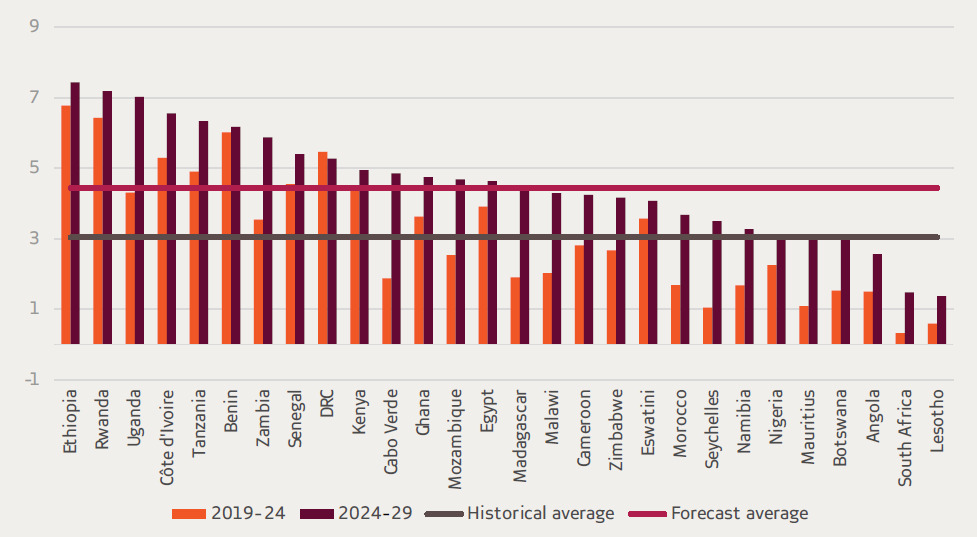
Figure 1. Positive gross domestic product forecast for AFMI economies
Five-year historical and projected GDP annual growth rate, %
Source: LSEG Data and Analytics, International Monetary Fund and OMFIF analysis
Note: 2024-29 figures based on IMF forecasts.
Despite the difficult backdrop, countries are expanding and diversifying their financial product offerings to attract both domestic and foreign investment to the continent. A wider range of products, including Islamic and climate-related finance, helps economies build resilience against global shocks and keep pace with investor trends.
New financial products launched in the past year have a strong focus on infrastructure. Tanzania issued its first sovereign sukuk bond in February 2025, which aims to fund infrastructure and social development projects. It also launched its first Samia infrastructure bond to finance critical development projects. Meanwhile, Kenya approved its first asset-backed security to help finance a new sports complex.
In total, 18 AFMI economies now offer environmental, social and governance-related or Islamic financial products, providing crucial diversification for both short- and long-term investment.
Reason for optimism
There have been backtracks on ESG goals globally in the past year due to changes in the US administration’s priorities. However, many African economies remain focused on introducing policies and products that foster action on climate concerns.
Four AFMI countries have issued green bonds for the first time this year, taking the total number to 14. Ghana introduced climate stress testing to its financial market frameworks, joining the eight other countries already doing so, while South Africa went one step further, conducting its first climate risk stress test on six systemically important banks. Egypt introduced Africa’s first regulated voluntary carbon market, marking a milestone for the continent in climate-aligned financial instruments.
Expectations for GDP growth rose in 22 countries this year despite the more challenging economic conditions (Figure 1). Ethiopia has the highest projected annual growth rate over the next five years at 7.4%, supported by structural reforms and a focus on investing in infrastructure. This widespread progress suggests that African economies are building resilience to global shocks and find themselves better able to weather storms than they were a few years ago.
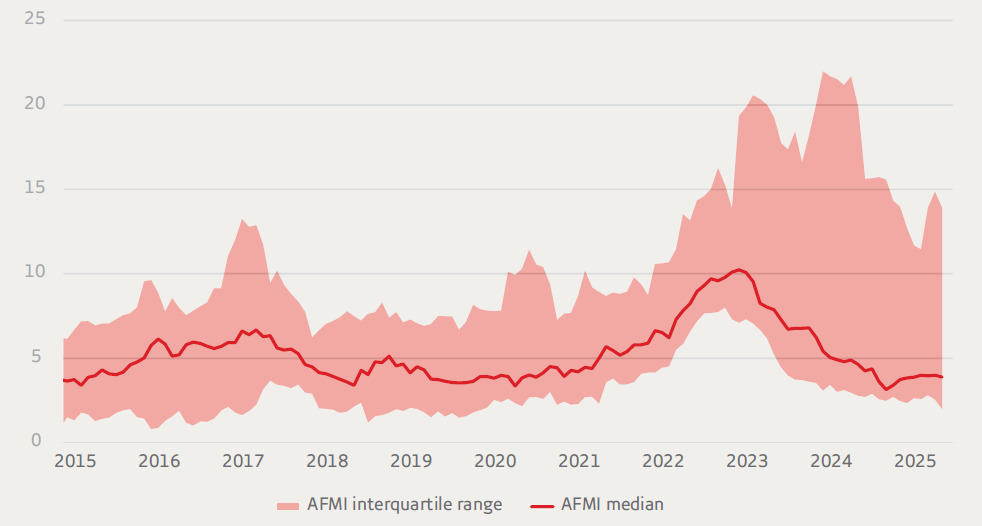
There was also clear progress in taming inflation in the year to June 2025 (Figure 2). It fell in 22 countries, with Egypt and Nigeria leading the way. Similarly, external debt-to-GDP ratios improved in 16 economies due to tighter fiscal discipline.
Figure 2. Inflation remains in the lower range for AFMI countries
Consumer price indices, AFMI median and interquartile range, year on year, %
Source: LSEG Data and Analytics, national central banks and OMFIF analysis
Note: The AFMI interquartile range shows the middle 50% of the consumer price index, excluding the top and bottom 25% of values.
The index assesses financial market development across the continent through the lens of transparency, accessibility and openness. Now in its ninth year, it provides a benchmark for market infrastructure and an opportunity for policy-makers to learn from improvements across Africa.
With support from the United Nations Economic Commission for Africa, the index covers 29 economies in the region. This equates to approximately 80% of the population and GDP of Africa.
Download the Absa Africa Financial Markets Index 2025.