

‘It is time for women,’ vowed Claudia Sheinbaum in her inaugural address as the president of Mexico last week. Her accession to the top political position in the country is a watershed for gender equality in Mexico, reflecting a broader trend of increasing female representation in leadership roles across Latin America and the Caribbean.
Beyond the political sphere, the country has a strong track record of gender parity in leadership roles. In 2023, justices chose Norma Lucía Piña Hernández to head the Supreme Court, making her the first woman to hold the position. A year prior in 2022, Victoria Rodríguez Ceja was appointed governor of Banco de México. Two of the four deputy governors at the central bank are also women – Irene Espinosa-Cantellano and Galia Borja Gómez. It is only one of three G20 central banks to be led by a woman and scored 76 in OMFIF’s 2024 Gender Balance Index – the highest score in the group.
As culture and political will can impact gender balance in financial institutions, recent developments in Mexico are a positive sign of mutually reinforcing trends of female empowerment.
Latin American institutions making strides towards parity
Latin America and the Caribbean has made significant strides towards gender parity. As of December 2023, 10 countries in the region had changed their gender quota laws to gender parity laws for political representation. And in many of these cases, the law extends to political institutions beyond the legislative bodies.
This year, LAC saw the biggest increase in its GBI score compared to other regions over eight iterations of the index (Figure 1). The score rose to 42 in 2024 from 5 in 2017, peaking at 45 in 2023. The increase in scores has been due to new appointments at the senior-most levels of leadership – governors and deputy governors.
Figure 1. Latin America has the biggest increase in regional GBI score
GBI scores by region, weighted by GDP
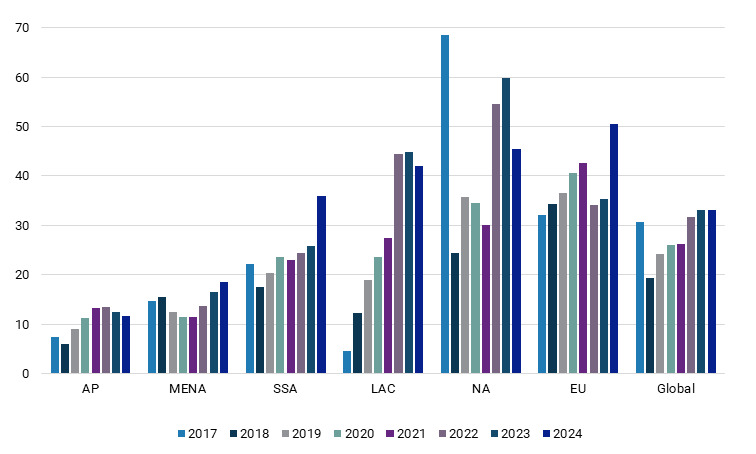
Source: OMFIF GBI 2017-24
Note: Figures do not include the European Central Bank and regional Federal Reserve banks.
Elsewhere in the continent, Banco Central de Chile was the only central bank to score 100 in the 2024 GBI. Stephany Griffith-Jones’ appointment as deputy governor in January 2024 boosted the central bank’s score from 86. A score of 100 reflects a 50-50 split between women and men in senior leadership positions, weighted by seniority.
It is also one of the most improved institutions in the index. The bank’s GBI score jumped from 25 in 2021 to 76 in 2022, following Rosanna Costa’s appointment as governor and other changes in staff.
Speaking to OMFIF, Costa explained how Banco Central de Chile has identified three areas to work on in relation to gender balance – recruitment, organisational culture and mentorship opportunities. She highlighted the various policies implemented at the bank, which include quotas for 50% representation of women in internship programmes, integration of diversity, inclusion and gender in the bank’s employee training programmes and coaching and mentorship programmes targeted at women.
Costa described how the central bank works to promote gender equality in other spheres of Chilean society by collecting and disseminating gender-disaggregated statistics and research. She added that, while the central bank is not involved in public policy, there have been instances where ‘the central bank had great professionals, some of whom have become ministers or have moved on to other relevant positions in the private and the public sector, so they end up contributing to the country from different parts by integrating women into our workspace.’
Battling the DEI retreat
Across the northern borders, in the US, which might soon welcome its first female president, financial institutions are grappling with a diversity, equality and inclusion retreat. While North American commercial banks had the highest average regional score of 44 in this year’s index, this was lower than in previous years, which suggests that commercial banks are moving backwards on gender balance.
It’s a similar story for central banks in the region. The Bank of Canada and the Board of Governors of the Federal Reserve System both witnessed a decline in their scores this year, which led to a decrease in the regional score for North America to 45 from 60. The departure of Lael Brainard as vice chair of the Fed board in February 2023 brought its score down to 44 from 59 as she was succeeded by Philip Jefferson. However, Jefferson’s appointment does mark a positive step for diversity at the Fed. He is the second Black vice chair at the institution, and Adriana Kugler, who was appointed to fill his previous role, became the first Hispanic governor to be appointed to the Fed board in its 110-year history.
Although the regional Fed banks still score highly, progress is plateauing. The score for the Federal Reserve Bank of Kansas City, which was the top-ranked central bank in GBI 2023, fell to 66 from 96 due to Kelly Dubbert retiring from his role as first vice president in addition to more changes in senior management. However, Kim Robbins has been chosen to replace him, which could lead to an increase in its score in the future.
The contrasting trajectories of gender balance in financial leadership across the Americas highlight both progress and persistent challenges. Latin America’s commitment to gender parity, exemplified by Mexico and Chile, demonstrates how intentional policies and cultural shifts can create meaningful change. However, the retreat in North America serves as a reminder that progress is not guaranteed and requires constant vigilance and renewed commitment.
Arunima Sharan is Senior Economist, Economic and Monetary Policy, OMFIF.
Download OMFIF’s Gender Balance Index 2024.
