
Trade openness has been in flux for some time, and the first joint review of the US-Mexico-Canada Agreement has just added to it. In July, the US did not agree to renew the USMCA in its current form, citing the need to address the agreement’s shortcomings and US trade deficits with its neighbours.
The USMCA, successor to the North American Free Trade Agreement, helped turn North America into a competitive economic bloc. It cut most tariffs, encouraged foreign investment and tied regional supply chains together, particularly in manufacturing, automotives and agriculture.
The agreement also helped make Mexico a major exporting hub. But it drew mounting criticism under President Donald Trump’s first administration in 2017, leading to a renegotiation that produced the USMCA, a more politically sensitive framework with an expiry date attached – the first of its kind for a US trade agreement.
Nothing legally changed on 1 July 2026. The agreement runs to the end of its term in 2036. But the US declined the USMCA’s optional 16-year extension, triggering annual joint reviews under Article 34.7.4 until the parties agree to extend it, or it expires.
What follows can best be described as structured uncertainty – a less-than-ideal situation for supply chains built on long-term planning. Industries that have benefitted most from North American free trade will now judge the future in 12-month increments. Trade policy uncertainty has been shown to reduce investment in export entry and technology upgrading, weighing on trade flows and real incomes. Members of Congress made this exact point during USMCA negotiations in 2018, warning that Article 34.7.4 would create uncertainty, discourage private investment and harm US businesses.
‘Repricing of uncertainty’ in the US
The review hasn’t stripped away existing protections, but the real and immediate impact is the repricing of uncertainty itself. Future regulatory risk will be built into contracts now for the supply chains that run across all three countries. Agricultural exporters ship more than $60bn a year to Canada and Mexico, nearly a third of all US agricultural exports, which is why the Agricultural Coalition for USMCA is lobbying hard to keep the USMCA intact.
Consumers will feel it too. North American trade has cut US food prices by roughly 12% since NAFTA, saving the average household about $700 a year. Any uncertainty premium priced into goods lands on households already squeezed by the recent fuel price shock, lingering inflation and tariff pass-through costs that are still working their way through the economy. Some 72% of US voters think the USMCA is good for the economy, and 79% say predictable rules give firms confidence to invest.
Automakers are the loudest objectors, and for good reason: USMCA integration has driven more than $200bn in North American manufacturing investment, supports close to 11m US jobs and 5.4% of gross domestic product. New car prices are already up 10.4% since a 25% tariff on imported vehicles and parts took effect last year – a tough sell in such a car-dependent country. A US push for a country-specific automotive content threshold is the most contested item ahead: Ambassador Jamieson Greer has told Congress Washington hopes for interim arrangements by end-2026.
Figure 1. Mexico’s growing role in US goods trade
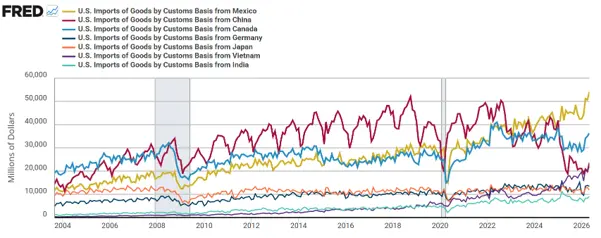
Source: US Bureau of Economic Analysis, US Census Bureau via FRED
Mexico’s foreign investment
For Mexico, the USMCA has helped to advance economic stability and long-term growth. This advantage has become even more concentrated amid the US’ trade disputes with the rest of the world as Mexican exports to the US reached record volumes in May.
The non-extension is unlikely to end Mexico’s nearshoring advantage, but it may shift investment towards shorter-horizon, more cautious projects as US-Mexico negotiations continue. Mexican foreign direct investment hit a first-quarter record of $23.6bn, yet $22.2bn of that was reinvested earnings, up 33%, and new investment came to just $1.7bn.
The automotive sector, worth 4.7% of Mexican GDP and over a fifth of manufacturing output, is most exposed. With the 25% Section 232 tariff on vehicles and parts already sitting outside USMCA’s protection, firms are unlikely to expand until the rules on regional trade and supply chains are clearer. The effects of these tariffs are evident in the data: Mexico’s steel exports to the US fell 36.6% in 2025, and automotive shipments were down 5.1% year-on-year in the first four months of 2026, to $48.6bn – a decline that puts as many as 350,000 manufacturing jobs at risk.
Agriculture remains another crucial pressure point. Two-thirds of Mexico’s $48.8bn in agricultural exports to the US already cross the border at USMCA’s 0% tariff rate. Avocados, tomatoes, berries and peppers claim this preference for over 99.9% of shipments. Agriculture is a sector that depends on long lead times to compete, especially amid commodity and climate shocks, and employs a large, often informal, workforce with far less cushion to absorb a slowdown.
Mexico has since moved to an active negotiating track. At the 20 July round, Economy Secretary Marcelo Ebrard pressed Washington on steel and auto tariffs, an economic security framework and a ban on unilateral measures; an agenda that Mexico says has already narrowed from 54 items to 14. President Claudia Sheinbaum remains optimistic, saying she expects the agreement to eventually be renewed for the full 16 years ‘even if it happens within four or five years’. A fourth round of bilateral talks is already scheduled for Washington in September.
Canada
Canada is arguably the most impacted by the 2026 review of the USMCA. The US is Canada’s biggest trade partner and as such, access to the American market is essential for Canadian growth and investment. Prolonged negotiations, likely to be lengthened by Trump’s recent tariffs, are already creating uncertainty for businesses operating across integrated North American supply chains.
As in Mexico and the US, the uncertainty is particularly acute in the automotive sector. Canadian automakers and parts suppliers will be forced to delay investment decisions until greater clarity is achieved on future rules of origin and tax exemptions. The continued use of Section 232 tariffs outside the USMCA framework has further undermined confidence that the agreement is enough to shield Canadian exporters from protectionist measures, as well as in the US as a reliable trading partner.
Energy provides Canada with an important negotiating advantage, but also creates exposure. Canada is the US’ largest foreign supplier of crude oil, natural gas and electricity and is heavily integrated into US energy markets. In response to recent tariffs, Canada announced a major long-term LNG export deal with Germany’s Uniper, and stated its aim to redirect 55% of energy exports away from the US by the early to mid 2030s.
Agriculture remains another politically sensitive area, particularly Canada’s supply managed dairy sector. This has long been a source of tension with Washington, with the US using it as an excuse to justify a 50% tariff on $20bn worth of Canadian goods, to come in effect in August 2026. With a powerful dairy lobby behind it, the Canadian government has so far demonstrated a strong unwillingness to dismantle the supply management system.
Canada’s stance on dairy does not mean that it is not willing to negotiate in other areas, having previously compromised on Washington’s ‘trade irritants’ to preserve trade stability. For example, Ottawa withdrew the digital services tax in March 2026 in an act of appeasement.
As the Canadian administration relies on targeted industrial policy to build economic sovereignty, preserving trade stability, especially in nation’s key sectors, will be in the best interest of all parties. Even as it is looking to diversify its trade relationships, geography dictates Canada will remain deeply integrated with the US for the foreseeable future.
Mariam Khan is an Economist and Jessica Pretorius is Programmes Coordinator at OMFIF.
Join OMFIF in London on 3 September for a discussion on Project Agorá, Pontes and the future of financial market infrastructure.

Interested in this topic? Subscribe to OMFIF’s newsletter for more.