

OMFIF’s Gold and Precious Metals Working Group, formed in 2026, brought together reserve managers from eight central banks to examine gold’s role in reserve allocation. Against a more fragmented and volatile economic environment, the discussions explored the competing priorities shaping reserve decisions: sovereignty versus liquidity, financial diversification versus geopolitical resilience, the convenience of tokenisation versus the security of physical ownership and the interplay between retail and institutional demand.
A new report, ‘Holding power: How reserves, technology and investors are reshaping the gold market’, distils the conclusions of the working group conversations. The work builds on OMFIF’s 2024 report, ‘Gold and the new world disorder’, which examined developments in central bank gold policies and the broader motivations behind official purchases.
The working group extends that analysis by considering the operational, geopolitical, technological and environmental dimensions of gold ownership, as well as the influence of retail demand.
Five key findings emerge, highlighting the need to align gold holdings with clearly defined strategic objectives.
1. Custody underlines the balance between sovereignty and liquidity
Gold can be highly liquid in market terms while remaining difficult for reserve managers to mobilise. Custody arrangements, legal frameworks and operational capabilities determine whether holdings can be sold, transferred or pledged when needed.
Storage location creates a trade-off. Domestic custody offers greater direct control, while international trading centres provide easier access to markets and settlement infrastructure. There is no universally optimal model: diversification across locations and custodians can balance these considerations, but the appropriate arrangement depends on gold’s intended portfolio function. Holdings maintained primarily for sovereign protection may require different arrangements from those expected to meet immediate liquidity needs.
2. Financial diversification and geopolitical resilience increasingly overlap
Diversification remains central banks’ stated rationale for holding gold, with most citing portfolio diversification or rebalancing towards a target allocation (Figure 1). However, distinguishing conventional financial risks from geopolitical vulnerabilities is increasingly difficult. Asset devaluation, sanctions, financial system disruption, custody restrictions and asset freezing can directly link political developments to reserve management outcomes.
Figure 1. Diversification is the top reason to invest in gold
Why do you invest in gold? Share of respondents, %
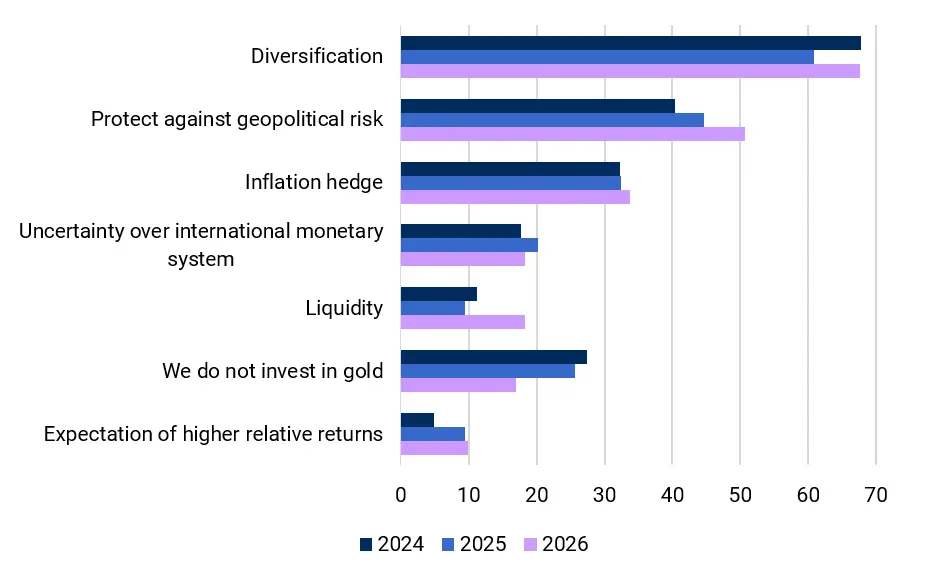
Source: OMFIF Global Public Investor 2024-26
Physical gold can offer protection against some of these vulnerabilities because it does not depend on an issuer’s promise. Yet its usefulness remains conditional on ownership and access. Secure, accessible gold can remain useable when financial infrastructure fails or access to other reserve assets is restricted. Reserve managers must therefore assess diversification benefits alongside the legal and operational conditions governing crisis access.
3. Tokenisation’s strongest case key numbers lies in mobilising gold
Tokenisation could make gold easier to transfer, pledge and deploy across financial markets. Faster settlement and automated collateral processes may improve the efficiency of existing holdings, creating opportunities to mobilise gold without necessarily changing its strategic allocation.
However, technological convenience does not automatically reproduce the characteristics central banks value in physical gold: direct ownership, legal certainty and dependable access during crises. Tokenisation therefore presents a stronger case as a mobilisation mechanism than as a substitute for physical reserves. Official adoption would require enforceable ownership rights, reliable redemption into physical gold, resilient infrastructure and strong compliance arrangements. The decisive question is whether a tokenised structure preserves gold’s strategic purpose while improving its operational usefulness.
4. Retail demand combines long-term saving with active trading
Retail investors primarily purchase gold to preserve wealth over the long term, but treating them as a uniformly patient investor base overlooks important differences. A smaller, actively traded segment can amplify price movements and contribute to volatility, complicating assessments of retail demand’s stabilising influence. Retail purchases are also more price-sensitive when measured by weight than by value.
Digitalisation could broaden participation by making gold easier to access and trade. Sustained adoption, however, depends on trust, transparent fees and interoperable infrastructure. Understanding these distinctions helps reserve managers interpret market conditions and changes in demand.
5. Gold’s environmental footprint should be assessed within a resilience framework
Gold’s appeal as a safe haven reflects concerns about geopolitical tensions, economic uncertainty and inflation. Climate change can intensify these pressures by exacerbating instability and pushing up food and energy prices.
This connection gives reserve managers reason to examine gold’s environmental footprint alongside its protective qualities. Assessing those emissions helps clarify how an asset held to cushion portfolios against volatility may also contribute to an underlying driver of volatility. Environmental considerations therefore fit within a broader assessment of gold’s long-term strategic role.
Andrea Correa is Head of Research at OMFIF.
Download ‘Holding power: How reserves, technology and investors are reshaping the gold market’.

Interested in this topic? Subscribe to OMFIF’s newsletter for more.