

With the euro area crisis in full swing in April 2012, dozens of governments collectively committed more than $430bn in new resources to the International Monetary Fund. Christine Lagarde, then-IMF managing director, celebrated the deal as raising the IMF’s total resources above $1.3tn, which translated into an ‘almost doubling’ of the Fund’s lending capacity to roughly $1tn.
The international community, she said, had demonstrated its resolve to safeguard global financial stability. For the past 14 years, the IMF’s lending capacity has barely changed (Figure 1).
Figure 1. Fund’s lending capacity relatively unchanged
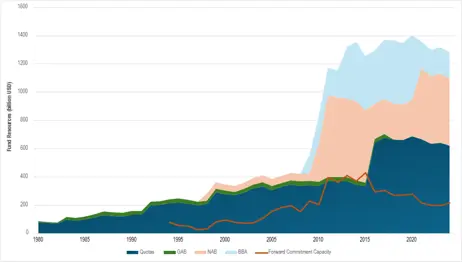
Source: International Financial Statistics, IMF annual reports
A $1tn lending capacity looks increasingly inadequate relative to the global economy. Since 2012, nominal global gross domestic product has risen to roughly $118tn today from around $76tn, an increase of 56% or 44% after adjusting for inflation. Relative to other benchmarks, such as global external liabilities, the shortfall is even more stark. In a 2023 speech, Kristalina Georgieva, current managing director of the IMF, noted that in 1980, the IMF’s lending capacity covered about 2.5% of global external liabilities. By 2000, this was down to 1.5%. Today, it is below 1%.
Fund staff noted in 2021 that past quota increases typically restored the IMF’s quota base to around 1.2% to 1.3% of global GDP. This implies a target quota base of around $1.47tn today. However, even after the 16th General Quota Review, which will result in an equiproportional 50% quota increase if fully implemented, the IMF’s quota base will rise to only $960bn. This amounts to only 65% of the historical target. Moreover, this quota increase was designed to replace borrowed resources and leave the IMF’s overall lending capacity unchanged. No matter how you benchmark it, the IMF is being asked to backstop an expanding global economy with a stagnating level of resources.
How large the IMF should be has long divided its members. At the 1984 IMF-World Bank annual meeting, Donald Regan, then-US secretary of the Treasury, acknowledged that members had just recently ‘significantly strengthened IMF resources’, and that now it was essential ‘to husband [their] use’. Pranab Kumar Mukherjee, India’s minister of finance, reached the opposite conclusion, arguing that the quota increase ‘was lower than what even a pessimist would have predicted’.
My research on thousands of statements delivered at the IMF-WB annual meetings shows that this divide is remarkably persistent. The figure below characterises speeches delivered at the annual meetings, with lower scores indicating greater pessimism regarding the adequacy of the IMF’s resources. Since the 1960s, emerging and developing economies that may borrow from the IMF have repeatedly called for significant expansions in the IMF’s lending capacity while the major shareholders, especially the G5 of the US, Japan, Germany, Britain and France, have generally been more circumspect.
Figure 2. Waves in sentiment regarding Fund’s resource adequacy
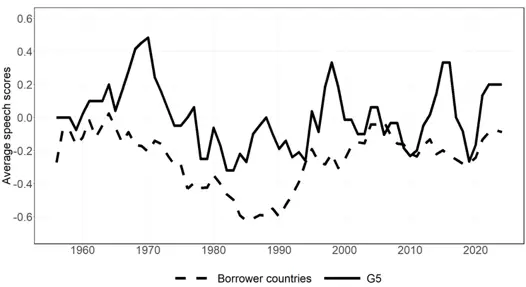
Source: Statements from IMF-WB annual meetings
The caution of the major shareholders matters because IMF governance gives them considerable leverage over resource decisions. A general quota increase requires approval by members holding at least 85% of the Fund’s voting power. Since the US alone holds more than 15%, expansions in the IMF’s lending capacity cannot proceed without the support of the largest shareholders. The erosion in the IMF’s lending capacity is therefore a result of the IMF’s governance structure and the declining willingness of the major economies to bear the costs of sustaining the postwar international economic order.
At the 1989 annual meeting, César Vásquez Bazán, Peru’s minister of economy and finance, put it this way: ‘Forty-five years after the historic debate between Keynes and White on the resources that the Fund would need for operations… a clear majority of countries is calling for an increase in the resources of the Fund… Nevertheless, a few countries have chosen to ignore that call… It is incomprehensible that half a century later, we are still discussing the same issue.’
The striking thing today is that this debate has largely disappeared from view. The published programme of public events for the 2026 annual meeting in Bangkok contains no event devoted to the adequacy of the Fund’s lending capacity. If roughly $1tn was the amount member states judged necessary in 2012, leaving it essentially unchanged for 14 years deserves renewed attention. More than three decades after Vásquez Bazán called it incomprehensible that governments were still debating whether the IMF had sufficient resources, what is incomprehensible today is how little public debate occurs at all.
Michael Gavin is a Lecturer in International Relations, School of Political Science and International Studies, University of Queensland.

Interested in this topic? Subscribe to OMFIF’s newsletter for more.