
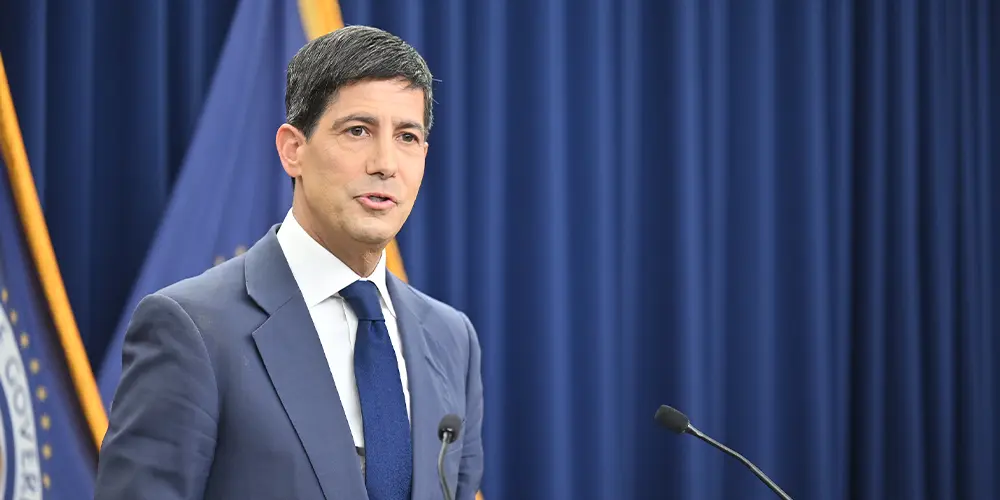
Karl Marx once said: ‘The philosophers have only described the world… the point, however, is to change it.’ New policy-makers always need time to find their communications footing. But after two elliptical press conferences that fell flat, caused much head-scratching and began to hit his reputation, Jackson Hole was an opportunity for Federal Reserve Chair Kevin Warsh to speak frankly. He began to do so, though he avoided the elephant in the room.
Economic assessment
Towards the end of his address, Warsh – better late than never – turned to his economic assessment and tackled some of his earlier perceived missteps. He argued that the labour market is consistent with full employment. In achieving price stability, which he underscored was the Fed’s job, Warsh stressed that the Fed is committed to its 2% personal consumption expenditures target, rather than emphasising that the information provided by other measures warranted close monitoring.
Short-term rates are the Fed’s key tool. On the balance sheet little was said other than that unconventional policy should be ‘used sparingly, if at all’. Year-over-year PCE was 3.7% and the six-month change annualised was 4.1%. No matter how you slice it, that’s greater than 2%. Warsh emphasised that the last two months of muted price readings didn’t suggest that meaningful underlying progress was afoot. To boot, financial conditions are not restrictive in his view.
As this assessment was perceived as hawkish, bond market yields surged. The probabilities for a September hike jumped from roughly a third towards almost two-thirds. The move was concentrated at the front end – two-year yields rose 14 basis points, flattening the yield curve. The flattening could be read as suggesting that the Fed can set the policy rate, but not the term premium. Yet, Warsh avoided definitively or firmly signalling that a September hike was in the bag.
Markets will be looking for action, not philosophising. The clear logic of Warsh’s speech is that the Fed funds rate should move higher. But that runs the risk of perturbing President Donald Trump who has again called for lower rates, suggesting Warsh’s honeymoon may be brief. To be sure, there is a path back to 2% inflation if supply shocks subside and energy prices come down, but Warsh hardly seemed to be banking on it. Absent major data surprises, if the Fed doesn’t hike in September, Warsh’s reputation will take further hits, and the market will punish the Fed. Warsh should choose his poison.
Philosophers don’t make good central bankers
More can be less. Near-silence can be golden. Former Chair Jerome Powell proved that with his 8-minute Paul Volcker-esque speech at Jackson Hole in 2022. Warsh’s speech could have been more impactful had it stuck to the current economic situation, but it largely tackled other broader themes.
Would a Warsh speech be complete without tedious philosophising about forward guidance and reaction functions, the stuff of navel-gazing central bankers? Forward guidance is clearly too prescriptive for Warsh. Perhaps defining one’s reaction function could properly steer markets because it is not a target that commits a central bank to how it would respond to developments. But explicit reaction functions are a bridge too far, especially as Warsh objects that forecasting is inexact.
But if all that holds, what then are the guideposts? The Warshian answer: perhaps markets can provide information to the Fed rather than the central bank spoon-feeding markets. But, of course, markets seek the authorities’ guidance and, if the chair won’t provide it, they’ll find it elsewhere. And you cannot tell investors to play the ball rather than the referee without telling them the rules.
‘Transparency in communications about future policy decisions is not a virtue unto itself,’ said Warsh. On that front, he has succeeded.
The AI boom
AI may be a ‘hinge point’ in history, but it’s certainly not about the here and now for monetary policy, as Warsh acknowledged.
But much goes unstated. In the short term, booming AI investment is boosting demand and won’t facilitate easing inflation. While the late 1990s burst in productivity is cited as keeping a lid on inflation, it is also used to infer that interest rates could come down. But it wasn’t that Alan Greenspan didn’t cut rates in response; he just didn’t hike them. If AI boosts productivity as Warsh avers, that should lift the neutral rate.
The elephant in the room
Warsh understandably didn’t touch on the elephant in the room. But if he wants to be credible, he may need to soon.
That is because Treasury Secretary Scott Bessent, on behalf of Trump, may have launched the opening salvo in a Treasury-Fed battle over the future of the Fed’s balance sheet and independence.
Warsh says in effect he wants bond markets to find their own levels. But bond market yields, particularly in the long end, are being pushed higher first and foremost by America’s incontinent fiscal policies, along with other factors such as persistent inflation, geopolitics and AI demand. Again, if inflation falls back towards 2% or the AI boom drops, longer-term rates could well come down.
In the meantime, the administration is alarmed over the higher rates – the government’s interest bill is soaring and high mortgage rates are hitting the housing market. This will not win the Trump administration friends at the ballot box. But America’s political class is shamefully unwilling to do anything about its self-inflicted fiscal recklessness. For the Trump administration to do so now would mean walking back on the One Big Beautiful Bill. Nor can Trump credibly argue tariff revenue will save the day.
To the rescue – Bessent, purported ex-hedge fund wizard. Bessent’s call for expanding usage of the Foreign and International Monetary Authorities repurchase agreement facility and the increased use of buybacks have direct implications for the Fed’s balance sheet. They are a manifestation of creeping fiscal dominance and a seeming wish to use financial repression to keep a lid on rates and reduce the government’s interest bill. And should we be surprised? After all, Trump posted on Truth Social in July: ‘Fed should cut Rates by 3 Points. Very Low Inflation. One Trillion Dollars a year would be saved!!!’
But Bessent’s manoeuvres, including the recent Treasury yen intervention, are at best band-aids. Are calls for quantitative easing or yield curve control, which Warsh would presumably find contrary to Fed independence, next in the Trump verbal armoury? Will Warsh have the intestinal fortitude to stand up to his anointers? Maybe next year’s Jackson Hole speech will write itself.
Mark Sobel is Vice Chair and Chief Economist of OMFIF.
Join OMFIF on 9 September for the next instalment of Money Disrupted: Will Warsh quell inflation and can the AI boom last?

Image credits: Federal reserve
Interested in this topic? Subscribe to OMFIF’s newsletter for more.