
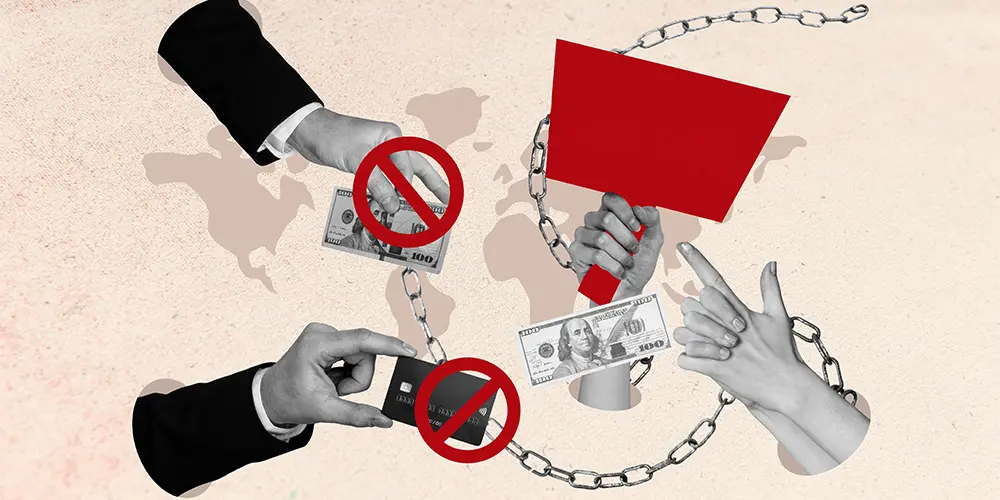
Washington’s campaign against Iran is shifting from military pressure towards financial coercion. Under Operation Economic Outcast, Treasury Secretary Scott Bessent has said the US is likely to announce new secondary sanctions every week, starting with banks and threatening institutions that maintain ties with Iran with exclusion from the dollar-based financial system. The aim is to turn Iran into a pariah economy and make continued resistance economically unsustainable.
The pressure is already being felt: President Masoud Pezeshkian said Iranian trade has fallen by nearly 35% because of US sanctions and the naval blockade, while annual inflation reached 66% in July. Yet economic pain is not the same as political compliance. Six months into the war, Tehran has not retreated and still sees the Strait of Hormuz as leverage.
The reach of the dollar
Washington’s strategy does not rest on a United Nations-backed global embargo. The presence of China and Russia on the Security Council make reaching consensus highly unlikely. But the US does not need UN approval to restrict access to its own financial system. Secondary sanctions force foreign institutions to choose between commerce with Iran and access to US correspondent banking and dollar transactions. The European Union has long regarded the extraterritorial application of US sanctions on Iran as contrary to international law, leaving their broader legitimacy contested.
The Banque Misr case demonstrates this power. The US Treasury has proposed cutting the Egyptian bank’s United Arab Emirates branches off from US correspondent banking after assessing that they processed about $1.8bn for companies potentially connected to Iranian shadow banking networks. The branches remain open but the threat to dollar access creates a powerful incentive to comply even outside the US.
China sets the limit
The decisive test is China, Iran’s largest trading partner and principal oil customer. Reuters estimated Chinese imports of Iranian crude at about 534,000 barrels per day in August, down from a peak of 1.6m earlier this year after the US reinstated its blockade. Yet independent Chinese refiners continue to buy Iranian crude, often through non-dollar channels, while Washington has so far avoided penalties against major Chinese banks.
Sanctions are therefore constraining Iran, but complete isolation would require a confrontation with institutions the US may be reluctant to target. The same dilemma applies across Iran’s neighbourhood. Tighter enforcement against remaining trade and payment routes risks imposing collateral costs on countries whose banks, ports and supply chains connect to both economies.
Hormuz spreads the shock
That damage is visible in energy markets. The Strait of Hormuz normally carries about 20% of global petroleum consumption and more than one-fifth of liquified natural gas trade. Shipping remains severely disrupted and Brent moved above $90 a barrel at the end of August.
Oil and gas are only part of the exposure. Hormuz is also a major route for agricultural inputs, handling about one-third of internationally traded fertiliser, and the disruption has already raised production and transport costs across agricultural supply chains. Fertiliser markets are particularly exposed because there is no equivalent of a strategic petroleum reserve that can quickly replace lost supply.
The Food and Agriculture Organization of the United Nations has warned that shortages and higher fertiliser costs threaten crop yields and food supplies into 2027, with import-dependent economies in Africa and Asia among the most exposed. A prolonged confrontation with Iran could ultimately feed through from oil prices to agricultural production and, eventually, to global food inflation.
Pressure at home
Those spillovers also matter for Washington as US gasoline prices have remained above $4 a gallon, roughly $1 higher than a year ago. What began as a geopolitical shock is therefore becoming an increasingly visible cost for American households, just as the US heads into the 3 November midterm elections with control of Congress at stake.
An August Reuters-Ipsos poll found voters preferred Democrats to Republicans by 36% to 28% on the cost of living. A later Reuters-Ipsos poll found Trump’s approval rating stands at 33%, with 71% disapproving of his handling of living costs. Democratic voters also report greater enthusiasm about participating in November’s elections than Republicans.
Fuel prices will not determine the elections on their own, but they reinforce a Republican vulnerability on affordability. The longer disruption in Hormuz keeps energy costs elevated, the greater the risk that Washington’s campaign against Iran becomes an electoral liability at home.
The administration is clearly aware of this pressure and Trump is expected to meet US refiners and fuel retailers as the White House looks for ways to bring gasoline prices down before November. The Strategic Petroleum Reserve is near a 44-year low at around 290m barrels, while Trump’s plan to replenish it with Venezuelan oil underscores Washington’s search for alternative supply and how Iran-related disruption is feeding back into US energy policy.
The dollar-gold paradox
Aggressive sanctions will not necessarily weaken the dollar immediately. The dollar’s share of global foreign exchange reserves rose to 57.1% in the first quarter of 2026 from 56.4% in the previous quarter, according to the International Monetary Fund, partly reflecting valuation effects and the Middle East conflict. Dollar dominance is precisely what gives US sanctions their force.
But repeated use of that force can strengthen incentives to diversify. OMFIF’s 2026 Global Public Investor survey found that, for the first time since the report began recording central banks’ long-term intentions in 2023, more reserve managers plan to decrease their dollar holdings than increase them over the next 10 years. Gold has emerged as one of the clearest beneficiaries, as 82% of central banks now hold physical gold and a net 30% plan to increase their allocations over the next 1-2 years.
Protection against geopolitical risk is becoming an increasingly important motivation, cited by 51% of respondents. Sanctions may reinforce demand for dollars in the short run as institutions seek to remain inside the US system. Over time, they can also strengthen the case for gold and alternative payment channels as insurance against geopolitical risk.
Success therefore depends on the objective. If the aim is to damage Iran’s trade and intensify domestic economic pressure, the campaign is working. If the objective is economic collapse or a change in Tehran’s political position, the outcome is far less certain. As long as China remains a partial outlet and Hormuz gives Tehran a way to impose costs on the rest of the world, Washington faces a trade-off between tighter enforcement and wider disruption. Economic warfare may isolate Iran further, but it cannot isolate the world economy from the consequences.
Yara Aziz is Senior Economist at OMFIF.
Join OMFIF on 9 September for the next instalment of Money Disrupted: Will Warsh quell inflation and can the AI boom last?

Interested in this topic? Subscribe to OMFIF’s newsletter for more.