
Money went digital decades ago. Tokenisation does not change that. It changes the route in which claims travel and the balance sheet against which payment becomes final. That determines who creates liquidity, who absorbs risk and whether a dollar at one bank still equals a dollar at another.
The contest over tokenisation is a contest over money’s anchor. Start with the instrument. A tokenised deposit is a commercial-bank deposit recorded on a programmable ledger. It remains the liability of the issuing bank. It is redeemable at par. The ledger may allow round-the-clock transfer, conditional execution and simultaneous exchange against another asset. None of that comes free with technology. Each feature depends on how the system is designed and what the law recognises. Bank credit risk stays with the claim. Cyber, operational and legal-finality risk sits with the rail.
The Genius Act already contemplates this. Its definition of a deposit covers one recorded on a distributed ledger. In April 2026, the Federal Deposit Insurance Corporation proposed to make the point explicit in its coverage rules. The rule is not final, and the Genius Act does not take effect until 18 January 2027, or 120 days after the primary regulators issue final rules if that comes sooner. The legal position much of the market treats as settled is still a docket.
Three digital dollars can look identical and mean different things (Figure 1). A tokenised deposit is a claim on a bank, with the bank’s balance sheet and prudential regime standing behind it. A fiat-backed stablecoin is a claim on its issuer. What that claim is worth depends on the reserves behind it and on whether redemption is legally enforceable. Tokenised central-bank reserves carry no private credit risk at all. The question is never how the token looks. It is who owes the holder the dollar.
Figure 1. Three digital claims
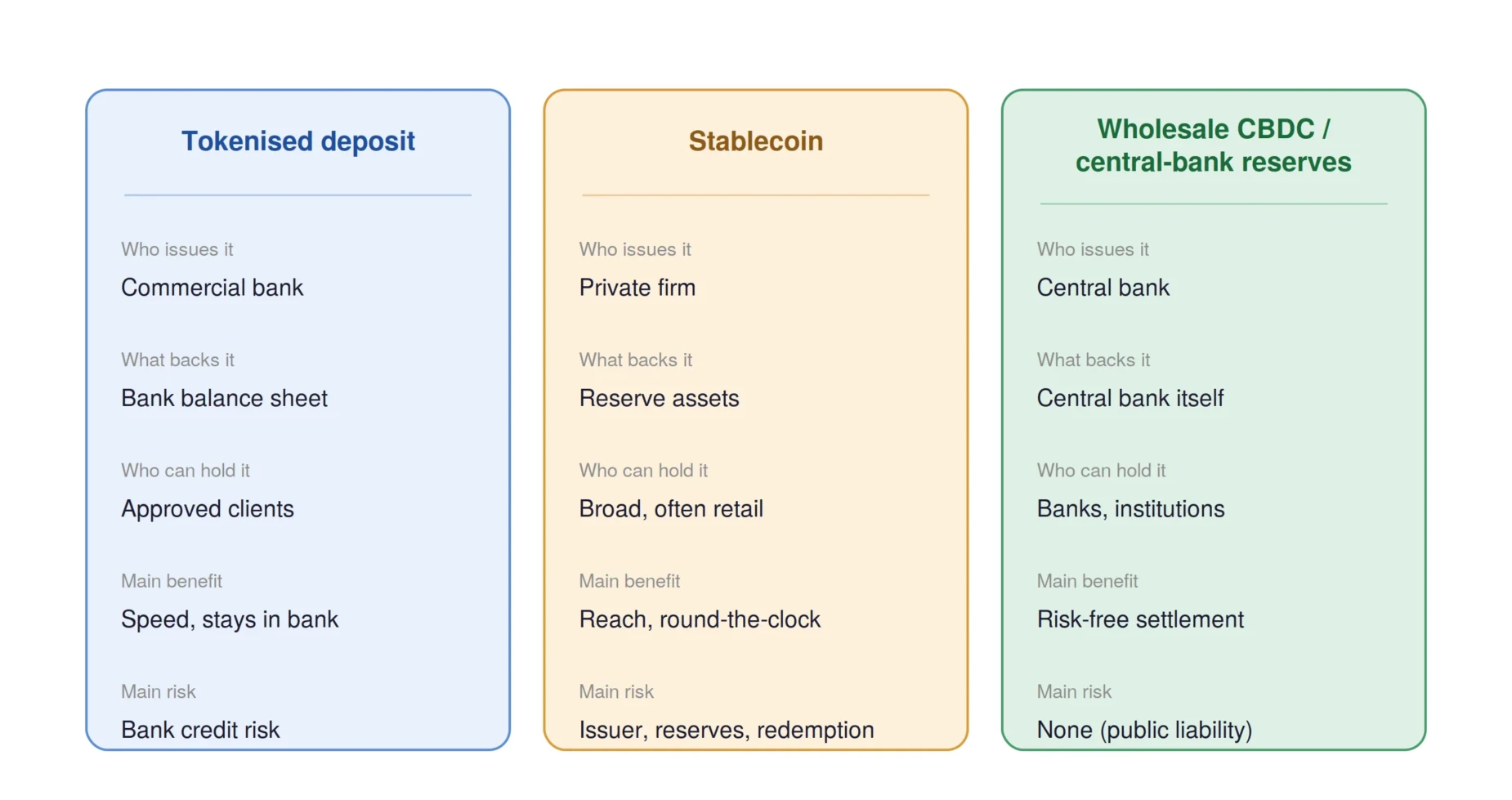
Source: Adrian (2026), Garratt and Shin (2023) and Bank for International Settlements (2026).
Within a single bank, a token can change owner and stay the bank’s liability. Across banks, more is needed. The sending bank cancels its token. The receiving bank issues a new one. The interbank obligation settles in central bank money. A shared programmable platform can make those steps atomic. It does not remove the public settlement anchor. It brings the anchor onto the new rail. Payment can be fast and still not be final.
Atomic settlement with Agorá
Project Agorá shows the promise and the limit in the same test. Its prototype, reported in May 2026, put tokenised deposits and tokenised reserves on one multi-currency platform. In July, 28 financial institutions and central banks completed controlled real-value transactions worth about CHF 800,000 across 17 scenarios, settling on average in roughly 80 seconds. Atomic settlement worked. Feasibility is not commercial scale. Currency conversion, compliance and differences in national law all remain.
The near-term case is wholesale and cross-border. Domestic instant payments already work for households. Tokenisation earns its keep where cash, securities and collateral have to move together under compliance. But efficiency has a price. Atomic settlement reduces principal risk. It also raises intraday liquidity demand because settling gross in real time ties up more cash than deferred netting. Always-on execution can synchronise withdrawals, margin calls and collateral sales. Concentrate on the ledgers or cloud providers, and one operational failure becomes a market event.
The deeper issue is architecture. Singleness is the property that makes a dollar at one bank interchangeable with a dollar at another bank. It is held because private bank money settles against a common public asset. Tokenised deposits can keep that structure intact. They also keep the elasticity of a two-tier system, in which banks create deposit money by lending. Stablecoins are pre-funded. They may extend reach. They do not create credit.
No guarantee
Now the part that is usually asserted rather than argued: stablecoin growth does not automatically remove an equal volume of bank funding – it relocates it. Who buys the token matters, and so does where the issuer parks the reserves. If reserves come back as bank deposits, funding is recycled, but into balances that are larger, more concentrated and quicker to leave.
If reserves are invested in Treasury bills, bank balance sheets shrink. The credit effect turns on composition and distribution, not on the headline number. Work by the Federal Reserve Board staff lands in the same place: aggregate credit supply is likely to fall, lending costs are likely to rise and access is likely to become uneven across borrowers and regions. Tokenised deposits are the banking system’s answer to competition for the deposit franchise. They are not a guarantee that intermediation survives unchanged.
Jurisdictions are already chosen differently. The Eurosystem’s Pontes will connect tokenised platforms to Target Services and keep settlement in central bank money, with initial launch planned for this quarter. The US has legislated a federal framework for payment stablecoins. For the issuer of the dominant currency, regulated dollar tokens extend reach and support demand for its own safe assets. For everyone else, the same instrument can import digital dollarisation.
Emerging and developing economies
That trade-off is sharpest in emerging and developing economies. Dollar stablecoins cut cross-border friction and offer a store of value where the domestic currency is not trusted. Roughly 98% of stablecoin value is dollar-denominated, so the traffic flows in one direction. The same tokens accelerate currency substitution, thin out local bank funding and complicate monetary control. Regulating the token will not fix that. A jurisdiction needs a currency that people choose to hold and rails they choose to use. A weak monetary anchor cannot be repaired by a better ledger.
The outcome will be mixed rather than clean. Banks will issue tokenised deposits. Central bank money will remain the interbank settlement asset. Stablecoins will hold the markets where open-network reach matters most. Tokenised securities will grow where synchronised settlement pays for itself.
The test is not speed. It is whether the new architecture preserves singleness, supplies liquidity under stress and stays governable when automated markets move faster than committees. Technology changes the form of money. The institution behind the promise still sets its quality.
Udaibir Das is Vice Chair of OMFIF, Member of the Bretton Woods Committee, Distinguished Fellow at the Observer Research Foundation-America, Visiting Professor at the National Council of Applied Economic Research, and Senior Adviser of the International Forum for Sovereign Wealth Funds.

Interested in this topic? Subscribe to OMFIF’s newsletter for more.