

The digital euro is usually discussed as a matter of monetary sovereignty, privacy and financial architecture. For users, the decisive questions may be less grand: how long will it take to sign up? Will it work as quickly as a card? Will sending money to a friend be easier than making a bank transfer?
These details look prosaic next to the future of public money. They are not. Small frictions can compound into large differences in adoption. A strategically important instrument that is awkward to use could become a wallet people possess but rarely open.
The European Central Bank’s approach to promoting adoption of the digital euro has already drawn concerned comment. The central bank is expending immense political capital to get the legislation through a thoroughly ambivalent parliament and, while it is expected to succeed, the project’s opponents will be keeping a watchful eye on its adoption. If the ECB doesn’t set and achieve realistic targets for the instrument’s use, then it will find itself the subject of hostile investigations into its costs.
To see how likely this is, OMFIF teamed up with a researcher at Imperial College London’s Centre for Financial Technology to explore how three design decisions might shape that outcome. We built an agent-based model that simulates buyers deciding whether to adopt a new digital payment method and when to use it across retail, person-to-person (P2P) and online channels.
What the model indicates
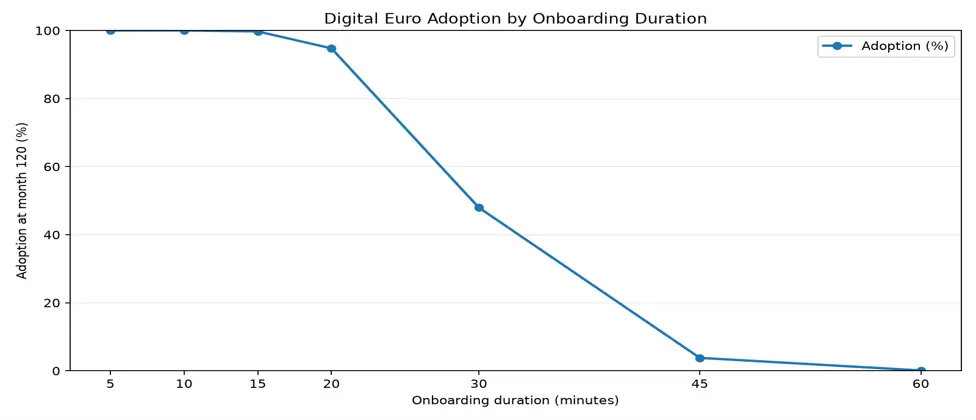
Swedish payments app Swish and the Riksbank’s modelling of its adoption forms the baseline. As a result, the agent-based model indicates that friction in the sign-up process is a key barrier to adoption and that the ECB should ensure that signing up should take no more than 20 minutes (Figure 1).
Figure 1. Users engaged in onboarding for the first 20 minutes
% of agents adopting the digital euro
Source: Centre for Financial Technology
If the digital euro is primarily accessed through banking apps, then sign-up should be quick because the bank has already gathered all the information necessary for know-your-customer/anti-money laundering checks.
However, banking apps’ existing functionality does not provide efficient peer-to-peer payments. Swish’s adoption trajectory demonstrates that successfully making these payments more efficient was the most important factor in driving adoption.
The ECB’s plans show an intention to develop its own app as well as to make the digital euro available through banking apps. The model indicates the central bank should ensure that, as well as having a sub-20-minute sign-up process, the app should optimise for fast P2P transfers.
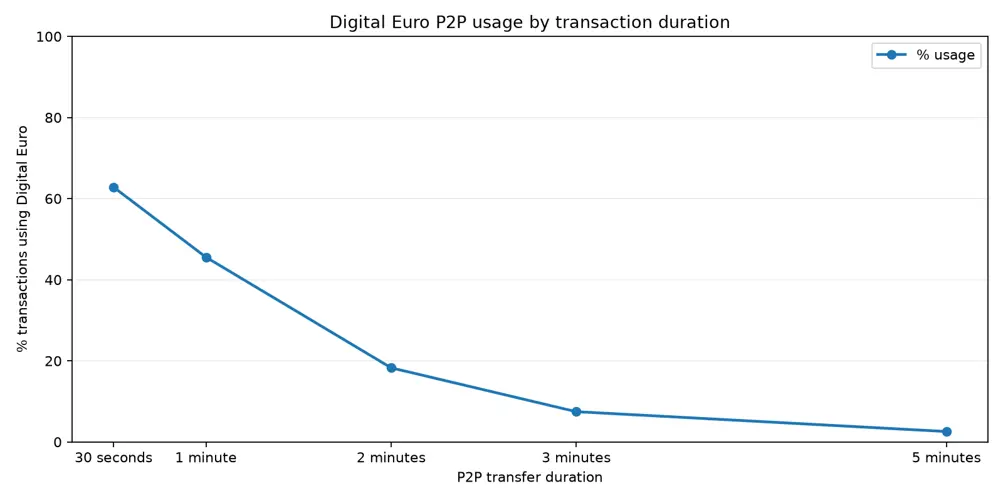
The ECB should aim to make P2P transfers as fast as Swish. In that system, a user can send money by selecting someone from their phone’s contacts or entering a phone number. Most people know their own phone number and can share it easily. We estimate that transfers of this kind take around 30 seconds.
If the recipient instead needs to display a QR code or copy and paste from an easily accessible place on the digital euro app, we estimate that P2P transactions would take around 60 seconds. Or if the recipient needs to log in to their legacy banking app to copy and paste two numbers (such as sort code and account number), we estimate that takes around two minutes.
Figure 2. How long is too long for a digital euro payment?
% of P2P payments using the digital euro as transaction times increase
Source: Centre for Financial Technology
ECB on the right track in some areas
Although there are concerns about the ECB’s approach to catalysing digital euro adoption, it has already signalled its intention to deliver two of the most important features: waterfall/reverse waterfall funding and co-badging.
Given the holding limits proposed for the digital euro, it is vital that the instrument does not require users to constantly top up their wallets to ensure that they have the funds necessary to complete a transaction. The waterfall allows funds received that would take the holder over the limit to be diverted straight into a nominated bank account, while the reverse waterfall allows wallets to draw straight from bank accounts in order to fund a transaction. Having to manually fund the wallet would introduce a friction to the use of the digital euro that would be fatal to adoption.
Similarly, the ECB plans to enable co-badging, allowing the digital euro to be used via a physical card (or digital equivalent residing in a mobile wallet). This would allow the digital euro to be used for in-store payments that would take around 12 seconds, comparing favourably with the 56 seconds for in-store payments with Swish.
This would markedly improve its adoption trajectory for retail payments. However, the model shows that P2P is the more fertile ground.
Product policy is part of sovereignty
So far, the ECB has communicated that they believe the digital euro is a vital step to achieving strategic autonomy in European payments. Still, it has failed to provide compelling reasons for citizens to use it.
These may come from merchants, who might advocate on the digital euro’s behalf if – and only if – it represents saving versus incumbent payment methods.
But even if the central bank can get merchants on-side, product design will be key. Our results indicate the ECB should focus on delivering efficient sign-up and quick P2P payments through its standalone app, while its plans for co-badged cards should help with adoption for in-store payments.
The timing benchmarks support those choices: sign-up should take no more than 20 minutes, P2P payments should take 60 seconds or less and retail payments should match the speed of a physical card (12 seconds or less). The exact numbers will change outside a model, but the direction is clear.
The ECB may build a digital euro that is safe, resilient and technically impressive. That will not be enough if it is annoying to use. The digital euro is public infrastructure, but it also has to be a good product.
A more detailed description of the model is available here: Using agent based modeling to predict digital euro adoption.
Lewis McLellan is Head of Content at the Digital Monetary Institute at OMFIF and Cal Mitchell is Researcher at the Centre for Financial Technology at Imperial College London.

Interested in this topic? Subscribe to OMFIF’s newsletter for more.