

Market commentators are atwitter debating Japan’s foreign exchange market intervention and the US unusual participation. The yen’s weakness is a misalignment reflecting Japan’s inconsistent economic policies, not market disorder as the ministry of finance would have it known. That calls into question the operation’s wisdom, including the US Treasury’s unusual support.
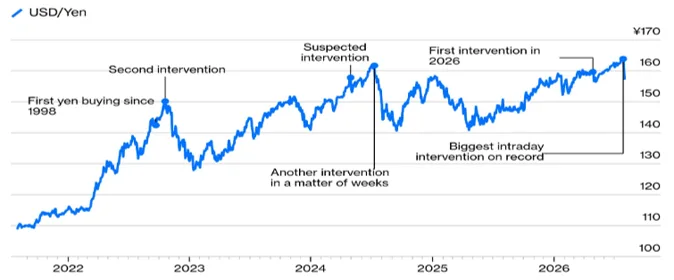
The yen’s multi-year weakness against the dollar in the ¥140-160 range frequently falls towards 160 (Figure 1). Approaching ¥160, weakness is met by the standard moves in the ministry’s playbook – jawboning, rate-checking and then intervention.
Figure 1. The finance ministry has increased its resolve to defend the yen
Source: Bloomberg
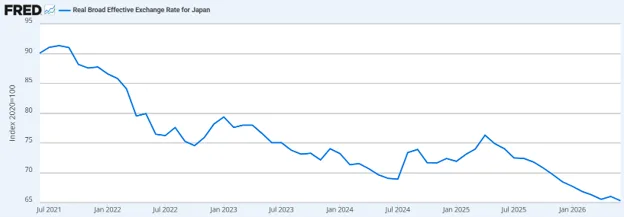
Figure 2. Yen’s weakness also pronounced on an inflation-adjusted basis
Source: Bank for International Settlements
When the yen weakens towards 160, the ministry of finance – responsible for Japan’s FX policy – characterises it as reflecting market disorder. However, trading in yen isn’t disorderly: the market is not wildly volatile; bid/offer spreads are not gapping; business is getting done.
The size of the latest intervention is unclear – estimates suggest Japanese intervention sits around $75bn and the US operation, much smaller, is probably closer to $5bn to $10bn. But that’s guesswork. If markets aren’t disorderly, what’s really going on?
Overly accommodative policy
Markets are responding to doubts about Japan’s macroeconomic policy. Monetary policy is seen as overly accommodative, fuelling a carry trade. Despite higher inflation in recent years, the Bank of Japan has been cautious in hiking rates given Japan’s long prior bout of low growth and de/lowflation.
Regardless, Japan’s official rate is 1.0% versus the federal funds rate at 3.5% to 3.75%. The longer term spread between US and Japanese rates, which surged after the pandemic, has been declining. But it’s still wide, the BoJ owns half of Japanese government bonds keeping rates down, and US long-term rates moved higher in 2026. Plus, market pricing suggests the Federal Reserve may hike again this year.
Japanese fiscal deficits relative to GDP have decreased in recent years, but Japan’s debt is high and the Sanae Takaichi administration wants to expand spending for technology, defence and boosting consumption. Given Japanese energy dependence, the yen is not helped by the Iran war.
The yen’s weakness is also unpopular with Japan’s citizenry, dampening real incomes and boosting inflation. It is a political issue. The ministry’s interventions check the box on being seen as doing something.
A successful and sensible intervention?
Often, the ‘success’ of intervention is debated, yet ‘success’ goes undefined. Broadly speaking, there is agreement that for floating currencies traded in deep liquid markets, intervention may ‘succeed’ in countering disorderly markets by briefly steadying trading, catching out stretched positions and moving exchange rates a few percentage points in the desired direction. But intervention is seen as unable to produce lasting changes unless signalling or accompanied by fundamental economic shifts.
Thus, countering disorderly markets is a recognised rationale for intervention, but if exchange rates are ‘misaligned’ that calls for policy action.
Perhaps the latest yen operation could be viewed successfully as the yen moved to ¥155 from roughly ¥164 and Japan’s seeming line in the sand of ¥160 was defended. But the yen has already moved back towards ¥158.
Further, at the time of the intervention, the BoJ kept its official rate unchanged. The Takaichi administration just called for cuts in the consumption tax on food. Markets expect a BoJ hike in the coming months that is largely priced in and markets see the BoJ as behind the curve.
America joins the party
The most surprising aspect of the operation was the unusual US Treasury participation. Japanese fundamentals aren’t meaningfully changing. This century, the US intervened only twice – the US joined the G7, buying euros in 2000 and selling yen in 2011 after the Fukushima disaster.
Further, the Treasury and the Fed held equal and identically invest amounts of yen and euros; the 2000/2011 operations were conducted 50/50. It does not appear the Fed operated alongside the Treasury this time, nor did the G7 operate collectively. Thus, from these standpoints, the highly unusual US leg of the operation didn’t make much sense.
In the operation’s aftermath, Japan’s finance minister said future dollar-selling intervention would be financed through the Fed’s Foreign and International Monetary Authorities repurchase agreement facility to avoid selling US Treasuries. Treasury Secretary Scott Bessent publicly called for the FIMA facility’s expansion. The US also used euros to purchase yen, not dollars, perhaps motivated by a desire to limit Treasury sales. Bessent later noted a weakening yen could drag down other Asian currencies and that he felt the BoJ would do the right thing. Bessent may still think, given his past, like a hedge fund trader.
It thus appears one Treasury motivation, aside from supporting a friend, may have been concerned a weak yen could spark upward pressures on US longer term rates. These have risen significantly this year – the 10-year Treasury has risen from 4.1% early in the year to 4.6% currently.
If that is the case, the best way to limit the upward surge in US yields would be to implement fiscal consolidation, rather than resort to bandages. Fed Chair Warsh will also have to improve his communications with markets, though he’s just at the beginning of his term and time will tell.
Mark Sobel is Vice Chair and Chief Economist of OMFIF.

Interested in this topic? Subscribe to OMFIF’s newsletter for more.