
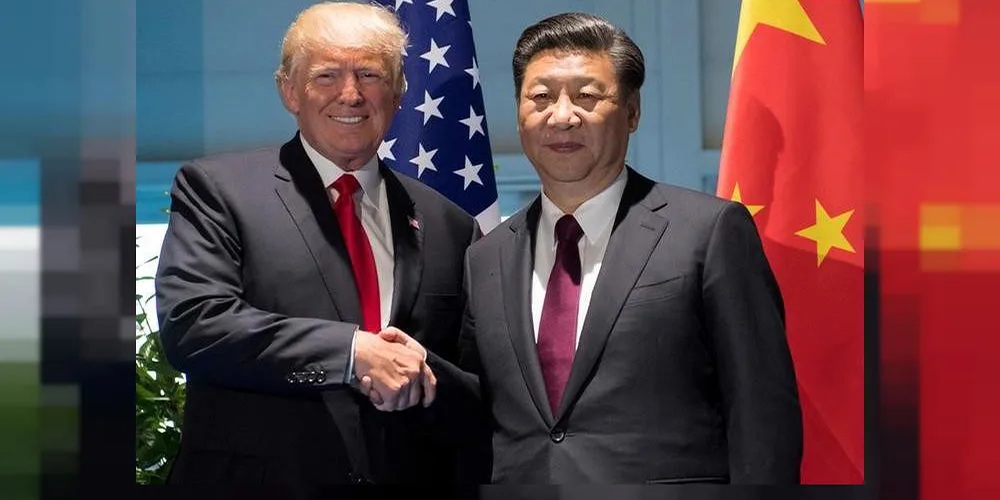
The same day in May that President Donald Trump flew to Beijing for the first state visit to China of his second term, Bristol Myers Squibb inked a deal worth $15.2bn with Jiangsu Hengrui Pharma, China’s largest pharmaceutical company by market capitalisation. The deal – one in a series of recent multi-billion-dollar licensing agreements by Big Pharma with Chinese drugmakers – embraced early-stage Chinese drug innovation as solution to its pending patent cliff and navigated around Washington’s hard-edged, bipartisan China consensus.
The timing of the summit and the blockbuster strategic partnership were coincidental. The geopolitics and economics driving the deals and the summit were not. The Big Pharma deals reflect a new calculus that may view tie-ups with players once labelled rivals as simply less risky than going it alone in a world of geopolitical fragmentation and economic uncertainty.
Imagery from JP Morgan’s Global China Summit in Shanghai last month was itself a kind of datapoint. The gathering of 2,900 delegates from 1,300 companies across 35 countries and markets was eager to assess the economy that has gone from ‘uninvestable’ to something approaching a refuge over the last five years. JP Morgan Chief Executive Officer Jamie Dimon’s headline observation – that China has become ‘more consistent’ in its dealings with the world – crystallised a sentiment circulating in global capital markets.
Whether this assertion of a ‘more consistent’ China reflects a durable reality or a convenient one is the central question investment and business leaders now must answer for themselves.
US allies are looking to China
The facts on the ground are not subtle. At the start of this year, European leaders began visiting Beijing, starting with UK Prime Minister Keir Starmer. He became the first British premier to visit China since 2018. He left Beijing with $4.5bn in trade and market-access agreements covering artificial intelligence, clean energy, finance, healthcare and auto manufacturing. Canadian Prime Minister Mark Carney made a pilgrimage too, softening bilateral tensions and agreeing to open the Canadian market to electric vehicles made in China. Korean President Lee Jae-myung and leaders from Finland and Ireland received Xi Jinping in celebrated fashion.
The pattern is unmistakable. US allies and partners, rattled by tariff whiplash, the threats to regional stability posed by the Iran crisis and Washington’s outright unpredictability, are hedging – carefully, but meaningfully. At the same time, European capitals are conducting a tense reassessment of their own exposure, weighing the benefits of closer China ties against the risk that state-subsidised Chinese goods will flood domestic markets, cost jobs and undercut small and medium-sized enterprises.
Chinese outbound investment is climbing with an emphasis on projects for Xi’s Belt and Road Initiative, undertaken in 2013 as cornerstone to China’s intention to expand its footprint primarily in the global South. Overseas acquisitions by Chinese firms reached $9.6bn in the first quarter of 2026, the strongest since early 2021, led by mining and energy. According to the Rhodium Group, Zijin Gold’s $4bn takeover of Canada’s Allied Gold is a prominent example.
The shift in capital markets is likewise striking. Thomas Fang, UBS’ head of China global markets, told investors last month that some institutional investors are seeing Chinese assets increasingly as a safe haven. He referenced their ‘risk resilience and low correlation’ with the volatility that has buffeted US Treasuries and the dollar.
The main MSCI China Index is up roughly 8% year to date. Hong Kong’s Gavekal Research notes that long-dated Chinese government bonds held their value through multiple global shocks. OMFIF’s Global Public Investor 2025 found that 30% of central bankers surveyed anticipate expanding their renminbi reserves over the next 10 years though remain hesitant in the short-term because of comparatively low Chinese interest rates.
Chinese investment not without risks
And yet, risk may be lurking inside the opportunity. The International Monetary Fund and the World Bank, while noting China’s resilience, are simultaneously documenting structural vulnerabilities that long-term investors cannot afford to overlook. Taken together, it suggests that an alternate view of the ‘China as stable anchor’ narrative may well be as a marketing construct.
The diplomatic warmth witnessed during last month’s summit obscures the long-term investment risk posed by the fact that China’s economy is fundamentally unbalanced. Key indicators in the property sector – new starts, sales, investment and sales by floor area – are down 50%-80% from their 2021 peaks, and have not yet reached bottom. Domestic consumption remains chronically weak. Retail sales growth barely exceeded 1% at the end of 2025, and deflationary pressures remain unresolved.
Private investment is depressed not because capital is unavailable – banks are liquid – but because firms are uncertain about demand and profit. Goldman Sachs, Morgan Stanley and the IMF all project growth in the 4.5%-4.8% range for 2026, sustained almost entirely by exports. That is not the profile of a self-sustaining economic anchor.
China’s 15th Five-Year Plan for 2026-30 explicitly prioritises a pivot towards consumption-led growth, but the mechanisms to achieve it – stronger social safety nets, wealth redistribution, labour market reforms – are slow-moving at best. In the meantime, China’s record trade surplus of nearly $1.2tn in 2025 is generating its own blowback. A Mercator Institute for Chinese Studies study found that 52 of the world’s 70 largest economies launched new trade defence measures or investigations targeting Chinese goods over the past year.
The world is discovering that a ‘more consistent’ China can be a synonym for ‘more aggressively mercantilist’.
Leadership without responsibility
The Hoover Institution’s Elizabeth Economy argues that both Washington and Beijing are seeking the privileges of global leadership without assuming its costs. This has direct investment implications that are only beginning to show their price tag.
The US is pulling back from multilateral institutions, foreign aid and the kind of rule-setting that gave American business a structural advantage in emerging markets for decades. China is filling the visual space – signing bilateral deals, hosting summits, running BRI projects across Africa and Asia – but not the substantive responsibilities. Its foreign aid remains a fraction of what the US historically provided. It calls for ‘stability’ in security crises while arming Russia, pressing on Taiwan and advancing its ‘community of shared future for mankind’ vision.
For business, this paints a landscape that is simultaneously more open – in the sense that old alliances and frameworks are dissolving – and more treacherous, in the sense that there is no reliable institutional architecture to rely on. The post-1945 investment environment that American and European multinationals operated within – anchored by US security guarantees, multilateral trade rules, dollar hegemony and predictable dispute resolution – is giving way to something more transactional, more bilateral and more contingent.
The corporate executives who travelled to Beijing with Trump got a taste of this new reality. Boeing’s aircraft deal, Citi’s domestic banking approval and Nvidia’s H200 clearances are significant. But they came not from the operation of rules-based institutions but from the personal diplomacy of a single summit – deals that could be renegotiated, delayed or weaponised at any point based on the political temperature between two unpredictable leaders.
Tesla left Beijing without the full self-driving approvals it sought. Apple, BlackRock, Blackstone and Goldman Sachs shored up relationships but secured no major new access. The pattern reveals something important: China is opening selectively, strategically and on its own terms.
Unreliable superpowers
The South China Morning Post’s cautionary analysis of the ‘China safe haven’ narrative argues that Chinese assets are performing well in the current environment but that does not mean the underlying structural risks have disappeared. It may simply mean that US-denominated risk has temporarily increased faster.
Sophisticated institutional investors are wise to treat both Washington and Beijing as political risk factors simultaneously – diversifying not towards either but towards third geographies (India, Southeast Asia, parts of Europe and Latin America) that are building their own capacity precisely because they cannot count on either superpower as a reliable anchor. The countries responding ‘none of the above’ to these two superpowers are, increasingly, also where patient capital is looking for its next decade of returns.
The Trump-Xi summit stabilised the US-China relationship in the near term. Markets need a floor. Corporate executives need a signal that channels of engagement remain open. The investment community has duly noted. But the deeper structural reality – an America that is withdrawing from global leadership while maintaining tariffs, export controls and semiconductor restrictions, paired with a China that is ascending in narrative faster than in institutional substance – is a world in which the old investment rules no longer fully apply.
The new ones are still being written. That is the defining investment challenge of this moment, and a single summit, however warm and photogenic, has not resolved it.
Marsha Vande Berg is Deputy Chair of the OMFIF Advisory Council and Chief Executive Officer of MVandeBerg Advisory. She writes ‘Context at Geostrategics’ coming on Substack.
OMFIF’s Global Public Investor 2026 launches on 30 June. Register to attend the launch and find out how central bank sentiment towards China and the US has changed.

Image Credits: BipHoo Company
Interested in this topic? Subscribe to OMFIF’s newsletter for more.