
With most of the UK currently sitting under a rare ‘red’ warning for extreme heat, the irony has not been lost on attendees of London Climate Action Week, who gathered in the capital to discuss the risks of a warming world. The nine-day event is Europe’s largest city-wide climate festival, aiming to foster practical solutions and global climate diplomacy.
In London, temperatures reportedly reached peaks of 39°C, underlining the urgency of climate action in a city whose infrastructure remains ill-equipped for such extremes but whose position as a global financial centre gives it outsized influence in mobilising capital for the transition.
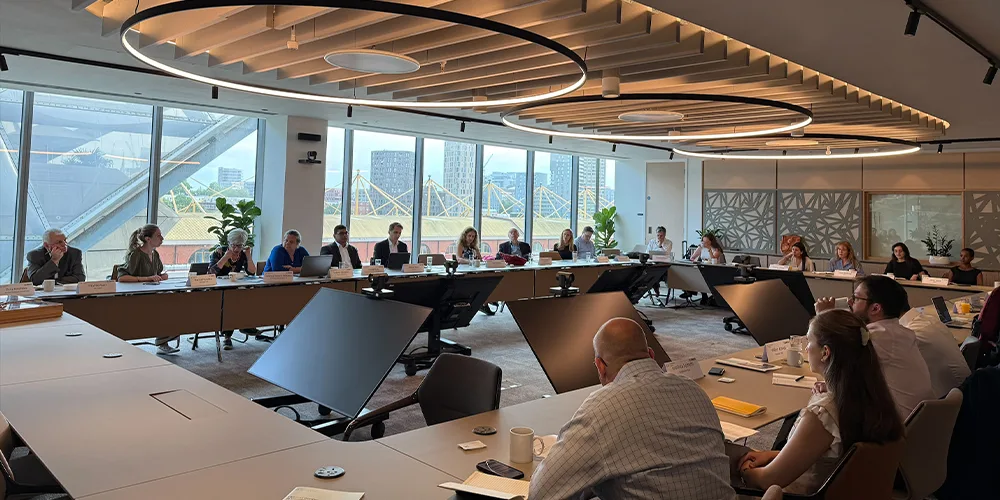
To mark the convention, OMFIF’s Sustainable Policy Institute co-hosted a roundtable with Sustainable Fitch. It brought together investors, standard-setters, asset managers and policy-makers to compare signals from the market and pressure-test where consensus is emerging and where major differences remain. OMFIF also attended a number of events for LCAW to learn how investors are approaching decarbonisation and what frameworks and incentives will be needed to support the transition in the years ahead.
The semantics of transition
A resonant theme at the OMFIF-Sustainable Fitch roundtable was the growing importance of language and definitions in climate finance. For many, exactly how concepts are framed can materially influence their adoption and effectiveness.
A pension fund executive in attendance pointed to the rise of ‘systemic stewardship’: a term used in recent years to describe coordinated engagement among multiple stakeholders in order to make informed decisions about investment.
While the underlying practice itself is far from new, the participant suggested that labelling it so has helped elevate its profile as an approach and encouraged broader uptake. By providing a clearer framework, complex processes are made more comprehensive, accessible and, in turn, more actionable.
More nuance, more flexibility
The discussion also reflected a wider shift in how investors assess transition plans. As one asset manager observed, climate investing is becoming increasingly nuanced – for better and potentially for worse. While climate performance was historically assessed primarily through carbon emissions, investors are incorporating a wider range of indicators that capture resilience, adaptation and transition preparedness.
The conversation is no longer framed in binary terms of ‘green versus brown’ or ‘aligned versus misaligned’. Instead, investors are taking a more holistic view of their portfolios, assessing how multiple factors interact and influence one another. This allows greater flexibility in approaches to transition plans, meaning greater attention is being paid to the realities facing different sectors of the economy, as well as different jurisdictions across emerging and developed markets.
Yet, this need for nuance muddies the waters, creating competing definitions and a proliferation of metrics. Roundtable participants were unanimous in identifying the measurement of success as one of the sector’s most persistent difficulties. Several observed that success itself has become a moving target, with benchmarks evolving alongside market expectations and advances in climate science.
To address this, investors are increasingly adopting the ASCOR framework, the first publicly available, independent and open-source investor framework and database assessing climate-related opportunities and risks of sovereign bond issuers. Participants noted that such tools are helping to establish greater consistency in sovereign climate assessments, while providing investors with more robust foundations for engagement and capital allocation decisions.
From data to decisions
Elsewhere in the city, Moody’s Ratings convened a gathering on ‘Unlocking capital for climate resilience: from data to decisions’ as a means of examining how physical climate risks, transition trends and insurance protection gaps impact credit ratings and investments.
A recurring focus was the insurance protection gap: the difference between what is and isn’t insured. In the US, more than half of hurricane-related losses are uninsured, while in Europe, a third of windstorm losses lack coverage. Participants at the Moody’s event argued this shouldn’t be viewed as an insurance failure, but rather an awareness problem as many readily assume government intervention when disaster strikes and aren’t aware that insurance is increasingly unable to cover these losses.
Described as the financial system’s shock absorber, insurance is one of the earliest indicators of mounting climate risk. When insurers withdraw from markets or sharply increase premiums, it is often a signal that underlying risks are becoming harder to manage. As such, insurers have an important role not only in transferring risk, but also in reducing it by encouraging resilience measures that limit future losses.
Insurance-linked securities
Participants stressed the need to distinguish between what is insured, what remains insurable and what is becoming increasingly underinsured, particularly across emerging and developed markets. Across these spheres, the insurance gap is becoming a systemic economic and societal problem that is translating heavily into credit risk.
A major area of focus was catastrophe bonds – insurance-linked securities that transfer natural disaster risk from insurers to fixed-income investors. These products have the potential to help close the protection gap, reaching $65.9bn in outstanding issuance by mid-June 2026, with first-half issuance totalling $16.1bn. This market growth reflects growing investor appetite as the asset class transcends from ‘specialist niche to institutional mainstream’.
For investors and asset managers, cat bonds also provide an important source of diversification. One participant commented that ‘hurricanes do not cause the stock market to crash and the stock market does not causes hurricanes,’ meaning cat bonds offer exposure to risks that behave differently from traditional assets.
Moving from discussion to action
Ultimately, for all the diversity of discussions across LCAW, several themes surfaced repeatedly: the divide between emerging and developed markets, the challenge of measuring progress, the importance of consistent standards and the need to align sustainability ambitions with economic realities. Since investors and companies are unlikely to pursue solutions that are not commercially bankable, regardless of their environmental credentials, the challenge therefore is to create the market structures and standards that make those outcomes investable at scale.
The red weather warning that framed the end of the week served as a reminder that climate risk is already here, disrupting infrastructure and testing resilience. The question now is whether capital can move quickly enough to keep pace with the reality unfolding outside.
Janan Jama is Content Editor at OMFIF.
Join OMFIF on 16 July for ‘Financing resilience: The intersection of defence and sustainable spending’.

Interested in this topic? Subscribe to OMFIF’s newsletter for more.