

Defence is a public good. Its benefits are collective, its costs are distributed unevenly and its returns are rarely visible in the short run. That combination has historically made it a poor candidate for capital markets, and the burden has been placed on national governments. But the scale of investment now being demanded makes it unsuited to national budgets alone, particularly in a continent where fiscal space is constrained, populations are ageing and welfare commitments are already stretched.
The argument for Europe to spend more on defence is an urgent political reality. Russia’s war in Ukraine has not only exposed the continent’s military vulnerabilities but also forced a reckoning with what collective security actually requires. At the same time, pressure from Washington, increasingly explicit under President Donald Trump, has made it harder for European governments to defer the question.
Nato member spending commitments, once treated as aspirational benchmarks, are now considered a floor, with some voices pushing for defence spending of up to 5% of gross domestic product. Add to this the wider question of energy security, and it becomes clear that Europe is not facing a single challenge but a structural shift in its conditions.
OMFIF’s Defence funding forum brought together stakeholders from across the defence, finance and policy communities to discuss the challenges facing the ecosystem. Through a series of expert-led panels, the forum examined how to secure resilient supply chains, defence as an emerging asset class, approaches to financing strategic autonomy and what it will take to strengthen long-term investment frameworks.
Why governments cannot do this alone
Even with the relaxation of European fiscal rules, most member states face binding constraints on how much they can borrow and spend. The investment required to rebuild European defence capacity, replace ageing equipment and develop the industrial base necessary for sustained production goes well beyond what national budgets can absorb. This creates both an imperative and an opportunity for capital markets.

L-R: Mihail Calinescu, Sarah Carlson, Annabel Dunne, Jonathan Lewis, Yuriy Butsa, André Figueira de Sousa
The case for bringing in private capital is not simply fiscal. Defence has significant spillover effects. The development of dual-use technologies in areas such as artificial intelligence, communications and advanced materials has historically generated economic returns far beyond the defence sector itself. Supply chains, particularly for small and medium-sized enterprises and start-ups, remain underdeveloped and underleveraged within the industrial base. Today, many of these companies are financed by American venture capital because European alternatives do not exist at scale. Digital technologies and research and development investment in defence are precisely the areas where private capital could multiply impact, provided the right frameworks are in place.
Participants at the forum observed that the fragmentation of European procurement systems is perhaps the largest single inefficiency in the current architecture. Each country has its own approach to procurement, which creates delays and difficulties in moving between different systems. Overcoming this requires political will and the right financial instruments.
Turning to bond markets
Defence bonds, pioneered in France by institutions such as Bpifrance and BPCE, were noted by forum participants as being among the most discussed innovations. Designed to channel financing to SMEs and supply chain companies involved in defence, they follow a framework broadly similar to that of green bonds, with accountability mechanisms tied to the use of proceeds.
Early French issuances were oversubscribed, indicating high investor demand. But the analogy with green bonds deserves scrutiny. It took years to develop the frameworks and investor comfort needed for genuine scale in the green bond market; defence bonds are at an earlier and more contested stage. Liquidity remains a concern, as institutional demand is not yet deep enough to sustain a liquid secondary market, which means issuers would need to price in a premium.

L-R: Christopher Garnett, Sven Reinke, Peter Sedgwick, Linus Terhorst
For some investors, the moral debate has not been resolved either. The distinction between armed defence and civil resilience, while increasingly blurred in practice, still matters to parts of the institutional investor base.
There is also an argument over whether turning to bond markets first is the correct answer. Governments should ask whether they are using existing fiscal space wisely. In some countries, political prioritisation can help resolve the financing gap. Governance and procurement reform should come first, followed by the financial architecture to support them.
New instruments for a new challenge
The forum featured presentations from several initiatives seeking to provide solutions to the defence funding problem. The Security Action for Europe programme uses European Union-level loans to help member states accelerate defence investment in line with Nato commitments, with a particular focus on joint procurement and strategic gaps. With implementation running to 2030 and financing horizons of up to 45 years, it offers a structural complement to national budgets.
Alongside this, the Multilateral Defence Mechanism, spearheaded by the UK, the Netherlands and Finland, aims to address fragmentation directly, pooling resources across member states to finance joint long-term projects, standardise tools and support smaller companies that cannot access financing through conventional channels.
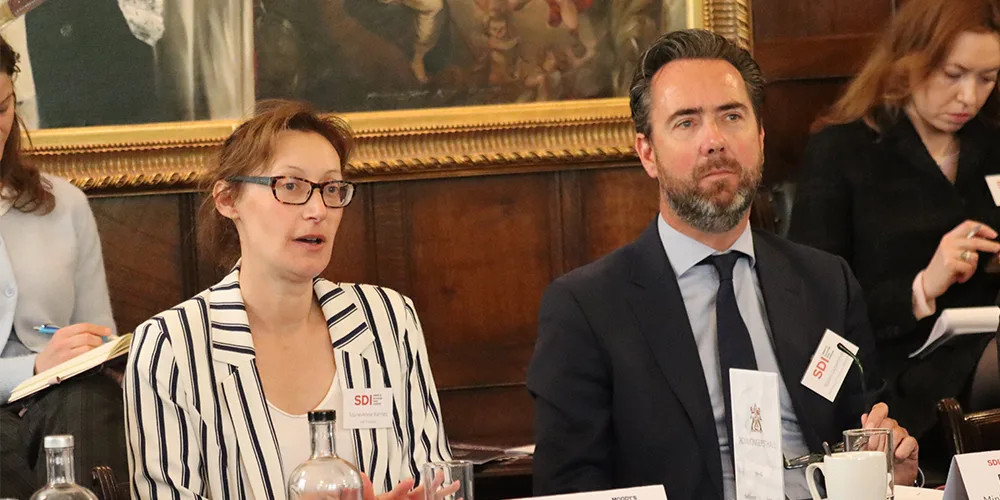

L-R: Marie-Anne Barnes, Robin Uyterlinde, Rob Murray, Ambassador Isabelle Hudon
Most ambitiously, a proposal for a dedicated Defence, Security and Resilience Bank has gained traction. This is a purposefully built institution to provide commercial bank lending to defence supply chains, without the constraints imposed by frameworks designed for a different era. Basel regulations, intended to make the financial sector safer, have had the unintended consequence of making defence financing harder to access. A new institution could operate outside these constraints while maintaining the governance standards that give investors confidence.
The work is still ahead
Attendees at OMFIF’s Defence funding forum were clear that none of these instruments is a silver bullet to the problems of defence financing, and the risk of fragmented enthusiasm producing fragmented outcomes is real.
What Europe needs now is decisions on purpose-built financial architecture. Joint procurement must move from aspiration to standard practice. Defence spending needs to be perceived as a productive investment with economic multipliers, rather than a fiscal burden. This shift needs to be embedded in the way governments, credit rating agencies and capital markets assess sovereign borrowing. And the policies put in place must be designed not only to provide security, but to generate the economic growth that sustains it over time.
Andrea Correa is Head of Research at OMFIF.
Join OMFIF in London on 22 May to examine Financial stability in an era of private credit and fragmentation.

Interested in this topic? Subscribe to OMFIF’s newsletter for more.