
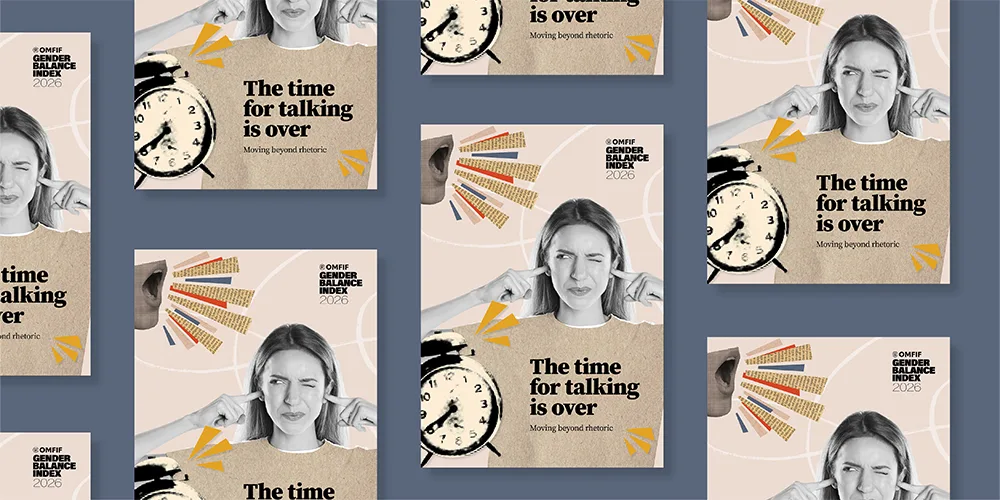
Financial institutions worldwide have made modest but meaningful progress in advancing gender balance in senior leadership – even amid heightened political scrutiny of diversity and inclusion initiatives, according to this year’s OMFIF Gender Balance Index.
The report, now in its 13th edition, analyses the state of gender parity in leadership roles across the financial sector. The 2026 edition explores the journey towards reaching gender balance across central banks, commercial banks, pension funds and sovereign funds, based on data from more than 300 institutions, covering over 6,000 individuals.
This year, the index highlights a steady improvement in women’s representation, with an average score of 44, up from 42 in 2025. Approximately half of the institutions included in the index improved their scores, signalling that diversity efforts are increasingly embedded within organisational structures rather than spurred solely by external pressures.
Record representation
A notable milestone in this year’s results found that 19% of top leadership roles are now held by women – the highest level recorded to date. However, progress remains uneven across sectors. Gains have been particularly evident in central banks and sovereign funds, while pension funds saw a decline in the number of women in top positions and commercial banks recorded no change – showing persistent structural barriers.
With leading voices in the field, from Galia Borja Gómez, deputy governor of Banco de México, Tea Trumbic, manager of the World Bank’s Women, Business and the Law project, as well as academics such as Sigtona Halrynjo from the Institute for Social Research and Mariarita Circi, former fellow at the Institute of Advanced Legal Studies, offering diverse perspectives on policy design and implementation, this year’s edition also features a dedicated in-focus chapter on policy, examining how targeted interventions can accelerate gender balance across financial institutions.
The promotion problem
Standing out as a key challenge is what has been identified as the ‘promotion problem’. While women account for 33% of senior roles overall, their progression to the highest levels of leadership remains limited. This gap highlights systemic obstacles that prevent a strong pipeline of female talent from translating into equitable representation at the top.
The report points to a range of well-documented policy tools that can address these challenges, including equal pay legislation, improved childcare provision, transparent hiring and promotion practices, and mentorship programmes. Despite extensive research supporting these measures, their adoption has been inconsistent and often insufficient. At the current pace of progress, it would take an estimated 22 years for the GBI to reach full gender parity.
The glass ceiling ratio
Some incremental changes have been noted. For instance, women’s representation in senior positions climbed by 1 percentage point this year, to 33%, up from 32% in 2025, and the share of women in the top role, such as chief executive, has edged up to 19% from 16% last year. To quantify the remaining discrepancy, this year’s report introduces the glass ceiling ratio – the degree to which women’s representation narrows at the apex of an institution, relative to their representation in senior roles more broadly.
This is not representation for representation’s sake. Research consistently demonstrates that diversity enhances decision-making and institutional performance. Women often contribute sharp insight into risk assessment and long-term planning – capabilities that are critical in the financial sector. As institutions face growing volatility and geopolitical fragmentation, the value of inclusive leadership becomes even more pronounced.
‘Gender balance is not merely an aspirational benchmark but as an operational necessity,’ writes Andrea Correa, head of research at OMFIF. ‘Ultimately, financial institutions should be able to reflect the realities of the times we live in and remain resilient to the challenges we face.’
The findings of the GBI 2026 are heartening. They demonstrate that progress is achievable, even in a challenging environment. However, they also mark the need for sustained momentum. Without continued commitment, improvements may stall, and opportunities for deeper transformation could be lost. The time for talking is over; the moment to act, however, is now.

Interested in this topic? Subscribe to OMFIF’s newsletter for more.