

As global conversations around gender equality evolve, the focus is increasingly shifting from commitments to measurable outcomes. This includes how legal frameworks, institutional practices and representation translate into real economic inclusion for women, and how we can better understand both the progress made and the barriers that persist across countries and sectors.
Tea Trumbic, manager of the Women, Business and the Law project at the World Bank, spoke to OMFIF for the Gender Balance Index 2026 to discuss the intersection of evidence-based policy-making and women’s economic empowerment.
OMFIF: Why is it important to measure women’s representation and the legal frameworks affecting them, and how does this help drive progress towards a more inclusive growth path?
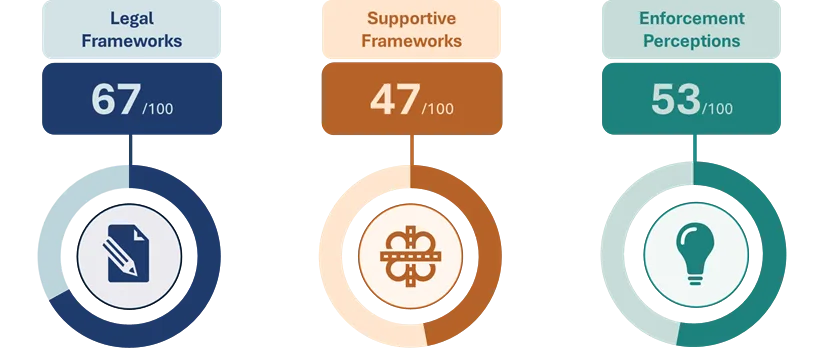
Tea Trumbic: What cannot be measured cannot be changed. Women enjoy roughly two-thirds of the legal rights of men, fewer than half the mechanisms needed to translate those laws into real opportunity are in place and even existing laws are only half enforced. Without rigorous data, these gaps remain invisible.
That is precisely what Women, Business and the Law 2026 tackles. Covering 190 economies and 120 indicators across three pillars, the report gives policy-makers a precise diagnostic to isolate where the system breaks down as well as a roadmap for reform. First, it reviews legal frameworks, evaluating the laws that either restrict or enable women’s economic participation. Second, through the supportive frameworks pillar, it quantifies the policies and institutions needed that make those laws effective. And finally, with the new enforcement perceptions measure, it assesses the extent to which rights are actually upheld in practice.
Closing these gaps can drive inclusive growth. Addressing gender disparities in labour force participation could raise gross domestic product by up to 20% in some economies – making gender equality not a social aspiration, but the foundation of a stronger, more resilient global economy.
Figure 1. Global WBL scores across three pillars
Source: Women, Business and the Law database, World Bank, 2026
OMFIF: From your perspective, how do legal and regulatory frameworks influence women’s progression from senior roles into top leadership positions?
TT: The pipeline to leadership leaks long before the top. Women’s labour force participation stands at 58% globally, against 76% for men. Unemployment among women exceeds that of men even among the most highly educated – the very cohort with the greatest potential to reach senior and leadership roles. This gap reflects not a deficit of talent, but a failure of legal and institutional structures.
The data from WBL 2026 are clear. Where legal frameworks are more equal, women are more likely to participate in the labour market, hold firm ownership stakes and serve in national parliaments. Gender-equal laws directly expand the conditions that allow women to move from economic participation into leadership.
One legal mechanism stands out: corporate board quotas. Empirical evidence shows they effectively increase the likelihood of women being appointed as directors, board chairs and chief executive officers. Yet only 40 economies have such provisions, just 15 set quotas above 40% of the board and enforcement remains weak across the board.
OMFIF: How have you seen institutions translate these legal insights into concrete internal policies or governance reforms that support gender balance and women’s representation in the workplace?
TT: The pace of reform is encouraging. Over the past two years, 68 economies enacted 113 legal reforms, particularly in safety, entrepreneurship and parenthood — with Egypt, Madagascar, Somalia, Oman, Jordan and the Kyrgyz Republic among those making the most salient advances.
Progress is also visible beyond legislation. Azerbaijan, Cambodia and Grenada have adopted targeted strategies to support women in science, technology, engineering and mathematics. Greece, Spain and Uruguay have incentivised fathers to take paternity leave, promoting a more equal sharing of care. Armenia, Bahrain, Malaysia and Micronesia have launched multi-year plans to support female entrepreneurship, while Fiji, Guinea and Indonesia have set measurable targets to expand women’s access to the labour market.
But WBL’s reach extends beyond governments. Policy-makers can use it to identify legal gaps and prioritise reforms; the private sector can advocate for enabling environments and civil society can hold institutions accountable. The interplay of these actors is what ultimately makes the difference.
OMFIF: Based on your findings, what are the most persistent legal or structural barriers preventing women from reaching top leadership roles?
TT: Three structural gaps create the deepest barriers to women’s economic participation: safety, entrepreneurship and childcare – consistently the weakest pillars in WBL findings globally. When women are not safe, they cannot participate in the economy at all. Yet worldwide, women benefit from only one-third of the legal protections they need against domestic violence, sexual harassment, child marriage and femicide. Without affordable, quality childcare – absent in 44 economies – women often leave or reduce their participation before they approach senior management at all.
For those who do participate, barriers to growth and leadership remain pervasive. Women entrepreneurs face persistent obstacles to finance, corporate leadership and public procurement. Half of the countries examined in WBL 2026 lack laws prohibiting discrimination against women in access to credit.
Inside the workplace, the picture is equally sobering. Board quotas – which directly shape who reaches the top – remain rare. Even where they exist, enforcement scores are weak. Equal pay laws face the same implementation gap, with a global enforcement perception score of just 55 out of 100. Without the legal right to request flexible work – a provision that exists in only 56 economies – caregiving responsibilities disproportionately borne by women become career-limiting. While most economies prohibit discrimination in employment, only 78 have a specialised body to actually receive complaints.
OMFIF: To what extent is political will and supportive public policy critical to institutional change that enables more women to reach leadership positions? Are there examples where legal reform has directly accelerated this progress?
TT: Political will is the bridge between legal frameworks and real outcomes. WBL data shows that countries with stronger gender-equal laws also tend to have more robust policies and institutions to implement them, and greater confidence among legal experts that rights are upheld in practice. The pattern is consistent: where commitment to reform runs deep, progress tends to be comprehensive – spanning legislation, implementation and enforcement.
Brazil offers an instructive example. Its Public Procurement Law introduced two gender-responsive criteria: a tie-breaking criterion that prioritises companies with workplace gender-equality measures and a requirement that eligible firms allocate at least 8% of positions to women survivors of domestic violence. This directly links economic inclusion to social protection. It is an innovative model, though the next frontier lies in extending preferential access to women-owned and women-led businesses, a step that some regional peers have already taken.
OMFIF: Our GBI research suggests that progress in women’s representation at senior levels may be stalling across financial institutions. What innovative approaches do you believe are needed to ensure more women transition from senior management into top leadership roles?
TT: Sustaining momentum requires action on several fronts simultaneously. On corporate leadership, the political momentum for board quotas is real: 13 economies introduced or strengthened them in a single reform cycle – including Brazil, Croatia, Denmark, Estonia, Finland, Ireland, Jordan and Spain. But momentum without enforcement is fragile.
Access to finance is equally critical. An estimated 700m women worldwide still lack a financial account and women-owned small- and medium-sized enterprises face a $1.9tn financing gap. Even when women seek credit, they are more likely to be rejected, offered smaller loans and charged higher interest rates – despite strong repayment records. Closing this gap requires legal frameworks that explicitly prohibit discrimination in credit access, paired with targeted financial instruments and policies.
Tea Trumbic is Manager of the Women, Business and the Law project at the World Bank.

Interested in this topic? Subscribe to OMFIF’s newsletter for more.