
‘Tokenisation’ has been the word on everyone’s lips for a few years now. Referring to the representation of assets on blockchains, it promises instant, cheaper settlement, greater efficiency and improved liquidity management.
But while the process of tokenising assets is well underway, the market has yet to come to a consensus on the appropriate payment instrument. Reaping the full benefits of tokenisation requires a way to represent cash on chain. While stablecoins can fill this role, they are not yet fully accepted by institutional market participants and, since they represent a novel form of money, it requires some adjustment to get used to a new type of risk.
Bank money is a much more familiar payment instrument and banks, eager to protect their role in payments, are adapting to the challenges of bringing their own money onto the new generation of financial market infrastructure.
This edition of the Digital Monetary Institute Journal looks at the changing landscape of tokenisation and the potential for commercial bank money in particular to move on chain. Featuring contributions from banks, blockchain services providers and industry experts, it explores the opportunities, risks and challenges that come with this form of digital money.
Nick Kerigan from Swift explains that tokenisation is so high on the industry agenda because of its potential to reduce costs, improve efficiency and enhance risk and liquidity management. While there have been some success stories of tokenised deposits, the main challenge is delivering interoperability. OMFIF’s John Orchard agrees. He says that tokenised bank money projects are finally on the move, but we’re still missing consensus on some big challenges, like how freely money can move, who manages settlement and how quickly, and whether money should be account- or token-based.
Regional approaches
This is leading to a regional patchwork of different regulatory approaches, which can risk creating an even more fragmented, frictional system. However, trying different approaches isn’t always a bad thing, as Vivian Clavel Díaz of Minsait (Indra Group) points out. Latin America has adopted a fragmented approach to payments digitalisation. While this might look messy from the outside, she says that the region is collecting useful data about what works and what doesn’t.
The UK is taking a more collaborative approach. Lee McNabb from NatWest gives an overview of the UK Finance GBTD project and explains the bank’s involvement in it. He notes that the UK is moving towards a ‘multi-moneyverse’ as part of its strategy for digital payments.
From the perspective of the US, JP Morgan’s Wee Kee Toh talks to OMFIF about JPM Coin, a deposit token on a public blockchain launched in November 2025. He says that there is strong value in offering payment products on both private, permissioned blockchains and public ones to capitalise on network effects.
Disruptor or enabler?
Stablecoins have often been seen as a way to shake up traditional finance and as such have been regarded by some as too risky to fully adopt. But David Anderson and Andrew Gallucci of Circle argue that the US Genius Act positions stablecoins to enhance, not threaten, existing bank business models by helping them move money almost instantly and almost anywhere in the world.
But we should also look beyond stablecoins and bank money. Ousmène Mandeng from Economics Advisory believes that tokenised money market fund shares deserve just as much attention as tokenised deposits and stablecoins. He says this could become one of the most consequential innovations in wholesale liquidity management.
Tokenisation also holds much potential for reducing transaction risk. Dom T. Ghazan from Global Trade Finance explains that tokenised bank money is a prerequisite for viable artificial intelligence-based compliance controls because authority constraints can be programmed into the payment object itself. Compliance ceases to be a retrospective policing function and becomes an embedded feature of the payment life cycle.
Ultimately, whether tokenisation is successful depends on adoption. Andrew Forson from DeFi Technologies points out the broader financial community is not clamouring for bank stablecoins. Instead, commercial bank stablecoins appear to be more of a regulatory response than the result of market demand. It remains to be seen whether these new regulatory frameworks will catapult tokenised deposits into a position as a trusted, widely used form of digital money.
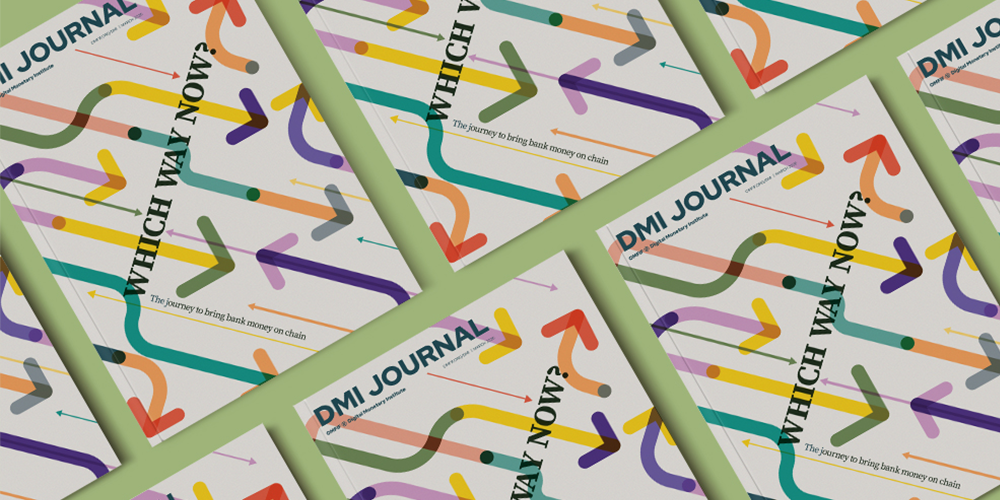
Download the March 2026 edition of the Digital Monetary Institute Journal, ‘Which way now? The journey to bring bank money on chain’.

Interested in this topic? Subscribe to OMFIF’s newsletter for more.