
You would be forgiven for thinking that action to address climate change has been somewhat derailed in the past 12 months. The previous few years saw real momentum in the transition to a sustainable economy, with governments, regulators and financial institutions making net zero an international priority. But following the re-election of Donald Trump in the US, the environmental agenda has been dealt a blow.
Since January 2025, major banks and market participants have distanced themselves from the frameworks and alliances set up in the wake of COP26 in 2021. Amid faltering climate commitments from its members, the Net Zero Banking Alliance announced in October that it would cease operating, while the Glasgow Financial Alliance for Net Zero has rolled back its activities and relaxed requirements on its members. These are disappointing consequences of the ‘drill, baby, drill’ attitude of the White House.
However, the gloomy headlines are not reflective of the wider financial sector. In September, New York Climate Week and Hong Kong Climate Week both saw record attendance as financial institutions came together to discuss the needs of the transition. In conversations OMFIF has had with pension funds and multilateral development banks, the message has been that these institutions are more committed than ever to addressing climate risk.
That commitment is what motivates the work of OMFIF’s Transition Finance Working Group. The conversations we had in 2024 showed that the green transition is on the agenda of leading public funds and investors. But they also showed that the amount of capital required to finance the transition was a long way from where it needed to be, particularly for developing economies most vulnerable to the physical impacts of climate change.
Digging deeper on transition finance
This year, the working group reconvened to delve deeper into these topics. We spoke with major funds from across the globe to assess the transition finance landscape and examine the progress made in the past year as well as the challenges that remain. The conclusions of these conversations have formed the basis of a new report from the working group. The next frontier in transition finance assesses the ESG landscape over the last 12 months and probes into the complications investors are facing in their transition goals.
All funds agreed that the transition space has become more complicated, with some of the companies they invest in delaying or scaling back their net-zero goals. However, the funds said it is business as usual for their own climate-related investments and they are not planning to decrease their allocations to environmental, social and governance assets (Figure 1).
Figure 1. Funds are not planning to decrease allocation to ESG assets
Do you plan to increase, decrease or maintain your allocation to the following ESG assets over the next 12-24 months? Share of respondents, %
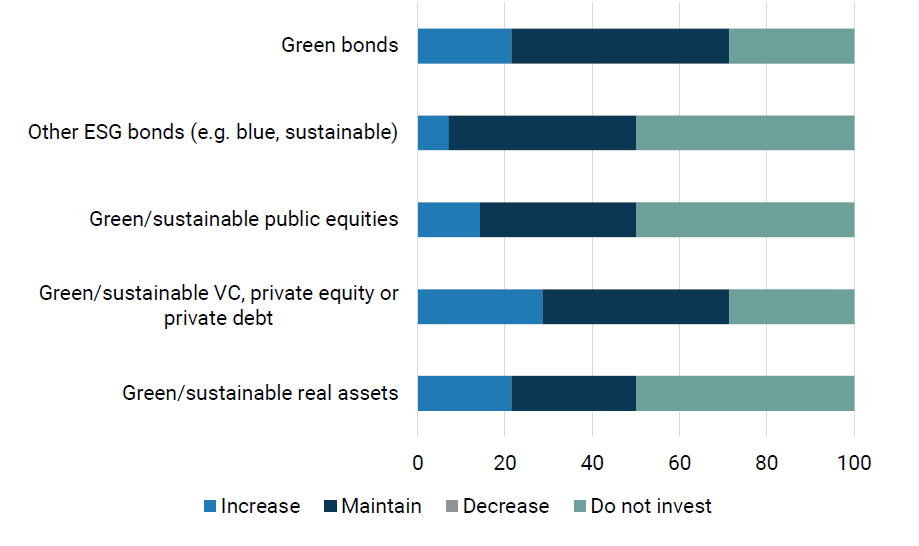
Source: OMFIF Global Public Investor 2025 survey
The report finds that, while momentum seems to be faltering in the US and other jurisdictions, it is picking up speed in Asia, Latin America and Africa. The U-turn in US policy is creating opportunities for investment in other regions, and Asia stands to benefit due to high demand for renewable energy.
Attitudes towards blended finance as a vehicle for raising concessional capital have become more optimistic since last year’s report. All the funds we spoke with agreed that it had a role to play in financing the transition, especially in emerging markets, though some investors observed it could make a positive impact in developed economies, too.
But most warned that it was not a silver bullet for overcoming the obstacles investors still face, namely low returns and a lack of scalable projects (Figure 2). Governments and multilateral development banks can help here by providing a pipeline of investable projects and acting as a stamp of approval for riskier ventures, which would make it easier to crowd in private capital.
Figure 2. Barriers persist to investing in blended finance
What are the main barriers to your fund committing more to blended finance solutions? Share of respondents, %
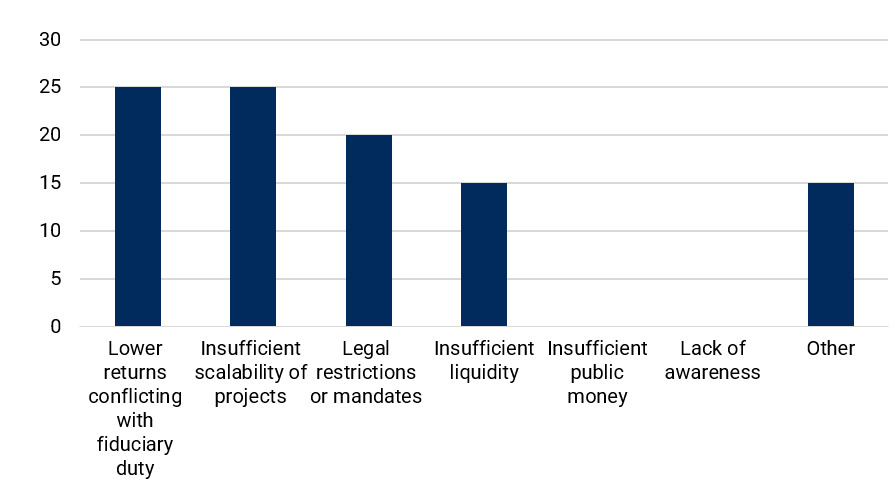
Source: OMFIF survey of public pension funds
Adaptation and resilience measures are providing new investment opportunities for funds to keep the transition alive and provide economic benefits to the people who rely on them. Historically, the focus has been on mitigating the impact of climate change, but attention is shifting to the need to adapt to a new environment as extreme weather patterns become more frequent. Funds listed infrastructure, agriculture and real estate as the sectors providing the most opportunities to invest in adaptation.
While some funds are increasingly recognising their impacts and dependencies on nature and biodiversity, they have not yet starting actively investing in nature-based products and solutions. Most are waiting for more data, particularly in emerging markets, and are struggling to quantify nature risk. One fund observed that ‘Nature as a category is where carbon was 25 years ago.’
The conversations we had this year did not shy away from the challenges still ahead. But they also gave a great deal to be optimistic about. We are indebted to the funds that gave their time to speak with us for this project, and to our working group partners, MSCI and Moody’s Ratings, for their knowledge and guidance. We hope that this report will encourage further engagement and collaboration within the transition space and provide hope for a more sustainable future.
Sarah Moloney is Editorial Director at OMFIF.
Download The next frontier in transition finance.

Interested in this topic? Subscribe to OMFIF’s newsletter for more.