

Evolution in regulation, reporting standards and stakeholder interest is prompting companies to improve disclosure of their carbon transition plans. Clear, comprehensive, business-relevant plans help investors assess companies’ long-term evolution and associated risks.
Moody’s net zero assessments highlight that credible plans are pragmatic in their objectives, and aligned both with companies’ commercial strategies and with shareholders’ expectations. Such plans can support engagement with investors, facilitating access to capital.
Building on market-led reporting initiatives such as the Task Force on Climate-related Financial Disclosures, standard setters such as the International Sustainability Standards Board and the European Commission have developed integrated reporting standards for nonfinancial disclosures, including on climate.
Increasingly widespread reporting formats require companies to articulate well-defined decarbonisation plans. The publication of such plans is inconsistent, as only some countries have made it a regulatory requirement. Elsewhere, it remains driven by individual company strategy, investor engagement or other voluntary initiatives such as CDP.
The quality of disclosure also varies widely. This has resulted in external validation of entity-level transition plans gaining popularity. Some focus only on evaluating the ambition of stated targets, while others also evaluate the strength of the plans’ implementation and governance aspects, to varying degrees
What does a credible transition plan look like?
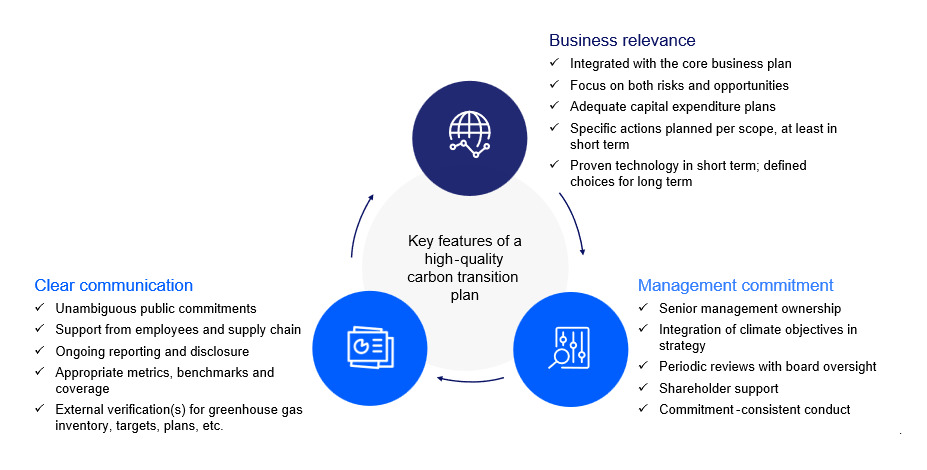
As the quality of disclosure can vary, so too does the quality of transition plans. Moody’s experience with NZAs indicates that business relevance, management commitment and clear communication are key ingredients of a credible transition plan, and fundamental to meeting regulatory reporting requirements and gaining support from stakeholders.
In Moody’s experience, transition plans are most likely to be successful when aligned with the company’s broader strategic aims. This involves a strong governance process that includes senior management ownership, periodic reviews and public commitments, which will allow the plan to evolve and adapt to business cycles. It will also involve support from shareholders and supply-chain partners.
Credible plans can mitigate credit risk from transition if they address risks and seize related opportunities. According to Moody’s annual environmental risk map, 16 sectors with $5tn in rated debt have elevated credit exposure to carbon transition risks.
Looking at the companies with the strongest NZAs, a number of features become clear. These plans use metrics and key performance indicators that are appropriate for the company and its business model, typically cover all significant emissions across the value chain of the company and are transparent about emissions that may be excluded.
The plans also set realistic decarbonisation objectives, in keeping with the sector and countries of operation of the company. Moody’s NZA analysis uses benchmarks that reflect the slower pace at which emerging markets are likely to transition compared with advanced economies. For example, using the Asia Pacific utilities benchmark allowed us to assess Hong Kong-based CLP Holdings’ environmental objectives in the context of regional transition expectations.
The most credible plans describe how the company will reach its objectives. In doing so, they clearly detail the specific actions envisaged, together with carefully assessed impacts on emissions and on the company’s business performance. However, given commercial sensitivities, companies rarely publicly disclose such plans in detail, generally choosing to report more aggregated figures. A plan’s credibility further depends on the nature of the specific emission reduction actions, their technical complexity and the financial impact on the company’s competitiveness and its return on capital.
Devising and implementing a credible transition plan is more difficult for companies that have less control over their emissions. This may be because those are mostly indirect scope 3 emissions, or because there are no solutions that are economically viable, or available at scale, to decarbonise their direct emissions.
Figure 1. Credible plans focus equally on technical, financial and business viability
Source: Moody’s Ratings
Credible transition plans can support access to finance
When investors can assess the credibility of a plan, this may strengthen the company’s access to financing, whether through labelled or unlabelled markets. There is currently a strong global policy and market focus to scale transition finance, especially in emerging markets and hard-to-abate sectors. This includes existing or upcoming regional taxonomies such as in Japan, Singapore, Australia and Hong Kong, and proposed initiatives such as the Loan Market Association’s Transition Loan Principles and guidance on transition finance from the International Capital Market Association and the UK’s Transition Finance Council.
While each of these has its specificities, the initiatives have a few common objectives. First, they aim to enable lending to, and tracking of, projects or activities that may not qualify for the green bond or loan label but nevertheless contribute toward reducing emissions. Second, they move beyond a singular focus on 1.5 degrees Celsius, recognising that regional benchmarks may accept technologies in one region that may not apply to another.
Third, they allow lenders to demonstrate how they are helping companies reduce emissions outside the green loan portfolio. Banks are facing regulatory attention on how much they are facilitating the transition of the broader economy. Green loans are an important part of this, but the greater hurdle lies in transitioning the rest of the economy. In Moody’s view, transition finance can provide the solution, provided the label is credible and not subject to greenwashing.
By boosting investor confidence, clarification of transition plans can facilitate market reception when companies issue transition-related instruments. Italian energy infrastructure company Snam published long-term targets and a detailed transition plan, along with an NZA, in early 2024 that helped clarify the opportunities and hurdles it faced in its transition. Given Snam’s position as part of the fossil fuel value chain, the NZA analysis supported the launch of its sustainability-linked bond framework, with issuance to date of €5.7bn.
A credible transition plan can also have significant investor engagement benefits. Most companies Moody’s has assessed publicly, such as Engie SA and EDF SA, have leveraged NZAs for high-profile events, such as a strategy update, an investor day or an annual results presentation. Companies, including Verbund AG and China’s GDS Holdings, have also chosen to publish their scores alongside the release of new or updated transition plans, to allow investors to more easily assess their credibility.
Vincent Allilaire is Vice President, Senior Credit Officer, and Swami Venkataraman, Associate Managing Director, Head of Sustainable Finance Assessments at Moody’s Ratings.
Download The next frontier in transition finance.

Interested in this topic? Subscribe to OMFIF’s newsletter for more.