
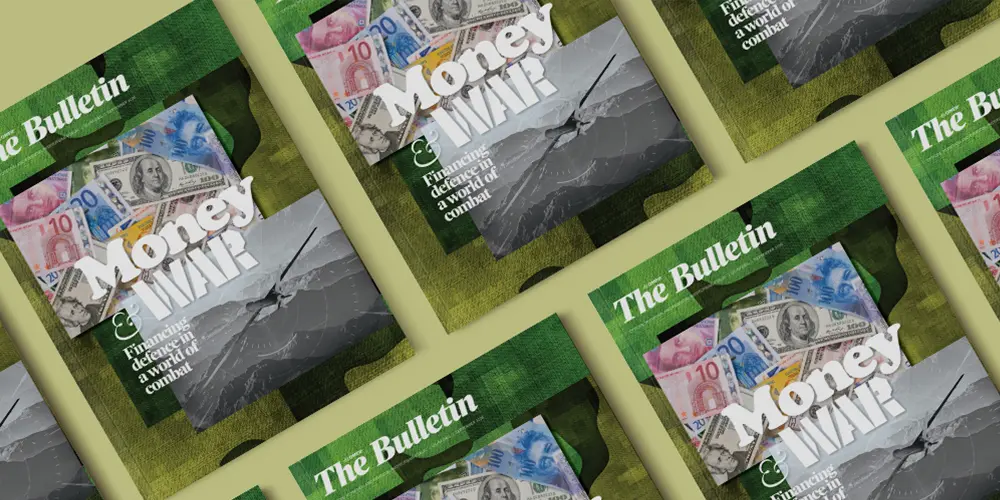
Talk about defence and you will most likely end up talking about targets. Targets for public spending, production of weapons and ammunition, international co-operation and security and resilience. But setting and discussing these targets is one thing, how to achieve them is another question entirely. How do governments juggle fiscal constraints, low growth, public appetite and high debt with a rapidly changing reality?
Because the world has changed in the last few years. The conflicts between Russia-Ukraine and the US-Israel-Iran are the most prolific, but barely veiled threats to sovereignty are coming from across the globe. Countries are feeling the urgent need to be prepared for military conflict, but it’s quite clear that most – particularly in western Europe – are nowhere near where they need to be.
The September 2026 edition of the OMFIF Bulletin gets to grips with complicated questions about how to fund defence spending. It does not shy away from the need for more investment, both public and private, and it examines various mechanisms and initiatives for how to scale this up. It acknowledges the macroeconomic impact of greater defence spending, as well as what it means for capital markets and sovereign debt. And it assesses the topic against an increasingly fraught backdrop of energy insecurity and climate crisis.
The public view
As an active war zone, Ukraine is living with the daily realities of greater defence and military needs. Yuriy Butsa, government commissioner for public debt management at the Ministry of Finance, explains how Ukraine’s procurement strategy has evolved since the invasion by Russia in 2022. He says: ‘The type of equipment we were looking for early in the war is not part of our priority four years later. Put simply, big slow metal things don’t survive for long on a battlefield penetrated by sensor-driven drones hunting for them.’ Instead, Ukraine has turned to a decentralised procurement strategy that distributes smaller amounts of public funds across competing solutions, rather than committing large amounts to one winner selected in advance.
Globally, it is becomingly increasingly clear that new mechanisms and organisations will be needed to fill the funding gaps left by low investment, sluggish production and supply chain bottlenecks. The Defence, Security and Resilience Bank, with nine founding members including Canada, is one of those proposed solutions. Rob Murray, chair of the international treaty negotiations for the DSRB, describes the bank as ‘part of the missing financial plumbing’ connecting existing programmes and initiatives, intended to use sovereign backing to provide long-term, low-cost financing.
Two articles from the International Monetary Fund, one from the multilateral surveillance division and another from the fiscal affairs department, examine Europe’s drive to re-arm. The first points out that the objective should not simply be for Europe to spend more on defence, but for those investments to be more strategic and targeted. The second article looks at how European Union defence spending increased by 30% between 2021 and 2024 and asks what effect this will have on the economy. It says IMF research ‘shows that defence spending can support economic activity in Europe, but that its impact depends critically on how the spending is designed and financed.’
Forthcoming research by the European Bank for Reconstruction and Development looks at how common it is for economies to develop new defence export capabilities and what circumstances can help boost such new industries. It finds that military markers are difficult to break into, but that policy support and specialisation lead to success over the long term, meaning conflict can provide impetus for developing a competitive defence industry.
The private view
Defence is moving from the sidelines of public financing to the centre. Rebecca Chesworth from State Street Investment Management explains that defence is now a defining part of investment cycles, while Georgi Yordanov of Citi writes about how defence finance is becoming part of strategic infrastructure. Jonathan Lewis from Clifford Chance LLP examines the different options open to Europe, from defence bonds to new multilateral initiatives.
A major part of this greater spending will be directed towards the technology sector, and this will have important implications for governance and regulation. Nout Wellink, president of De Nederlandsche Bank from 1997-2011, warns that the growing dependence of governments, businesses and societies on services provided by these companies means that the way they are governed needs to be urgently re-examined.
Tom Clooney from Capital Group looks at the road ahead and foresees continued polarisation, uncertainty and further breakdown in the liberal world order. Christopher Smart of Arbroath Group, holds a similar view, remarking that ‘the increasingly caustic exchanges on military and political differences have now fundamentally changed the economic relationship’ between the US and Europe and that ‘the surface cracks may start to threaten the foundation of the vast economy stretching from Los Angeles to Lviv’.
However, this fractured and more polarised environment does offer some opportunities for economies to drive growth and employment. An article from EY shares modelling that suggests the proposed defence spending increase could permanently push up growth and productivity, increasing UK gross domestic product by £30,000 each year. But this renewal will depend on delivery, not just ambition, as Moody’s Ratings cautions. The credit implications of this spending will be determined less by the headline expenditure numbers than by how that spending is coordinated, financed and spent.
Energy sovereignty and security
For a long time, defence was seen to be fundamentally incompatible with sustainability and environmental concerns, but this is starting to change. Marcus Pratsch from DZ BANK explains that civil defence, security and resilience are not the opposites of sustainability but prerequisites for it. He argues that, ‘given that the topic of defence and security extends far beyond armaments and that the world has undergone a profound transformation in recent years, it would be irresponsible to exclude it entirely from the sustainable finance agenda’.
Marina Petroleka from Sustainable Fitch expands on this, looking at the move by some investors to revisit their exclusion criteria, introducing caveats for certain geographies, technologies and sectors where they can serve civilian and military ends. She also examines how the emergence of defence-labelled debt instruments, namely use-of-proceeds, is providing definitional discipline and guidance around eligible investments for sustainable investors. She says: ‘UoP frameworks purpose-built for defence provide a dedicated channel for building up capital for Europe’s security, without stretching GSS labels beyond their intended scope.’
Furthering the conversation
This edition of the Bulletin builds on the varied and thought-provoking conversations OMFIF has been having throughout 2026 on defence spending and geopolitical conflict – from the Defence funding forum held in London in May to the monthly Money Disrupted roundtable series. These conversations have exposed the serious gaps in global financial architecture and examined potential solutions for filling them. They have been realistic that none of these solutions is a silver bullet to the problems facing sovereigns, but they have provided a pathway to a more resilient approach to security.
These conversations will continue later this year at OMFIF’s Defence forum, taking place in London on 17 November. It will bring together public and private finance leaders, defence industry executives and policy-makers to confront the financing and industrial challenges of western rearmament.
Sarah Moloney is Editorial Director at OMFIF.
Download the latest edition of the OMFIF Bulletin.

Interested in this topic? Subscribe to OMFIF’s newsletter for more.